
Stage 1 · First few days
Blisters
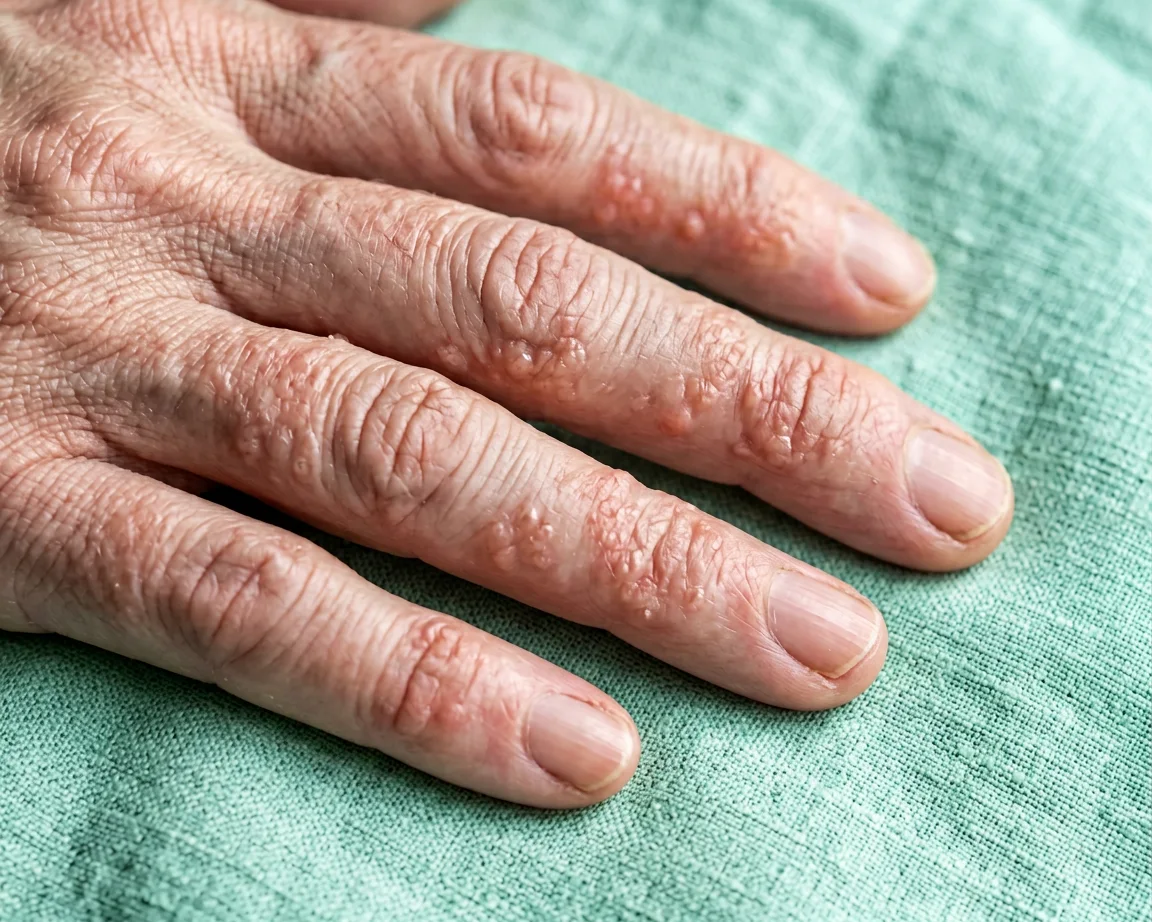
First itching or prickling, then tiny, tense blisters along the sides of the fingers and on the palm. They sit deep, so they feel like grains of rice. Some merge into a bigger one.
ITCHY · SIDES OF THE FINGERS
First you feel itching, prickling or burning. Then you notice clear little blisters along the sides of your fingers or on your palm. If you squeeze or scratch them, “water” comes out. Two or three weeks later the blisters are gone, but your hand starts to peel, feel tight and crack.
These aren’t three different problems. They’re three stages of the same cycle. The blisters aren’t filled with trapped sweat, and the condition isn’t contagious. The stage you’re in decides what your skin needs most: calming the inflammation, protection from a trigger, or rich care for the skin barrier.
“Dyshidrotic eczema, dyshidrosis, pompholyx: three names, one problem.”
For the bigger picture, see dermatitis and eczema.
The blisters are about 1–2 mm (under 1/10 in) across and look like they sit deep in the skin.
They show up on the palms, the sides of the fingers or the soles of the feet.
They itch a lot and can burn or hurt.
They’re not caused by blocked sweat glands, and they’re not contagious.
A single wave often lasts 2–3 weeks, then the skin peels.
The exact cause isn’t known, and triggers vary from person to person.
Flare-ups that keep coming back call for tracking down the triggers and, if needed, treatment from a dermatologist, not just switching creams.
The same finger, three to four weeks apart. Blisters, peeling and cracks are one flare-up in three stages, not three conditions. Once you know that, you stop changing your routine every week and stop hunting for three different culprits. The sketches are simplified and aren’t a tool for diagnosing yourself.
Why the stages matter: care is different in each stage. During the blister stage your skin needs calm. During peeling and cracking it needs rich barrier care. Using the same cream the whole time isn’t a mistake. Switching products every week is.
Tap a stage to see what’s happening in your skin, and what it actually needs at that point.
Cosmetic care makes sense only in the second and third stages.
Picture tiny pockets of water forming between the tiles, not under them. This is just a simplified explanation, not an exact anatomical drawing.
blocked sweat gland → trapped sweat
inflammation → skin cells pull apart → blister
Mixing up these three ideas is exactly why so many conflicting explanations float around online.
Related guides: contact dermatitis explains the difference between irritation and a delayed allergy, and atopic dermatitis covers a tendency toward sensitive skin.
It looks for a delayed contact allergy, a reaction that only shows up after a day or two. Doctors call it patch testing.
It’s used for a different type of allergic reaction that happens fast. So it’s not the right test for finding a contact allergy.
We don’t recommend nickel-free or cobalt-free diets for everyone with dyshidrosis. Cutting foods may only make sense for selected people with a proven contact allergy, under professional guidance.S2k↗︎
We don’t give a one-size-fits-all recommendation on glove material here, because some people are allergic to ingredients in rubber. If it’s work-related, choose your protection with a dermatologist or an occupational safety expert.Part 2↗︎
| Condition | What’s typical | Itchy or painful? | One side or both? | Key clue |
|---|---|---|---|---|
| Dyshidrotic eczema: the 3 stages of the blisters | Deep, tiny blisters, then peeling | Usually very itchy | Often both | A repeating cycle |
| Fungal infection | Peeling, often worse on one side | Itchy | Often one side | Changes on the feet too |
| Contact dermatitis | Where the contact happened or a bit wider | Itches or burns | Depends on the contact | A new product or exposure at work |
| Herpes rash on a finger | A cluster of painful blisters | More often painful | Usually one finger | Strong tenderness and pain |
| Pustular psoriasis | Deep sterile pustules, thickened skin | Can burn or hurt | Can be both | A different course and look |
| Scabies | Itching, often worse at night | Very itchy | Can be both | People close to you have it too |
This table isn’t a diagnostic test. The looks overlap, so if things are unclear or don’t go away, a checkup is worth more than comparing photos.
This section isn’t a recommendation for any specific medicine. It’s here to show that stubborn hand eczema now has some new options from dermatology too.
We advise against alcohol, essential oils, undiluted acids, DIY disinfecting and general elimination diets.
A very painful cluster of blisters on one finger, quickly spreading redness, fever or feeling generally unwell need a doctor’s assessment fast.
Active blisters come from inflammation. But after a flare-up, what’s left is a dry, sensitive, cracked skin barrier. That’s when skin loses water faster, and every contact with water or friction puts more strain on it.
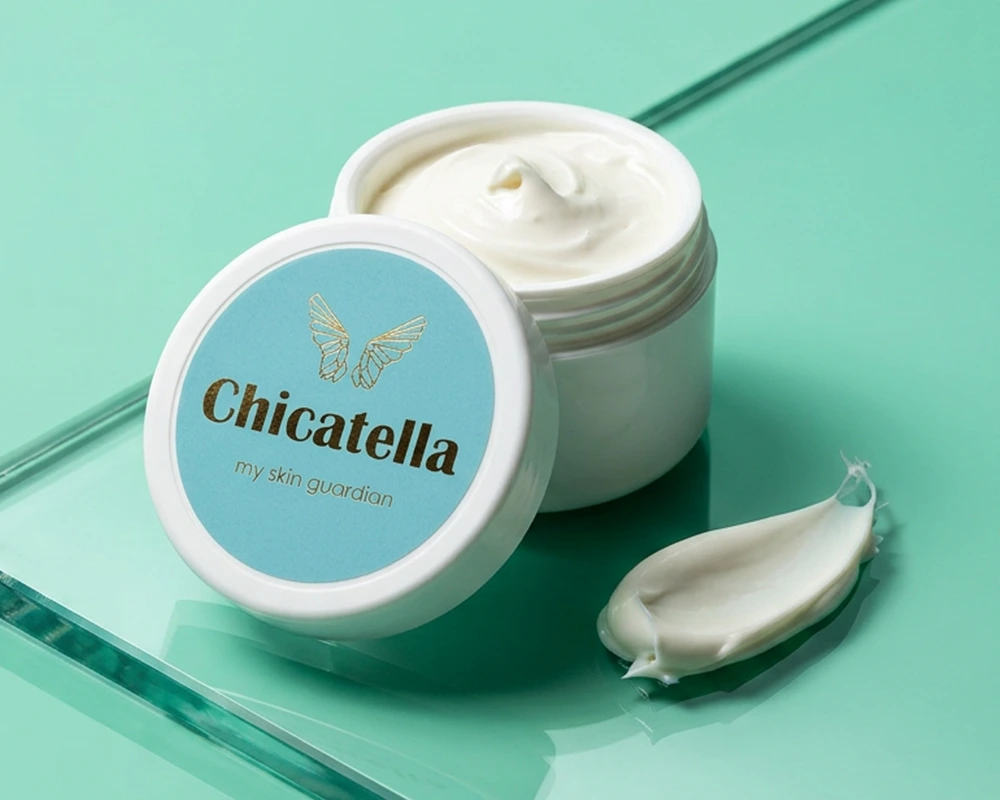
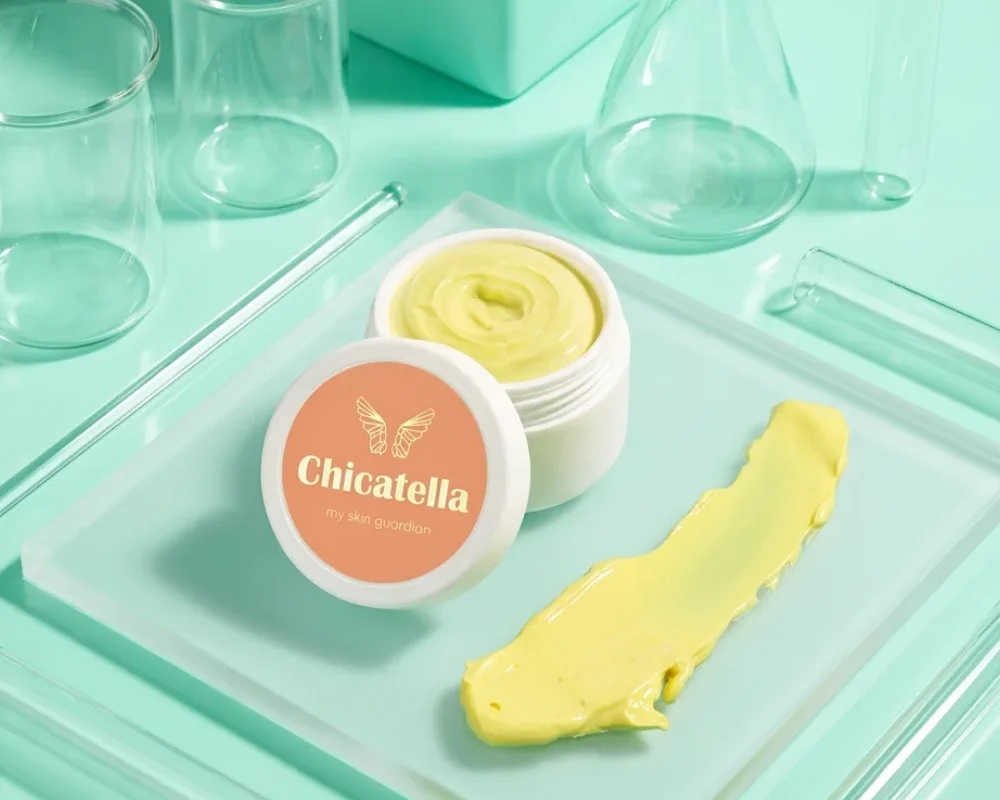
Chicatella supports the care of dry skin whose surface has closed over. Active inflammation and recurring blisters need a proper diagnosis and treatment.
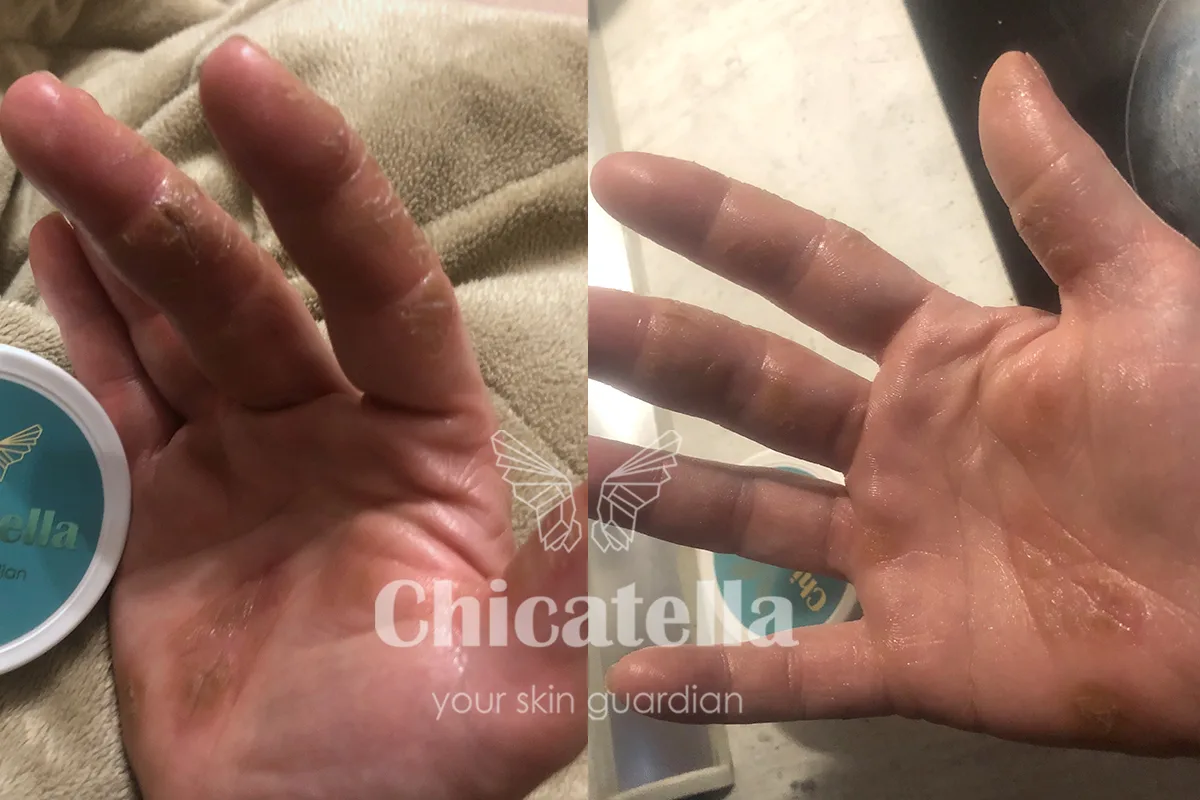
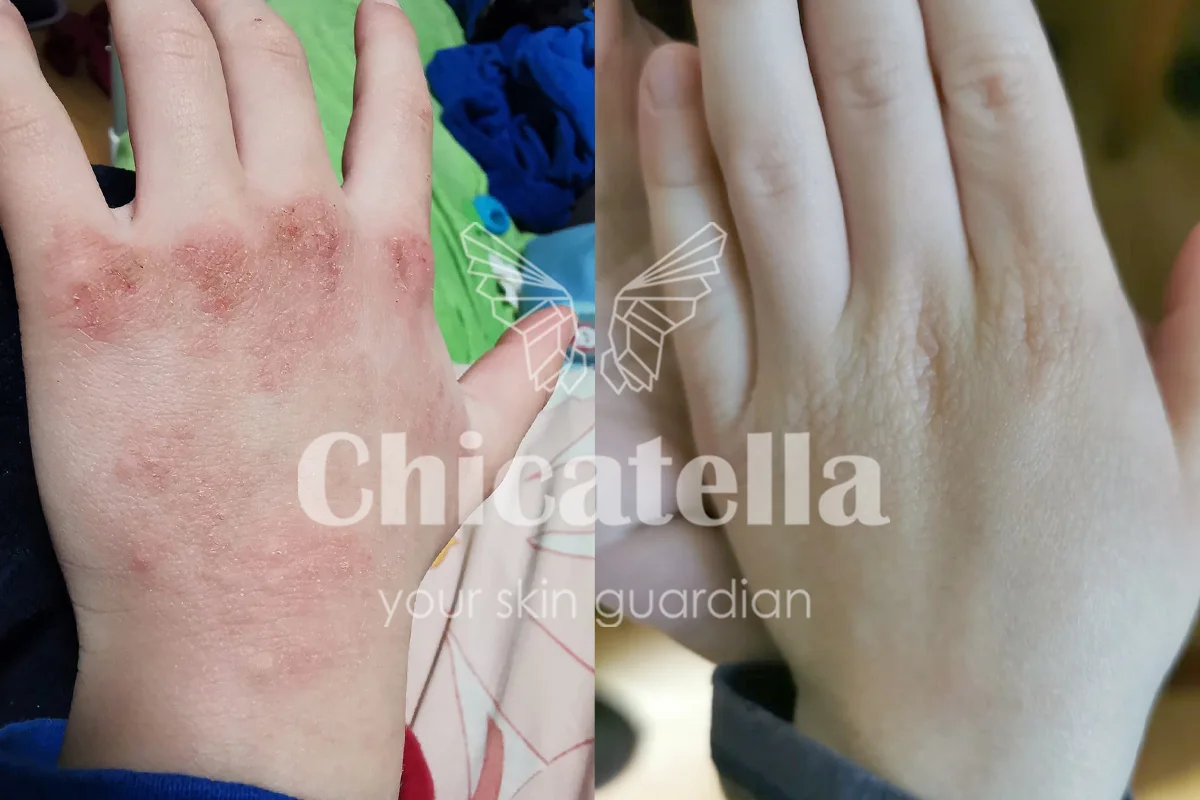
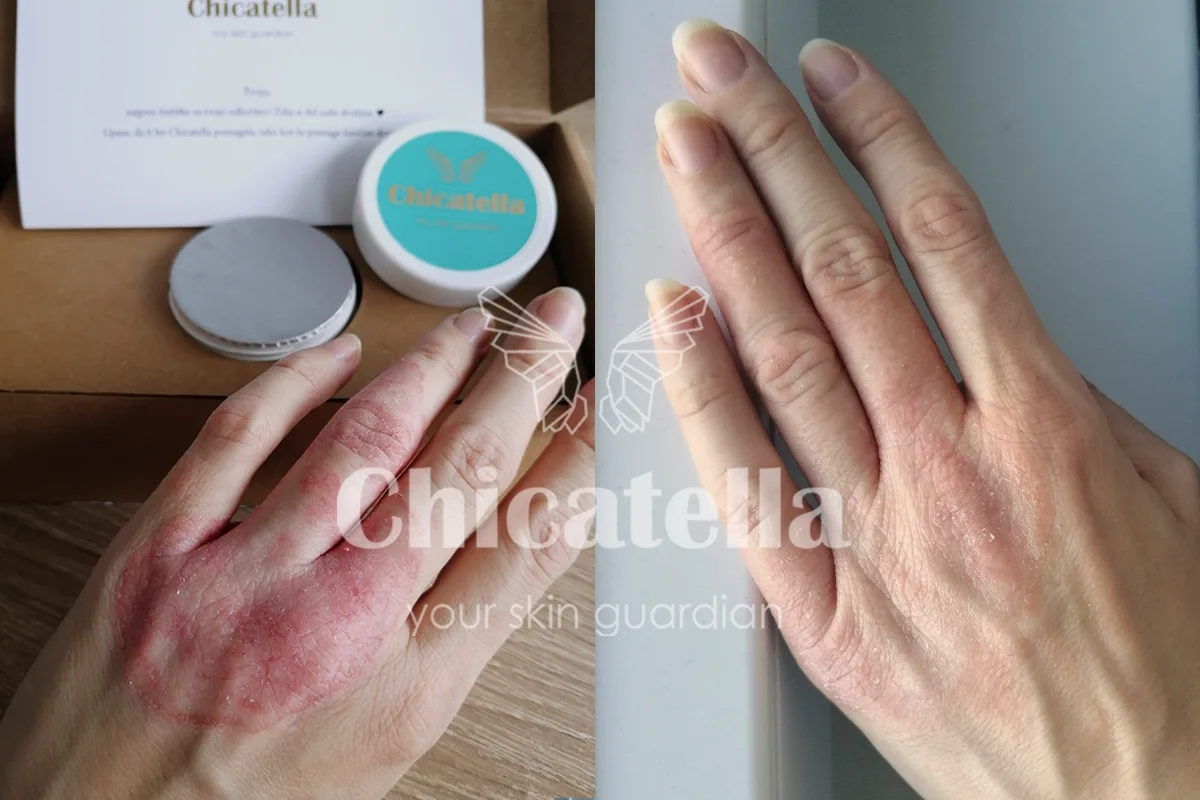
The same hands before and after care. Customer photos, shared with permission.
The photos show individual experiences with caring for very dry or irritated skin. The products are for cosmetic care, and individual results may vary.
Deep blisters, peeling and cracks are different stages of the same cycle, so the same fix isn’t right at every moment. Active inflammation needs calming and, if needed, treatment. Flare-ups that keep coming back need you to find the trigger. And dry skin that has closed over after a flare-up needs consistent repair and protective care. The best routine starts with one question: “What does my skin need today?”
No guesswork. Answer three quick questions and we’ll tell you what your skin needs.
This article helps you understand the stages and triggers of dyshidrotic eczema, but it can’t make a diagnosis or replace a checkup. Data on chronic hand eczema doesn’t apply only to the dyshidrotic subtype. Chicatella products are cosmetics for skin care, not medicines.
As soon as we’re ready to ship, you’ll be among the first to hear from us.