FREE SHIPPING ON 2 OR MORE·30-DAY GUARANTEE, KEEP THE PRODUCT·MICROBIOME-FRIENDLY CARE·FREE SHIPPING ON 2 OR MORE·30-DAY GUARANTEE, KEEP THE PRODUCT·MICROBIOME-FRIENDLY CARE·
Guide · skin conditions

Eczema isn’t one condition. It’s a group of types and skin states

Atopic, contact, nummular, dyshidrotic … the type tells you the pattern. Dry, inflamed, weeping or thickened tells you what your skin is going through right now. To pick a safe next step, you need to know both.

People often use “eczema” and “dermatitis” as if they mean the same thing. If you want the bigger picture of all kinds of skin inflammation, start with our guide to dermatitis. This page is all about eczema itself: its types and the states your skin can be in.
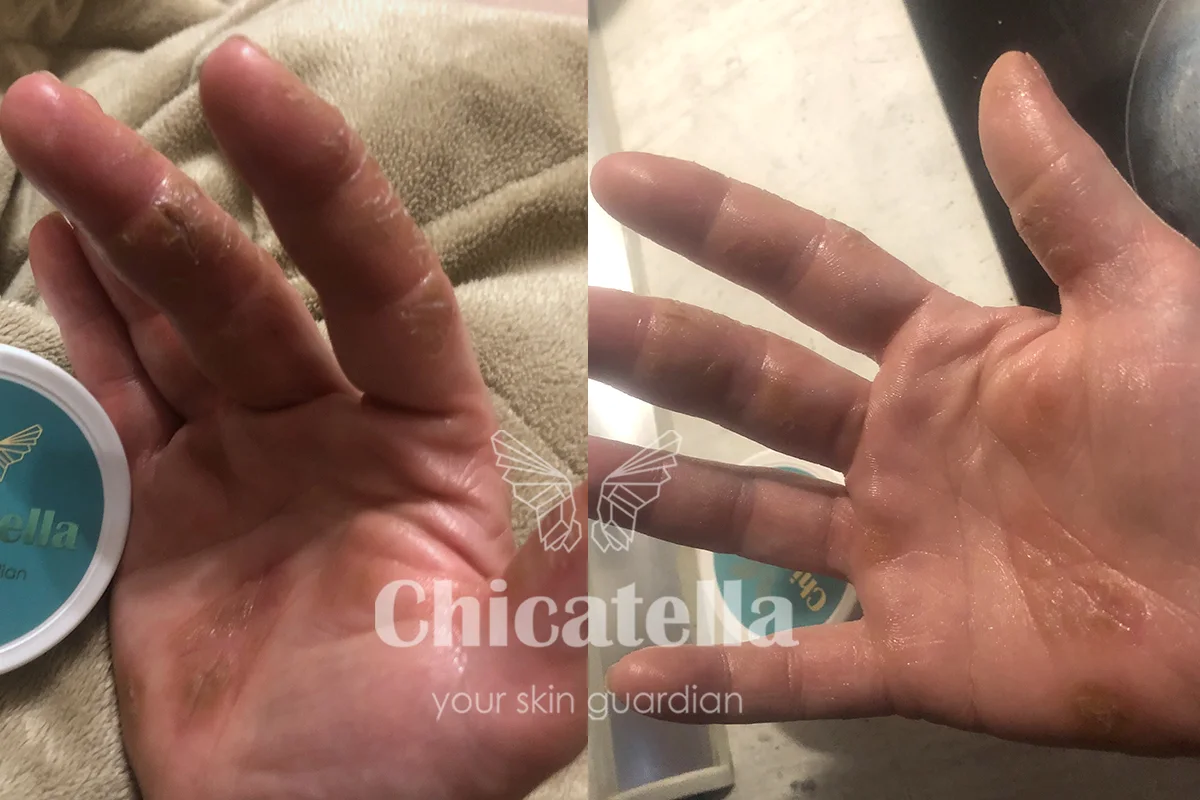

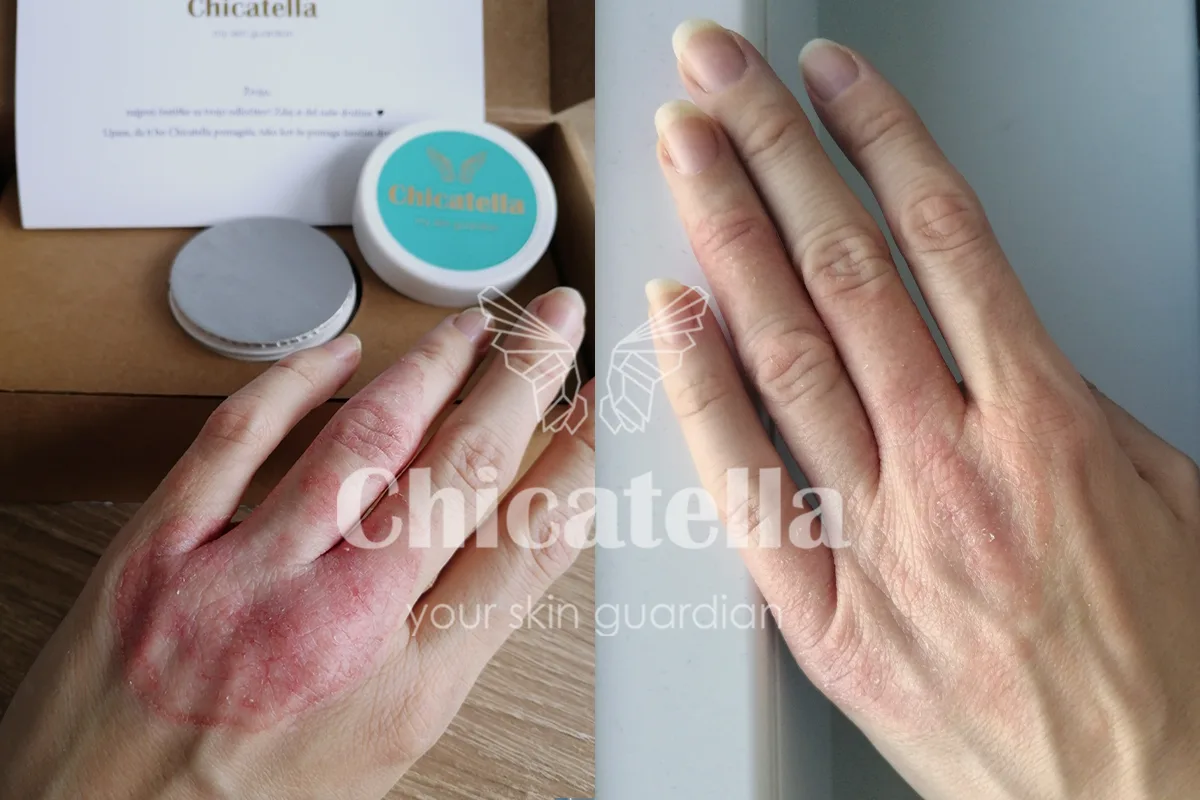
Eczema on the palm and fingers before and after – peeling, cracked skin on an adult hand
Customer photo, shared with permission. It shows how the skin looked and is not a diagnosis.
Reading time
≈ 21 min
Published
August 2026
Medically reviewed
August 2026
How we put this article together
This article is based on clinical guidelines, systematic reviews and peer-reviewed research. Every number links to its source, right in the text and in the list at the bottom of the page. It’s here to inform you, not to diagnose you. Chicatella publishes this article and sells the products shown near the end.
The key points in 30 seconds

If you only read one thing today

01

Eczema is an umbrella term for several itchy, inflamed skin conditions. It isn’t one single disease.

02

Atopic dermatitis is the type people talk about most, but it isn’t the only one.

03

“Dry,” “weeping” and “thickened” eczema usually describe what your skin looks like right now, not necessarily what’s causing it.

04

Dry, unbroken skin may need support for its protective barrier. Active inflammation often needs anti-inflammatory treatment as well.

05

Weeping doesn’t mean your skin is well hydrated. It means fluid is seeping out of badly inflamed or damaged skin.

06

Fast worsening, pain, pus, thick crusts, fever, clusters of blisters or feeling unwell all need a doctor’s opinion.

First figure out what state your skin is in. Only then choose a texture or your next step.

WHAT YOU CAN DO TODAY

A few quick tips

Before you buy anything, take a minute to look at what your skin actually needs.

1
Check whether your skin is just dry, or whether it’s also badly inflamed, weeping, painful or covered in crusts.
2
Notice whether it’s spreading fast and whether the person otherwise feels fine.
3
Write down when the change appeared, where it started, and whether you’d just started using a new product, detergent, piece of clothing, bandage or medication.
4
Don’t start several new products at once. Otherwise you won’t know what helped and what stung.
5
Don’t stop on your own a treatment your doctor prescribed.
6
Dry, unbroken skin that isn’t weeping can be washed gently and cared for with a product you already know your skin tolerates.
7
Weeping, very painful, pus-filled or quickly worsening patches: don’t just cover them up with a thick layer of ointment.
8
Take photos of the wider area, the patch with the skin around it, and a close-up, and watch how it changes over time.
What eczema looks like

Same look, different stories

Nine faces of eczema. They all itch and they all flake, but where it shows up, its edge and its shape tell you more than the redness does. The sketches are simplified and aren’t a self-diagnosis tool.

Browse→
elbow crease ATOPIC · SKIN CREASES
Atopic eczema

Dry, flaky patches in the creases of the elbows and knees, on the neck or the eyelids. The skin itches all the time, even when it doesn’t look inflamed.

edge CONTACT · SHARP EDGE
Contact eczema

Redness with a sharp edge that “copies” the shape of whatever touched it: a watch strap, a jeans button, the cuff of a glove. The edge is the biggest clue.

DYSHIDROTIC · BLISTERS
Dyshidrotic eczema

Tiny, tense blisters along the sides of the fingers and on the palms, like grains of rice under the skin. Peeling and cracks come next.

NUMMULAR · COINS
Nummular eczema

Round, coin-sized patches, most often on the shins and arms. The edge may weep while the center flakes.

SEBORRHEIC · GREASY SCALES
Seborrheic eczema

Yellowish, greasy scales beside the nose, between the eyebrows and on the scalp. It isn’t caused by dry skin, so rich care can make it worse.

swelling STASIS · NEAR THE ANKLE
Stasis eczema

Brownish, itchy skin above the ankle, with swollen legs. It’s linked to blood flow in the veins, not to contact or allergy.

NEURODERMATITIS · THICKENED
Neurodermatitis

A well-defined, thickened patch with deep skin lines. It forms after months of scratching the same spot.

ACUTE · WEEPING
Acute flare

Bright red, weeping skin with yellowish crusts. Weeping means the surface is damaged, not that the skin is moist.

DARKER SKIN
How it looks on darker skin

Inflammation isn’t always red. It can look purple, grayish or dark brown. Flaking and thickening are easier to see than color.

Frequently asked questions

Short answers first

What is eczema?
Eczema is an umbrella term for several inflammatory skin conditions. The skin often itches, flakes, changes color, cracks or gets tiny blisters. It isn’t one single disease and it doesn’t have one single cause.DermNet↗︎
Are eczema and dermatitis the same thing?
In everyday speech, and often in medicine too, the two words overlap. Dermatitis literally means inflammation of the skin. Eczema describes a typical inflammatory reaction in the upper layers of the skin. What matters more than the word is which type and which state you’re dealing with.
Is atopic dermatitis the same as eczema?
Atopic dermatitis is one type of eczema, and the most common one, but the words aren’t interchangeable for every type. One person can have several different types or causes of eczema at the same time.
Is eczema contagious?
Eczema itself isn’t contagious. You can’t catch it by touching, hugging or sharing a towel. But some conditions that look like it can be, such as fungal infections, and so can an infection that settles into damaged skin.
Is eczema an allergy?
Not always. Allergic contact eczema is one type of eczema, but atopic eczema isn’t simply an allergy to one thing. Allergies and eczema can show up in the same person, but an allergy isn’t automatically behind every flare-up.
Can eczema actually be a fungal infection?
Fungal infections can look a lot like round or flaky eczema. That’s why an antifungal cream isn’t the answer for every round patch. If things are unclear or won’t go away, it makes sense to have the diagnosis checked again.
What’s the difference between dry and weeping eczema?
Both terms usually describe what the skin is doing right now, not a final diagnosis. Dry means flaking and cracks. Weeping means fluid is seeping out of badly inflamed or damaged skin. It doesn’t mean your skin has plenty of moisture.AAD↗︎
What’s the best cream for eczema?
There’s no single best cream for everyone. The right texture depends on where the patch is, what state your skin is in, how sensitive it is, the weather, and what you’ll actually use every day. A skin care product supports the protective barrier. It doesn’t replace anti-inflammatory or antimicrobial treatment.
Can eczema be cured?
Many types of eczema are long-term and keep coming back, but they can often be kept well under control. With some types, like contact eczema, removing the cause can change things a lot.
When should I see a doctor?
Go soon if it gets worse quickly, if there’s strong pain, pus or yellowish crusts, fever, clusters of blisters, or you feel unwell. It’s also worth getting checked if you don’t know which type you have, if your skin care isn’t helping, or if the eyes, mouth or genitals are affected.
The two sides of eczema

Pick a type × the current state

The name of the type doesn’t always tell you how to care for the skin. Atopic eczema can be just dry when things are calm, then badly inflamed or weeping during a big flare. On the other hand, allergic contact eczema and nummular eczema can weep too. Pick one type and one state, and we’ll tell you more.

1 · Type or pattern
2 · Current state
Your pick — × —
A safe next step
Pick a type and a state above
Based on the state
This chart doesn’t diagnose anything or prescribe medication.
Based on the type
It only shows how the general approach changes with the type and the current state.

This is for information only. It doesn’t replace a checkup. If things are unclear or getting worse fast, talk to your doctor.

Eczema can change its look

Same skin, three stages

Going from weeping to flaking doesn’t necessarily mean a new condition. Often it’s the same inflammation changing over time.

Stage 01
Badly inflamed stage

The skin may be swollen, very itchy, warm, covered in tiny bumps or blisters, and weeping.

If you come across the term “acute eczema,” it means eczema that flared up suddenly or is badly inflamed.

Stage 02
In-between stage

The skin may still itch, flake and form thinner crusts as it moves from weeping to drier.

This isn’t necessarily a new condition. It’s the same inflammation changing.

Stage 03
Long-term stage

Months of scratching and rubbing can leave the skin thickened, with deeper skin lines, cracks, lighter or darker patches, and itching that keeps going even when the inflammation is less obvious.

Doctors call this “lichenification,” which means skin that has thickened from long-term scratching.

Source for the three stages: DermNet, eczema pathology.DermNet↗︎
Weeping eczema

Weeping isn’t hydrated skin

When eczema weeps, the fluid doesn’t come from outside, and it doesn’t mean your skin has enough moisture. It’s your body’s own fluid seeping out of badly inflamed, damaged skin.

Very active inflammation
Tiny blisters
Scratching and open skin
A reaction to a product, or an infection
INFLAMED SURFACE fluid collects on the surface and evaporates
Diagram, not a clinical photo.

Weeping on its own doesn’t confirm a bacterial infection. But pus, fast spreading, strong pain, fever, thick yellowish crusts or feeling unwell make an infection more likely. It doesn’t make sense to automatically seal weeping patches under a thick occlusive layer.NICE↗︎

The main types of eczema

Patterns dermatologists describe

Different classifications sort eczema a little differently, so this isn’t a law of nature. Each type has its own article that goes into more detail.

TypeThe telltale signWhere it often shows upMore
Atopic eczemaVery dry, itchy skin and flare-ups that keep coming backSkin creases, face, hands, depending on ageAtopic dermatitis →
Irritant contact eczemaWater, soap, detergent or friction damage the skin directlyMostly the hands and places of contactContact dermatitis →
Allergic contact eczemaA delayed immune reaction to a specific substanceWhere the skin touched it, sometimes widerContact dermatitis →
Dyshidrotic eczemaVery itchy, tiny blistersPalms, sides of the fingers and soles of the feetDyshidrotic eczema →
Nummular eczemaRound or oval itchy patchesLegs, arms or torsoNummular eczema →
Seborrheic eczemaGreasier or yellowish scalesScalp, eyebrows, beside the nose and behind the earsSeborrheic dermatitis →
Stasis (venous) eczemaLinked to swelling and poorer blood flow in the veinsLower legs and anklesStasis dermatitis →

One person can have more than one type of eczema. Hand eczema or eczema on the face describes where it is, not necessarily what causes it.

★ The Chicatella community

Be the first to know

Sign up and be the first to get our latest science-backed skin care tips. No boring emails, just good things for your skin.

Join 23,400+ fans · no spam, unsubscribe in one click
Location tells part of the story

Where does it show up?

Tap an area to see which patterns often show up there. Use it to help you think things through, not as a diagnosis.

Area
Pick an area on the picture
Each area has its own common patterns. Tap to see what’s worth considering.
The skin’s protective barrier

What all eczema has in common

Picture a brick wall: skin cells are the bricks and the fats between them are the mortar. When that protective layer is damaged, water escapes faster, and irritants and allergens get into the skin more easily.

Humectant: an ingredient that holds on to water.
Emollient: an ingredient that softens the skin.
Occlusive: a protective film that slows down water loss.
Water loss through the skin: water that quietly evaporates out of your skin.
HEALTHY DAMAGED water stays in water escapes

A damaged barrier plays a big part in many types of eczema, but it isn’t the only cause. With contact eczema, you have to remove the irritant or allergen. With stasis eczema, blood flow has to be addressed. With an infection, the infection needs treatment.

The itch cycle

Itching can make skin a lot worse

itch
→
scratching
→
damaged surface
→
more inflammation
↺

Scratching feels good for a moment, then damages the skin even more. Rubbing it for a long time makes the skin thicker.

Itching can become a habit of the nervous system and keep going even when you can’t see much inflammation anymore. That’s exactly why “just stop scratching” isn’t useful advice.

A cosmetic product won’t always stop the itch.

Microbiome

An ecosystem, not dirt

All kinds of microorganisms live on your skin naturally. Microbiome research is furthest along in atopic dermatitis.

Thousands of bacteria and yeasts live on every square centimeter (about a sixth of a square inch) of skin. Healthy skin isn’t sterile. It’s busy, and the variety of residents is what protects it. So skin care that kills everything isn’t the goal.

  • →During a bad atopic flare, variety can drop and some bacteria can take up a bigger share, especially Staphylococcus aureus.
  • →Having a bacterium on your skin (colonization) isn’t the same as an infection.
  • →A link between the microbiome and how severe the condition is doesn’t prove that the bacterium is the only cause.
  • →Findings from atopic dermatitis shouldn’t automatically be applied to every type of eczema.
Sources: Skin Microbiome Dynamics in Atopic Dermatitis, 2025PMC↗︎ · systematic review 2024PubMed↗︎
Diagram. Shapes are simplified and not to scale.
Who lives on your skin
Staphylococcus epidermidisRound cells in clusters
The most common resident. It takes up space so others can’t move in.
CutibacteriumRods
Lives in oily areas and feeds on sebum.
CorynebacteriumClub-shaped rods
Likes moist skin folds best.
MalasseziaA budding yeast
Found on everyone’s skin. Takes center stage in the seborrheic pattern.
Staphylococcus aureusRound cells in clusters
May be present, usually in small numbers. Being there isn’t the same as an infection.
Why a product stings

A burning feeling can have different causes

The product touched cracked skin.
An ingredient irritates skin that’s very sensitive right now.
For this skin state, the formula has the wrong pH or ingredients.
You’ve developed a contact allergy.
The skin is so inflamed it needs a different approach.
What doesn’t prove an allergy yet

A short sting on badly cracked skin doesn’t prove an allergy on its own.

What makes an allergy more likely

Getting worse, spreading, or coming back again and again where you apply it. You can develop an allergy to an ingredient you used without problems for a long time. And “natural” doesn’t mean it can’t cause an allergy.

If a contact allergy is suspected, a doctor can check for it with patch testing (small patches with test substances are taped to your back, also called a patch test).AAD↗︎

NOT EVERYTHING IS ECZEMA

Similar look, different story

Allergy

Allergic contact eczema is one type of eczema. But atopic eczema isn’t simply an allergy to one thing.

Fungal infection

Fungi can look like round or flaky eczema. That’s why an antifungal cream isn’t the answer for every round patch.

Bacterial infection

It can develop on damaged skin, but not every weeping eczema is infected.

Psoriasis

It can look like dry, flaky eczema, but it’s a different condition.

Scabies

Intense itching at night, people close to you with the same problem, and a typical pattern on the body all call for a different approach.

If what looks like eczema isn’t improving even with a sensible approach, the diagnosis itself should be checked again.

Skin color and tone

Color doesn’t always show how strong the inflammation is

  • →On lighter skin, eczema can look pink or red.
  • →On darker skin, it can look purple, grayish, dark brown, or just a little darker than the skin around it.
  • →Texture, swelling, warmth, itching and pain matter just as much.
  • →Once it calms down, a lighter or darker patch may stay behind. That doesn’t necessarily mean the eczema is still active.
Source: AAD, atopic dermatitis on different skin tones.AAD↗︎
lighter
medium
darker
very dark
Why there’s no single best cream

Lotion, cream or ointment?

The best texture doesn’t depend only on the name of the condition. It also depends on where it is, what state the skin is in, how sensitive it is, the weather, and what you’ll actually use every day.

Lighter lotion
  • easier to spread over larger areas;
  • can feel nicer in warm weather;
  • may not protect enough on very cracked areas.
Cream
  • medium protection;
  • good for everyday care;
  • the ingredients and how your skin tolerates them matter more than the word “cream.”
Ointment
  • forms a stronger protective film;
  • does a great job slowing water loss on very dry, cracked skin that isn’t weeping;
  • isn’t automatically the best choice for weeping, infected or very hot skin, or for the area around the mouth.
Different jobs
A skin care product supports the protective barrier.
An anti-inflammatory medication calms active inflammation.
An antimicrobial medication treats a confirmed or likely infection.
Removing the allergen is the fix for allergic contact eczema.
Treating the vein problem is part of managing stasis eczema.
Treatment depends on the type

A quick look at treatment

Atopic eczema

Regular barrier care plus the right anti-inflammatory treatment. For more severe cases, there are now other topical treatments, light therapy and targeted treatments too.

Contact eczema

Finding and avoiding the irritant or allergen is the core of the approach.

Seborrheic eczema

It may need treatment that also targets yeast, not just rich skin care.

Dyshidrotic or nummular

You need the right diagnosis. Fungal infections, contact allergies and other conditions can look similar.

Stasis eczema

Swelling and blood flow need attention too.

Used the right way, topical corticosteroids (steroid creams) are an established part of treatment for many actively inflamed types of eczema. They’re nothing to be afraid of. Cosmetics don’t replace them. Your doctor decides the strength, where to use them and for how long. A treatment that’s right for one type isn’t automatically right for another.AAD↗︎EuroGuiDerm↗︎

Warning signs

When to manage on your own and when to see a doctor

Keep your routine simple and keep an eye on it
  • a small dry patch;
  • no pain, weeping or fast spreading;
  • the person otherwise feels fine.
Book an appointment
  • the eczema keeps coming back;
  • it really gets in the way of sleep or work;
  • you don’t know which type it is;
  • there are changes on the eyes, mouth or genitals;
  • a product makes it worse again and again;
  • treatment isn’t working;
  • the patch has a sharp, ring-shaped edge;
  • your legs are swelling;
  • you’re losing hair on your scalp.
Get help fast or the same day
  • it’s getting worse quickly;
  • strong pain;
  • sudden spreading;
  • pus or thick yellowish crusts;
  • fever or feeling unwell;
  • clusters of blisters;
  • lots of similar-sized open sores;
  • changes close to the eyes;
  • the skin is very hot, swollen or very tender.

Weeping alone doesn’t confirm an infection. What matters is the whole picture, together with pain, pus and how the person feels.

Chicatella care

How can we help?

Eczema-prone skin struggles most when the barrier is thin and water escapes. That’s exactly what our care is made for: it locks in moisture, soothes the look of dry, cracked areas and helps keep your skin comfortable between flare-ups.
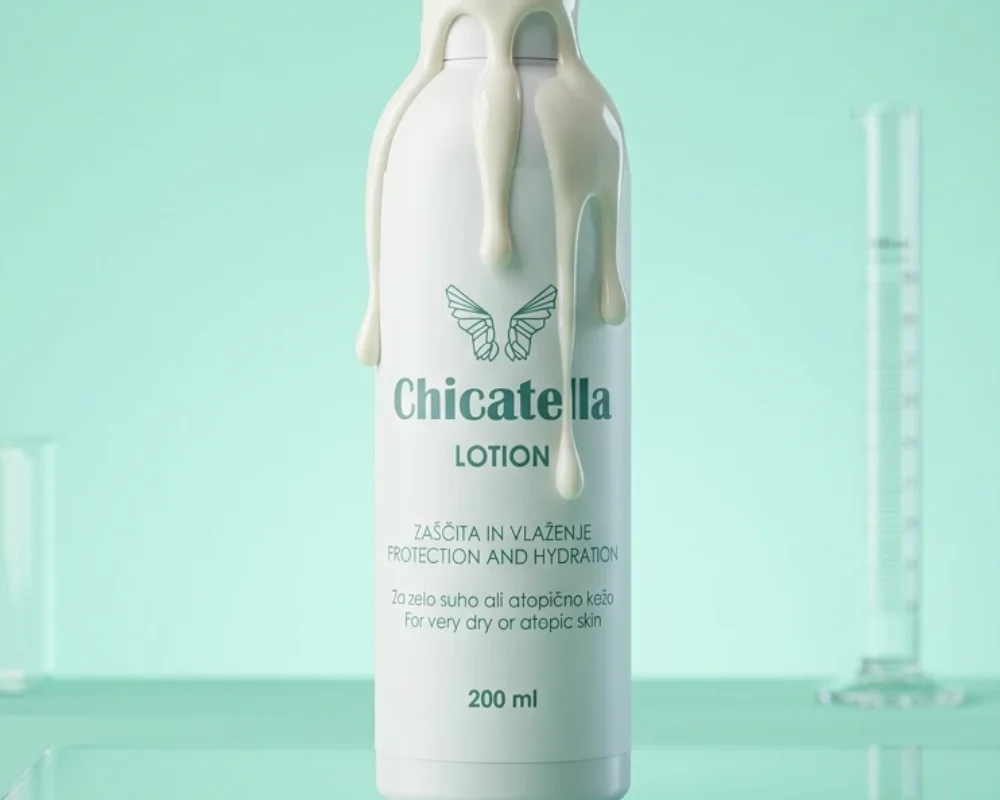
Lotion for eczema-prone skin – Chicatella Body Lotion, 200 ml bottle, gentle for kids
DRY OR IRRITATED SKIN · LARGER AREAS
Body Lotion

A lighter texture for everyday care of dry or irritated skin over larger areas. Creamy, absorbs fairly quickly and spreads easily.

When it makes sense: dry, irritated skin, after bathing, everyday care.
When it doesn’t: weeping, pus-filled or very painful patches.
Discover the lotion →
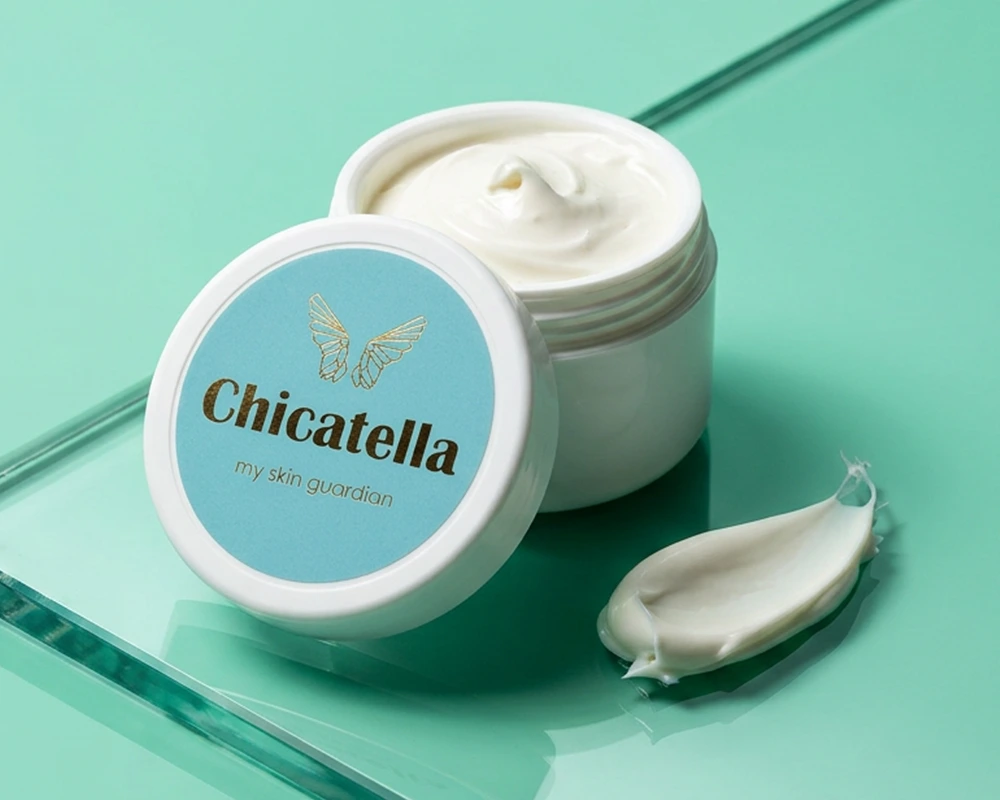
Eczema ointment for kids and adults – open jar of Chicatella SOS Ointment with a swatch
VERY DRY, ROUGH OR CRACKED · SMALLER AREAS
SOS Ointment

Forms a protective film and helps slow down water loss. It’s made for the problem spots on your skin, where it quickly soothes the look of dryness and irritation.

When it makes sense: a very dry, rough, cracked patch that isn’t weeping.
When it doesn’t: weeping, pus-filled, hot or very painful skin; tiny bumps around the mouth.
Discover SOS Ointment →
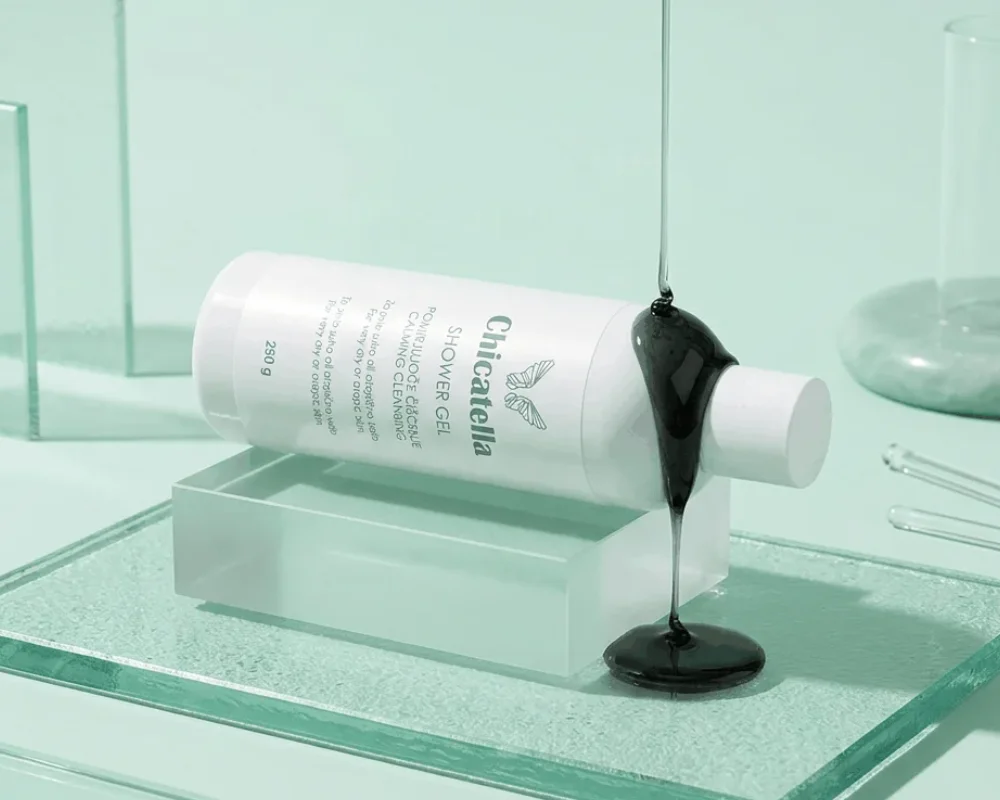
Fragrance-free body wash for eczema-prone skin – SOS Body Wash bottle with a stream of gel
Washing
SOS Body Wash

Gentle washing for days when your skin is dry and irritated. Made for mild cleansing that protects the skin’s natural moisture barrier.

When it makes sense: everyday gentle washing of dry skin.
When it doesn’t: open, weeping or very painful skin.
Discover the body wash →

If your eczema is actively inflamed, weeping or infected, talk to your doctor first.

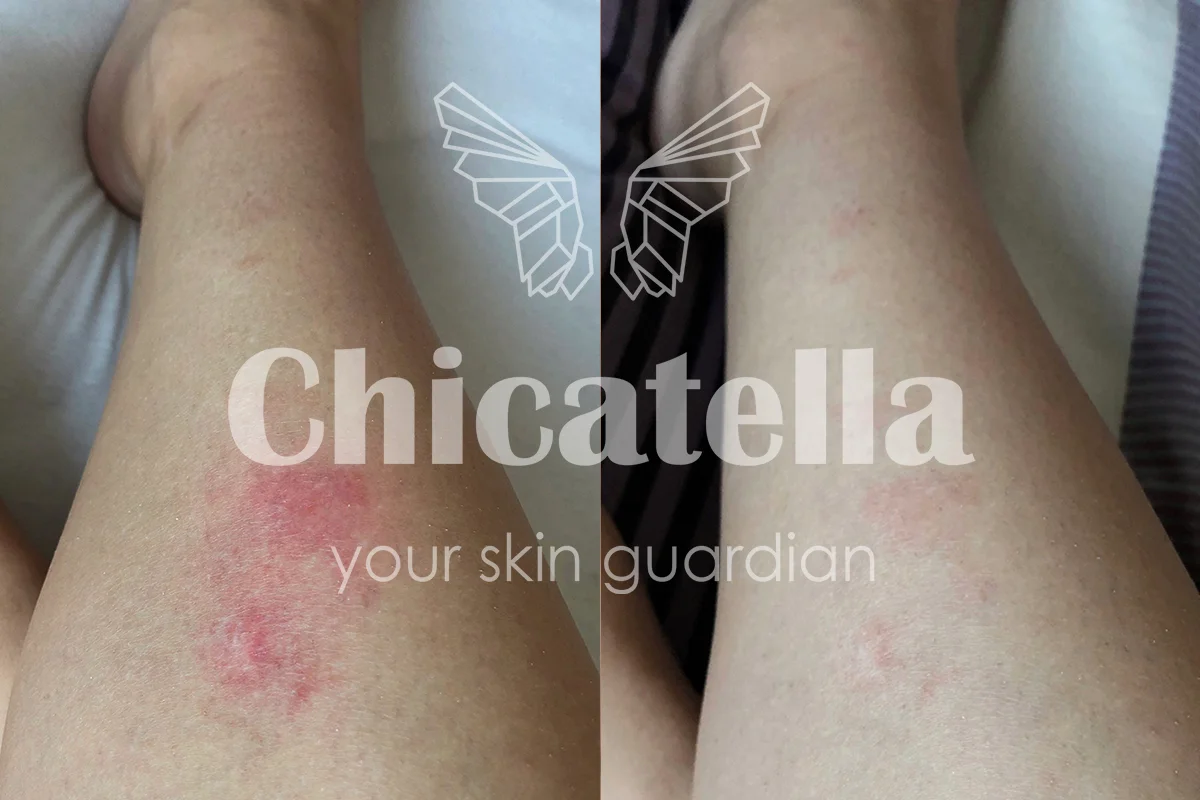
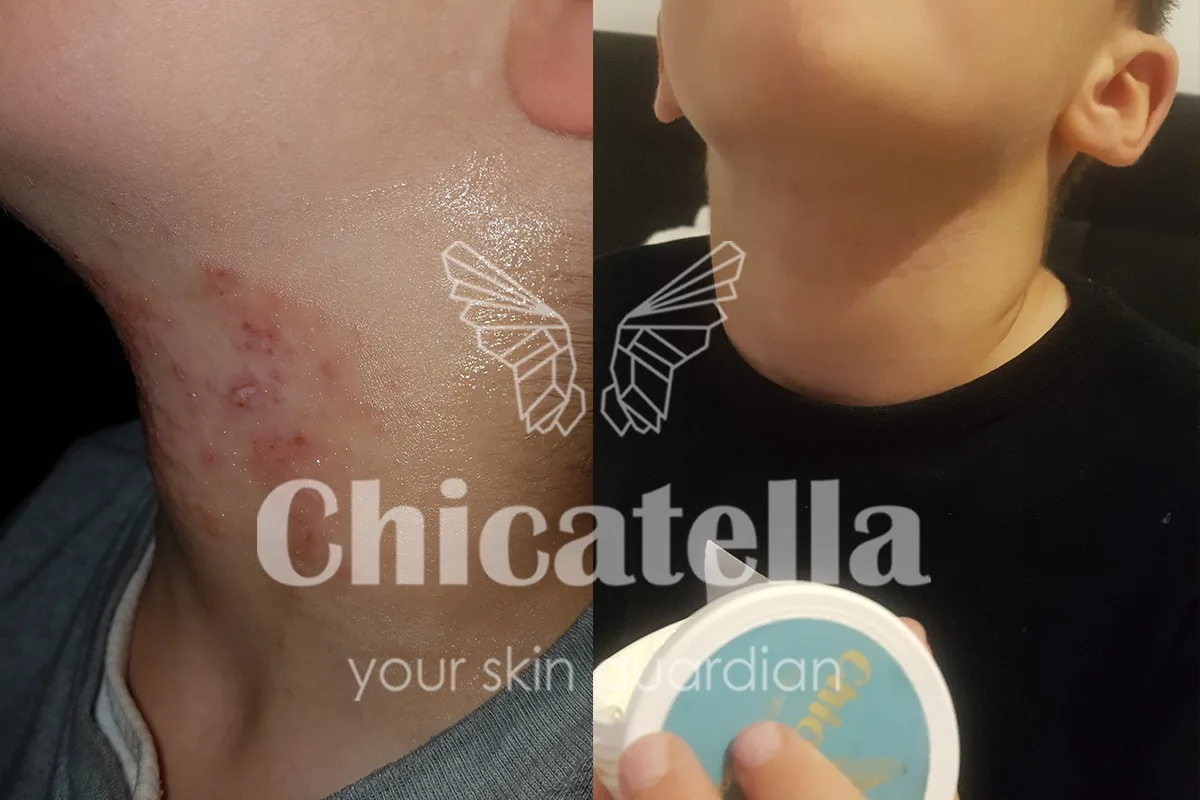
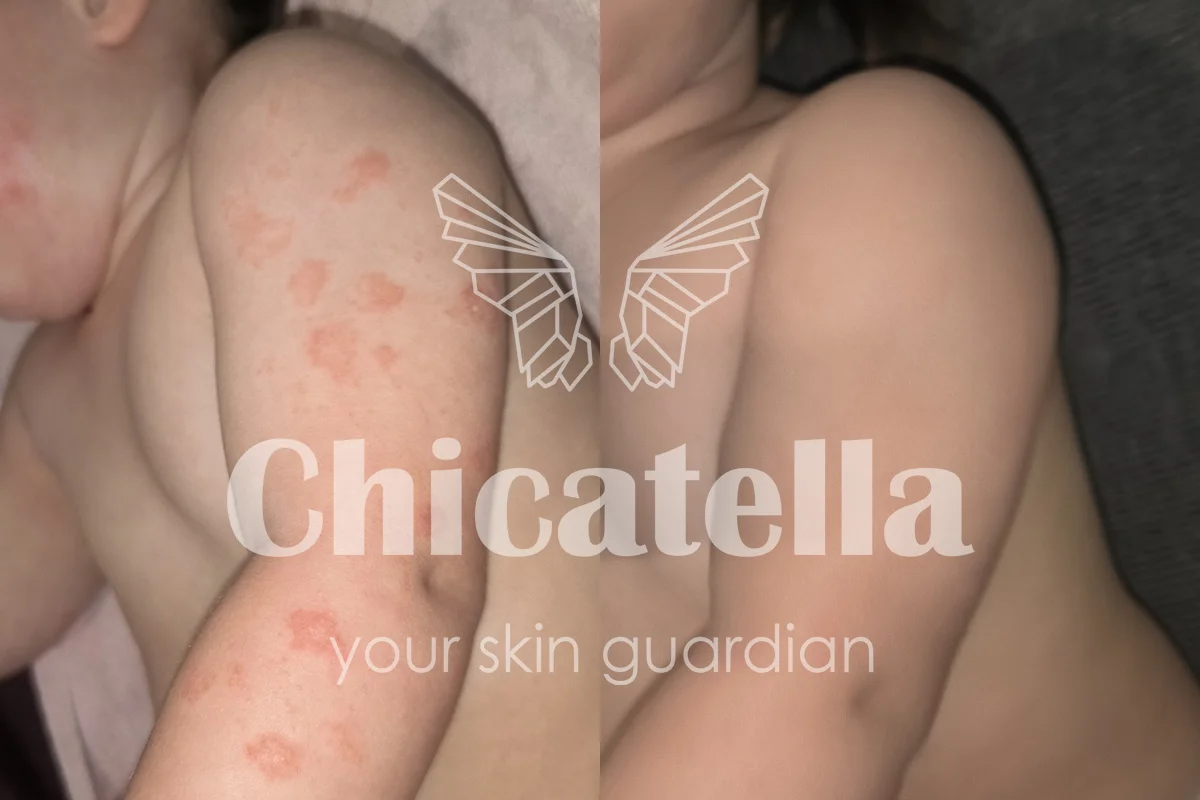
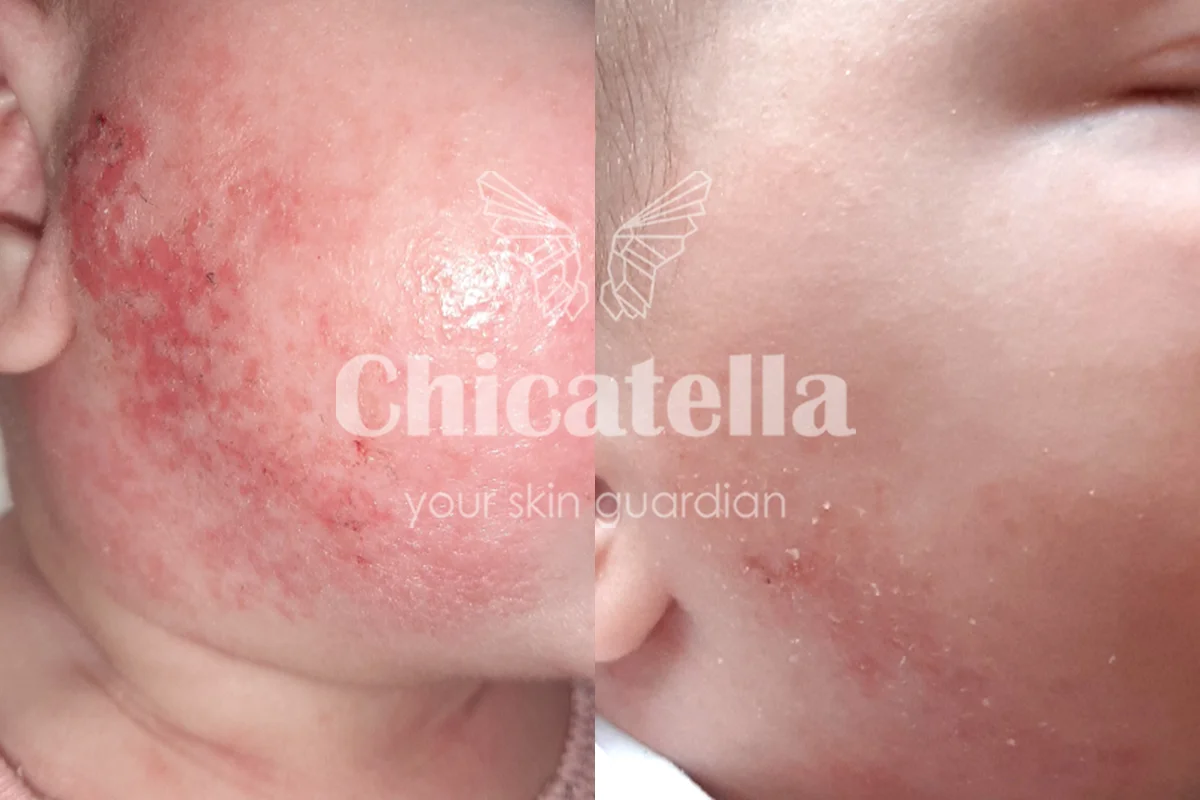
Before & after

What consistent care can do for eczema-prone skin

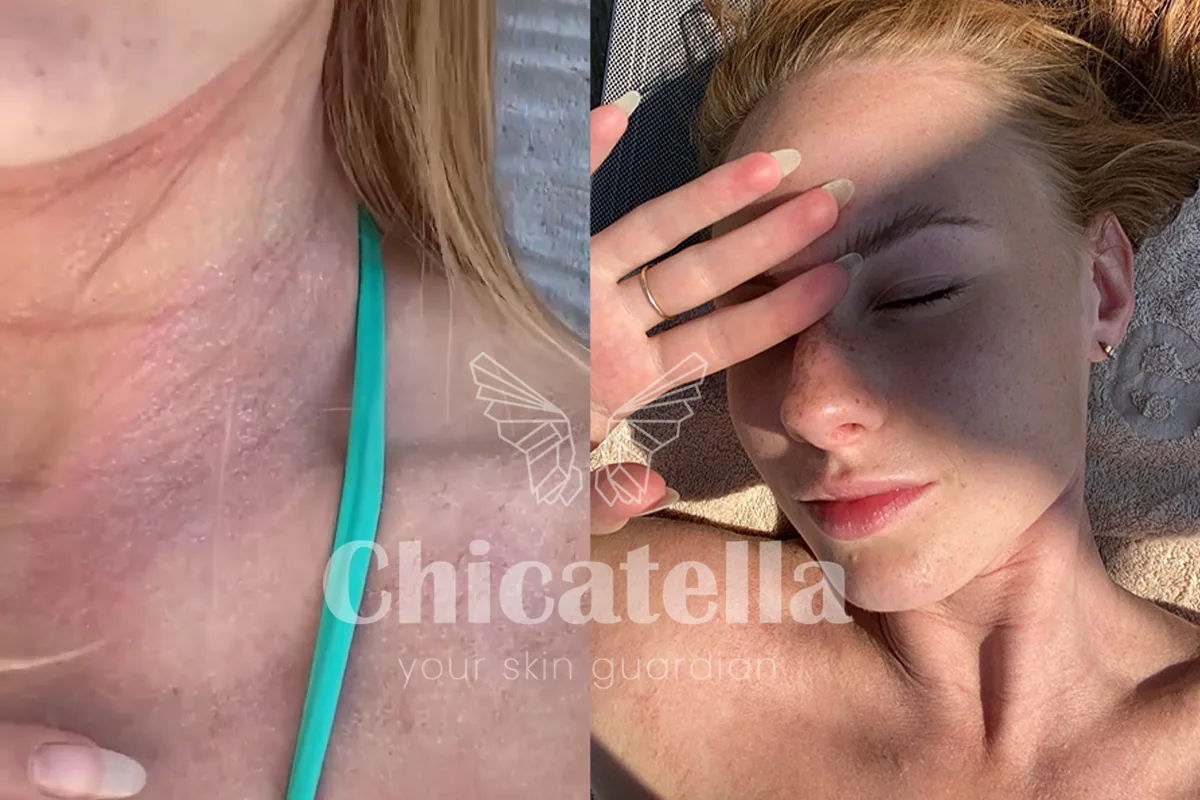
The same skin before and after care. Customer photos, shared with permission.
Browse→
Eczema rash on the neck and chest before and after – red, dry skin by a woman’s collarbone
Eczema on the hands before and after – red, rough skin over the knuckles on an adult’s hand
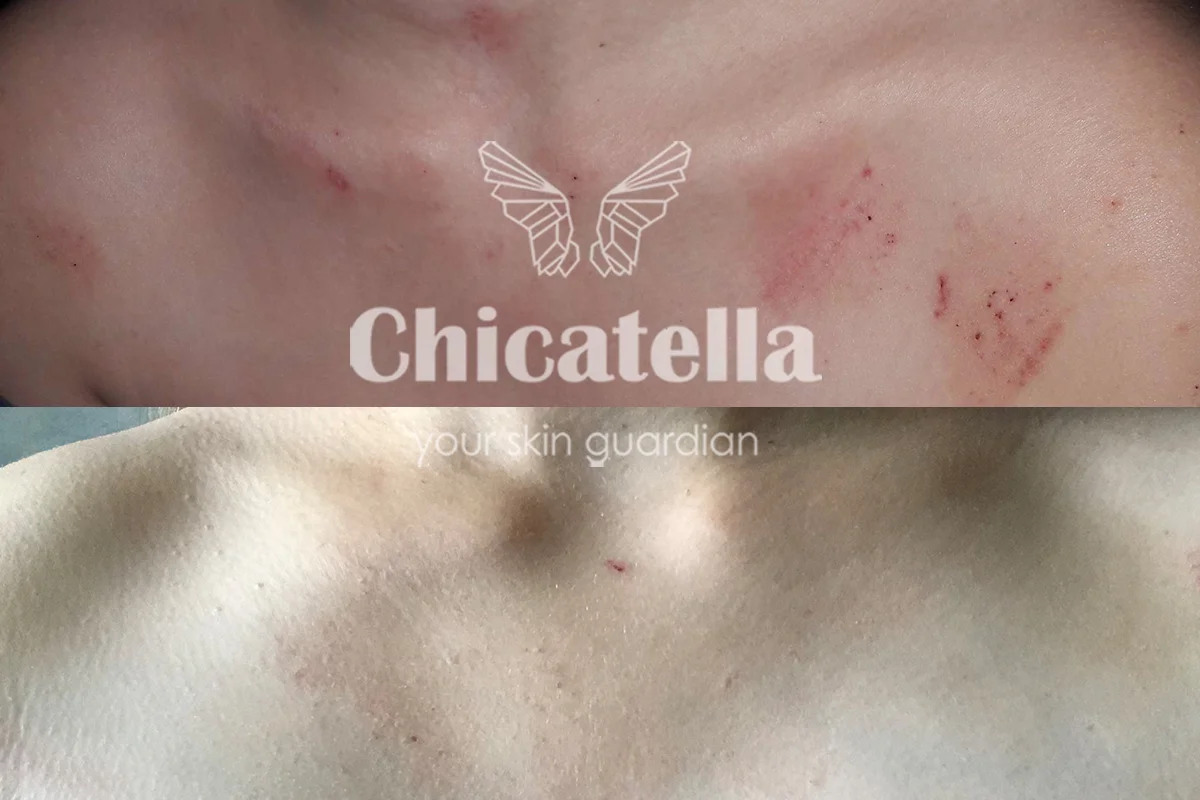
Eczema on the chest before and after – scratched, red spots below the collarbones
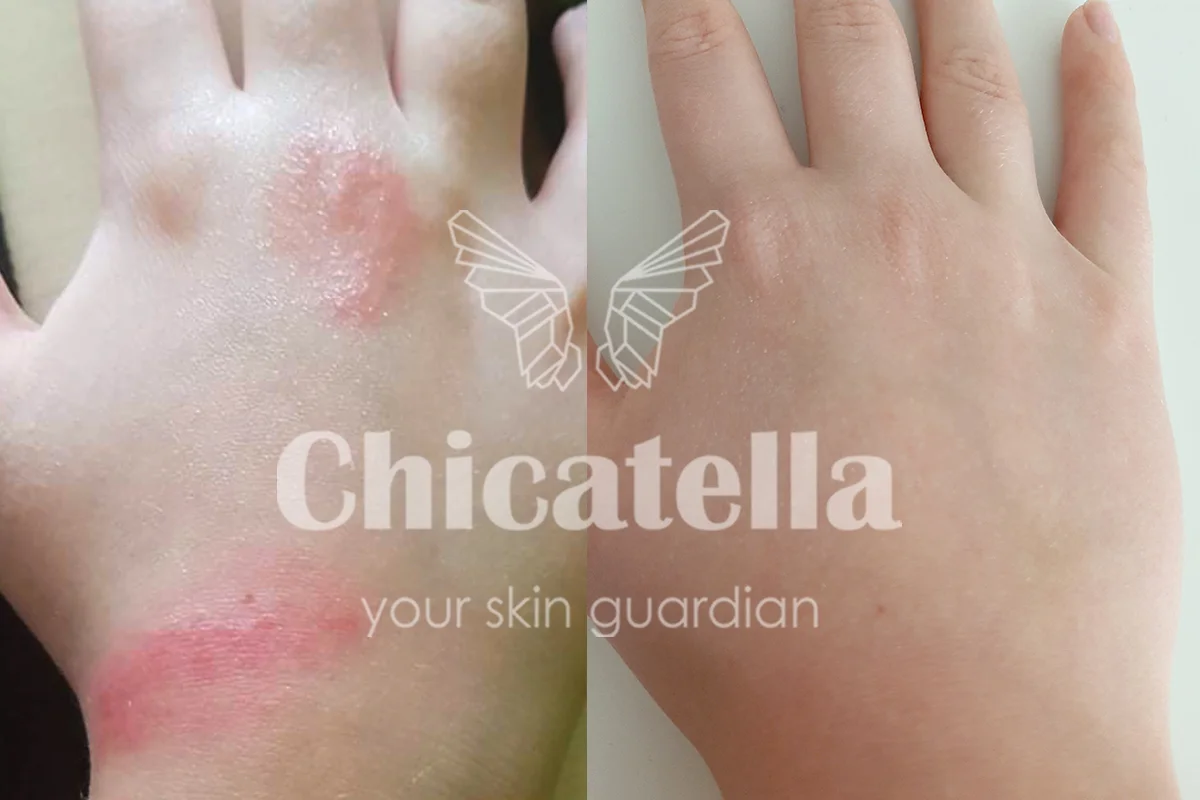
Eczema on the wrist and back of the hand before and after – red patches on a young person
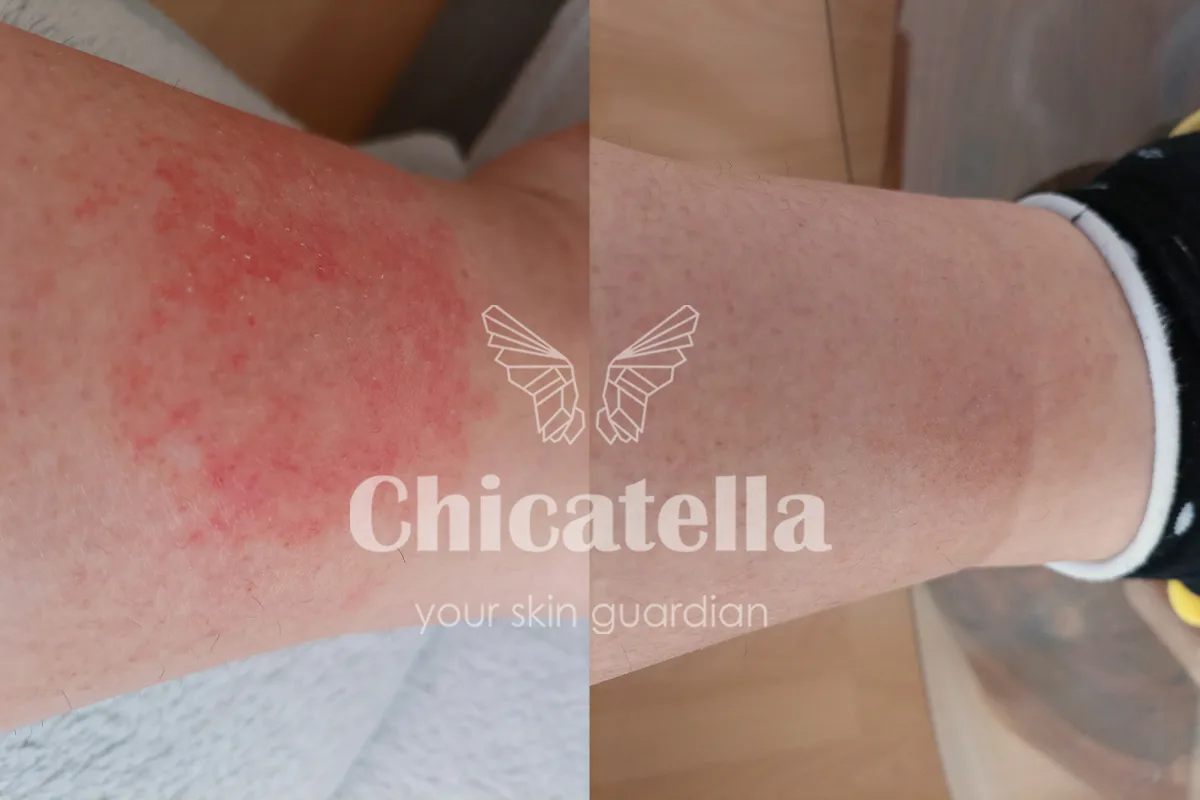
Eczema on the leg before and after – red, blotchy rash on the shin
Eczema on a child’s neck before and after – red, bumpy rash under the jaw
Eczema on a toddler’s upper arm before and after – round red patches on the arm and shoulder
Eczema in babies on the cheek before and after – red, rough rash spreading across the face
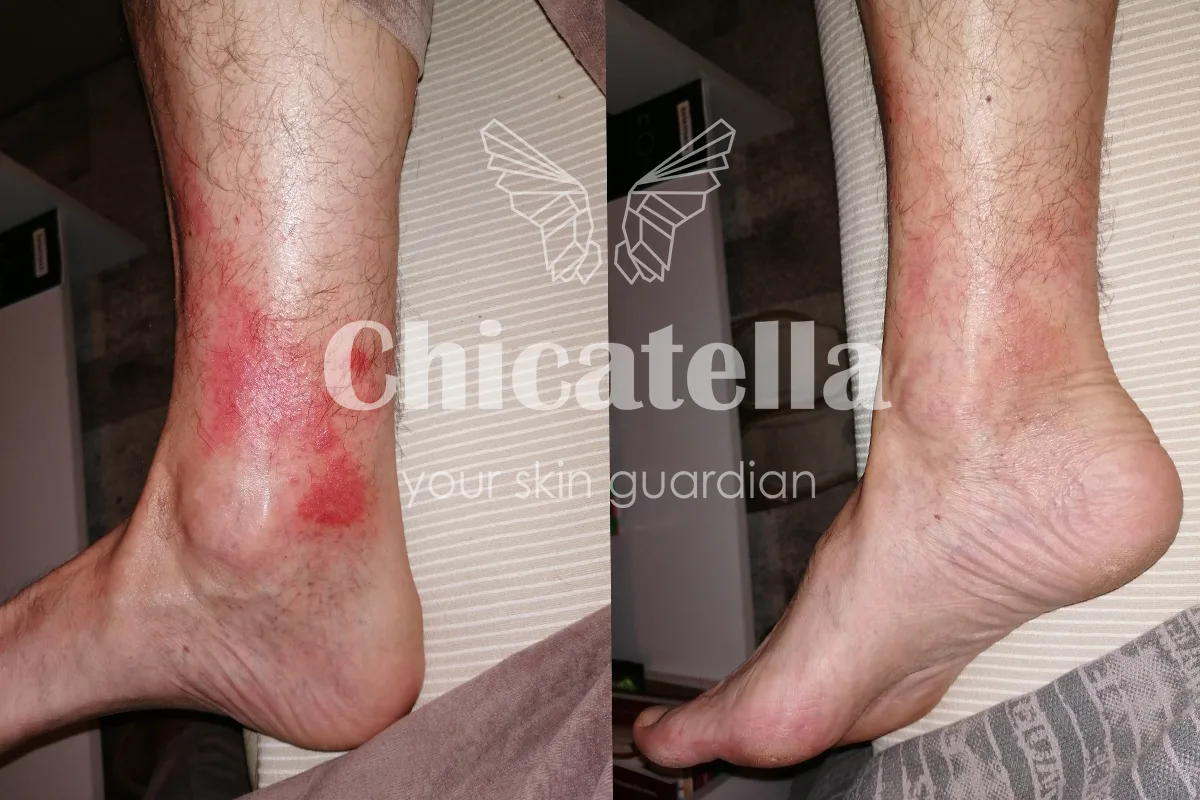
Eczema on the ankle before and after – red, irritated patch above the heel on an adult
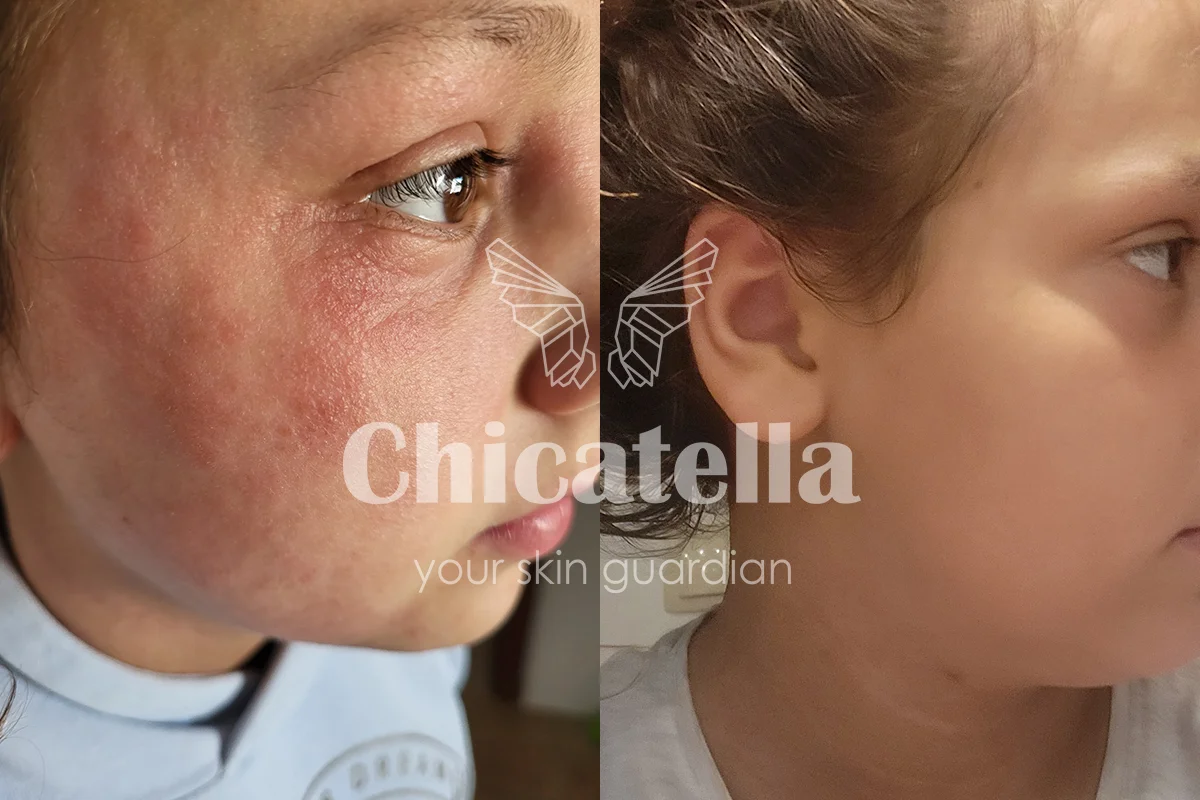
Eczema on a child’s face before and after – red, dry cheek next to the eye
Eczema in the elbow crease before and after – red, rough rash on the inner arm
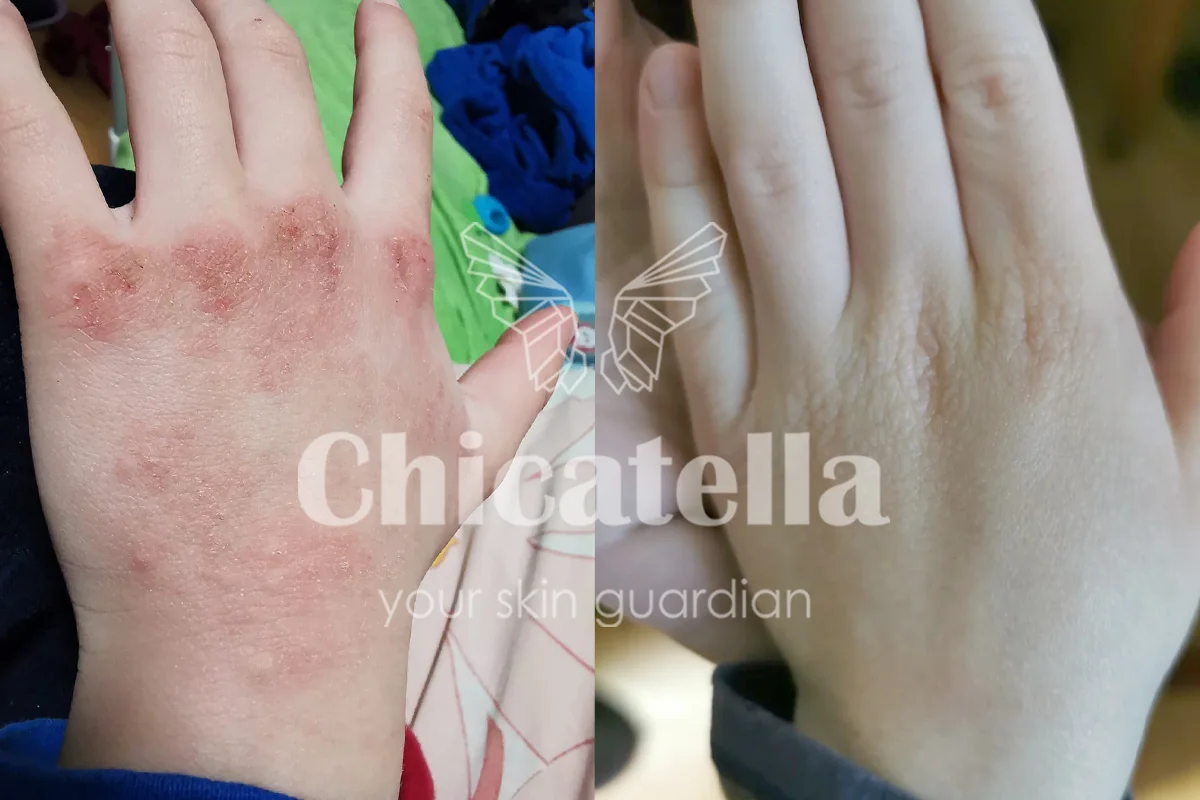
Eczema on the back of the hand before and after – dry, red patches over the knuckles

These are individual experiences with cosmetic care for very dry or irritated skin. Our products aren’t a medicine for eczema, and results vary from person to person.

Keep reading

Related reading

Dermatitis
The umbrella term for skin inflammation and its types.
Read →
Atopic dermatitis
The most common type of eczema.
Read →
Atopic dermatitis in children
Why it keeps coming back and what parents can do.
Read →
Contact dermatitis
Irritation and delayed allergy.
Read →
Seborrheic dermatitis
Oil, yeast and flaking.
Read →
Dyshidrotic eczema
Blisters on the palms and soles.
Read →
Nummular eczema
Round, coin-shaped patches.
Read →
Dry skin
The ground eczema often grows from.
Read →
Eczema cream
How SOS Ointment stands in for the barrier on eczema-prone skin: a guide to using it.
Read →
To sum up

Know what your skin really needs

Eczema isn’t one condition. The type and the current state of your skin are two different things: a dry patch that isn’t weeping needs a different approach than a badly inflamed or weeping one. Barrier care supports the skin’s protective layer, but it doesn’t fix every cause. Active inflammation, allergies, infections and blood flow problems each need their own solution. The goal isn’t to find one miracle cream. It’s to figure out what your skin actually needs.

Help me choose

Find the right care for your skin in three steps

No guesswork. Answer three quick questions and we’ll tell you what your skin needs.

This article helps you understand the types and states of eczema, but it can’t diagnose you or replace a visit to your doctor. The photos show how skin looked and aren’t a diagnosis. Chicatella products are cosmetic skin care products, not medicines.

Sources & further reading
  1. 01Dermatitis. DermNet NZ. ↗︎
  2. 02Eczema pathology (three stages). DermNet NZ. ↗︎
  3. 03Eczema: etiology, subtypes and therapeutic approaches. Frontiers in Allergy, 2025. ↗︎
  4. 04Atopic dermatitis. American Academy of Dermatology. ↗︎
  5. 05How to manage wet or weeping eczema, 2025. AAD. ↗︎
  6. 06Atopic dermatitis clinical guidelines. AAD. ↗︎
  7. 07EuroGuiDerm guideline update, 2025. ↗︎
  8. 08Secondary bacterial infection of eczema. NICE NG190. ↗︎
  9. 09Contact dermatitis. AAD. ↗︎
  10. 10Patch testing. AAD. ↗︎
  11. 11Dyshidrotic eczema. AAD. ↗︎
  12. 12Nummular eczema. AAD. ↗︎
  13. 13Stasis dermatitis. AAD. ↗︎
  14. 14Atopic dermatitis symptoms across skin tones. AAD. ↗︎
  15. 15Skin Microbiome Dynamics in Atopic Dermatitis, 2025. ↗︎
  16. 16Microbiome modulators for atopic eczema – systematic review, 2024. ↗︎