Hand eczema isn’t just dry skin. It’s a map of your day.
Your hands are the only skin you can wet, strip of oils, sanitize, shut inside a glove, rub raw and then take out into the cold, all within one hour. That’s why hand eczema (also called hand dermatitis) is rarely just a story about which cream you use. It’s a record of everything your hands have touched.
Once you figure out where it starts, when it gets worse and what happened a day or two before, you can stop swapping products blindly and start working on the part of the problem that actually matters.
If it’s mostly on your palms, with blisters or thickened skin, also take a look at eczema on the palms.

How we put this article together
The key points
It’s not one single condition. A similar look can come from repeated irritation, a contact allergy, an eczema-prone skin type or something else.
Where the changes start is an important clue, but location alone isn’t enough for a diagnosis.
What often keeps it going is a cycle of wetting, cleaning, water evaporating, friction and being exposed again.
You can develop an allergy to something you’ve used for years without any trouble.
The best results come from a system: less unnecessary irritation, the right protection, gentle cleansing and consistent barrier care.
If it’s long-lasting, very painful, on one hand only, oozing pus or won’t calm down despite the changes you’ve made, it’s worth getting checked.
Six patterns people describe most often
Six animated diagrams, because a pattern tells you more than a single photo: where it shows up on the hand, what it looks like and what usually sets it off. The diagrams are simplified and not a self-diagnosis tool. Swipe on your phone, use the arrows on a computer.
Short answers first
What is hand eczema?
Are hand dermatitis and hand eczema the same thing?
Is hand eczema contagious?
Why does the skin on my fingers crack until it bleeds?
How can you tell irritation from a contact allergy?
Why can an allergy show up after years of using the same product?
What do tiny blisters along the sides of the fingers mean?
Which gloves are best?
What kind of cream or ointment makes sense for very dry hands?
When do I need a dermatologist or a patch test?
Where on your hand does it itch or burn?
Tap the part of your hand that bothers you. We’ll show you what most often irritates it and what to look out for. Use the button below to flip the view between the palm and the back of the hand.
This sketch isn’t for diagnosis. It’s a way to spot a pattern and give your doctor more useful information.
If you want to keep exploring: contact dermatitis, dyshidrotic eczema, atopic dermatitis and eczema on the palms.
Same look, different ways to get there
How it looks and what causes it often overlap. That’s exactly why the same crack in two people doesn’t mean the same next step.
1 · Repeated irritation
Picture a glass filling up. One handwash usually isn’t a problem. But lots of small exposures without enough time to recover can add up.
Dryness, tightness, stinging, burning and cracks are common. Irritation can happen to anyone, but the threshold isn’t the same for everyone.
2 · Contact allergy
- →The body first becomes sensitized to a specific substance, little by little.
- →So years of trouble-free use don’t prove a product can’t be a trigger.
- →Once the allergy has developed, even a small amount of contact can set it off.
- →The reaction often shows up with a delay, which is why people only look at what they touched right before the itching started.
Common sources include metals, preservatives, fragrances, rubber, adhesives, acrylates, nail products and work materials. Which ones are most common varies by country and job, so we don’t give a one-size-fits-all ranking here. That’s what a patch test is for. More about how it works in our article on contact dermatitis.
3 · Eczema-prone skin
Some people’s skin is naturally drier and more sensitive, so it has a lower starting threshold. The same load can set off problems sooner.
Atopic skin and a contact allergy can exist together. Someone can have a more sensitive barrier, repeated irritation and an allergy all at once, and that’s often why one single change isn’t enough. More in our article on atopic dermatitis.
4 · Blistering and thickened patterns
Deep, very itchy blisters along the sides of the fingers and on the palms belong to the dyshidrotic pattern.
Very thick, hard and cracked skin on the palms can look like psoriasis.
The look alone can’t reliably tell you which mechanism is the main one.
5 · An option almost everyone overlooks: contact with proteins
- →It matters most for cooks, bakers, butchers, vets and others who often handle food, plants, animals or latex.
- →After contact, itching or a hive-like reaction can show up quickly at first, and with repeated contact, eczema develops.
- →This isn’t the same as a classic delayed contact allergy, and it doesn’t always show up on a standard patch test.
If your hands react within minutes when you work with food or animals, tell your doctor. This pattern isn’t something to self-diagnose.
Numbers that show you’re not the only one
From a systematic review of 66 studies with a total of 568,100 people.3↗︎
lifetime prevalence of hand eczema
have it within one year
have it at any given moment
more common in women
of cases were rated moderate or severe
Context: these are international figures on hand eczema, not an exact estimate for any one country.
In an online survey of 60,131 adults from Canada, France, Germany, Italy, Spain and the UK, this many participants said a doctor had diagnosed them with chronic hand eczema in the past year.4↗︎
Self-reported data, not US prevalence.
Chronic hand eczema is usually defined as lasting at least three months without a break, or coming back at least twice in twelve months.1↗︎
Why “wet hands” aren’t necessarily hydrated hands
In one study, about two hours a day with wet hands was linked to roughly 3.5 times higher odds of hand eczema, and the same was true for wearing gloves for long periods.5↗︎ Context: this is a link in an observational study, not a universal threshold or proof that everyone will get dermatitis.
A shield outside, a microclimate inside
- →Choose a glove based on the specific task and material.
- →No type of glove is best for every chemical.
- →Swap it when it’s wet inside, damaged or dirty.
- →Make sure your hands are dry before you put it on.
- →If you wear them for a long time, cotton glove liners can help, as long as they’re clean and dry.
- →Take off rings before wet work. Water and soap get trapped underneath.
- →If the problem shows up mostly under gloves, your doctor should also consider an allergy to rubber ingredients.

Does alcohol really always dry skin out more than soap?
- →On cracked skin, alcohol can sting a lot, because it reaches a barrier that’s already damaged.
- →But that doesn’t mean it’s more harmful than repeated handwashing with soap in every situation.
- →In healthcare settings, approved alcohol-based hand sanitizers are often less irritating and less drying than frequent washing with soap and water.11↗︎
- →The right advice depends on the situation: visibly dirty hands, certain germs and contact with chemicals call for a proper wash.
Please don’t skip the hygiene you need or your workplace rules because of this article. The goal is less unnecessary irritation, not less hygiene.
The culprit is hiding a day or two back
Skin on the hands often turns red only 1 to 2 days after touching something. So the last thing you touched often isn’t the culprit. It’s whatever you handled the day before yesterday.
What can look like hand eczema
The table points you to the right next step. It isn’t a self-diagnosis tool.
| Possible condition | Helpful clue |
|---|---|
| Fungal infection of the hand | Often more on one side, and the feet may be peeling at the same time. Not a hard rule; a skin sample test confirms it. |
| Psoriasis | Well-defined, thickened and cracked patches; nail changes are possible too. |
| Scabies | Intense itching at night, spots between the fingers and similar problems in other people in the household. |
| Bacterial infection | Quickly growing pain, warmth and swelling, pus or honey-colored crusts. |
| Herpes on a finger | Clusters of painful blisters, often on one finger. |
| Mechanically cracked skin | Very dry, cracked skin without a clear inflamed rash. More in our article on dry skin. |
How a doctor looks for the cause
A conversation about your job, hobbies, products, gloves, nail care and when it gets worse.
An exam of both hands, wrists, nails and, if needed, feet.
A patch test, when a contact allergy is possible.
A skin sample, when fungus needs to be ruled out.
Less often a biopsy, when the picture stays unclear.
The test makes the most sense with long-lasting or recurring problems, suspected job-related exposure, problems under gloves or after nail products, or when usual care and treatment don’t bring the expected improvement.2↗︎
Result, cause or both?
What we know and what we don’t yet, in four steps.
- 01
A damaged barrier changes the moisture, pH, fats and surface where microorganisms live.
- 02
Inflammation and scratching can change the microbial environment even more.
- 03
It’s not yet clear how much microbiome changes drive the condition and how much they follow it.
- 04
That’s why “balancing the microbiome” mustn’t become an empty marketing promise, ours included.
In people with moderate to severe chronic hand eczema, the bacterial community on affected skin was different from that on unaffected skin. There was more of the genus Staphylococcus, especially S. aureus. After two weeks of treatment, as the skin improved, the microbial pattern moved closer to that of unaffected skin.8↗︎
A small study doesn’t prove the microbiome is the starting cause, or that a cosmetic can “reset” it.
What actually helps
1 · Cut down unnecessary exposure
2 · Wash effectively, not aggressively
3 · Match your care to how your skin looks right now
4 · Inflammation needs treatment; the barrier needs support
Depending on the cause and how severe it is, a doctor may prescribe anti-inflammatory skin medicines, light therapy or systemic treatment. Cosmetic care doesn’t replace treatment, but it helps with dryness, roughness, tightness and water loss. Don’t stop prescribed medicines on your own.1↗︎
Chronic hand eczema is no longer seen as “just dry skin”
Delgocitinib is a prescription anti-inflammatory cream that blocks JAK enzymes. The European Medicines Agency approved it for adults with moderate to severe chronic hand eczema when steroid creams aren’t suitable or don’t work well enough.9↗︎
share with “clear or almost clear skin” vs. placebo
same measure in a second 16-week trial
Transparency: both trials were funded by LEO Pharma. It isn’t a miracle treatment for every case of hand eczema, and it isn’t a cosmetic product.
The main message isn’t the name of a drug. It’s that chronic hand eczema is a condition in its own right that’s taken seriously, and there are new options for it today. If yours has been dragging on for months, a talk with a dermatologist is worth more than the next cream.
When to get checked
quickly increasing pain, warmth, swelling, pus, honey-colored crusts, a red streak running up your arm or a fever.
Once you cut down the triggers, the barrier needs time
If your hands are mostly dry, rough, tight or cracked, supporting the skin barrier is exactly the part of the problem where good cosmetic care can make a big difference. It won’t get rid of a contact allergy and it isn’t a medicine for dermatitis, but it can help your skin hold on to more water and protect it while it recovers.
- your hands are very dry, rough or tight;
- they sting after washing and quickly stop feeling comfortable;
- the skin cracks on your fingertips or knuckles;
- winter, water, cleaning or frequent handwashing make it worse;
- your skin needs longer-lasting protection against water evaporating.
- a contact allergy is keeping it going;
- deep blisters, strong inflammation or signs of infection show up;
- it mostly affects one hand;
- it doesn’t go away despite consistent care.
In these cases, care is still useful. It just won’t be enough on its own.
How the look of hand eczema can change
The same area of the hand before and after care. Customer photos, shared with permission.
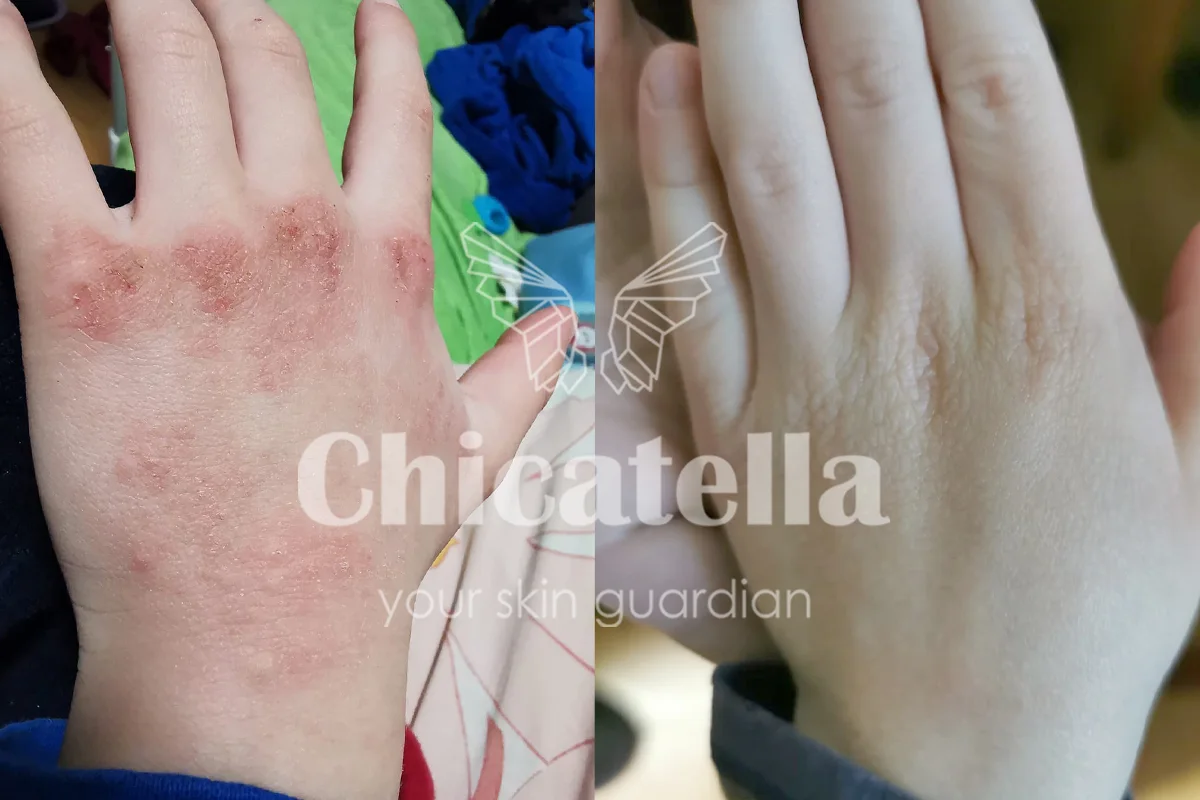
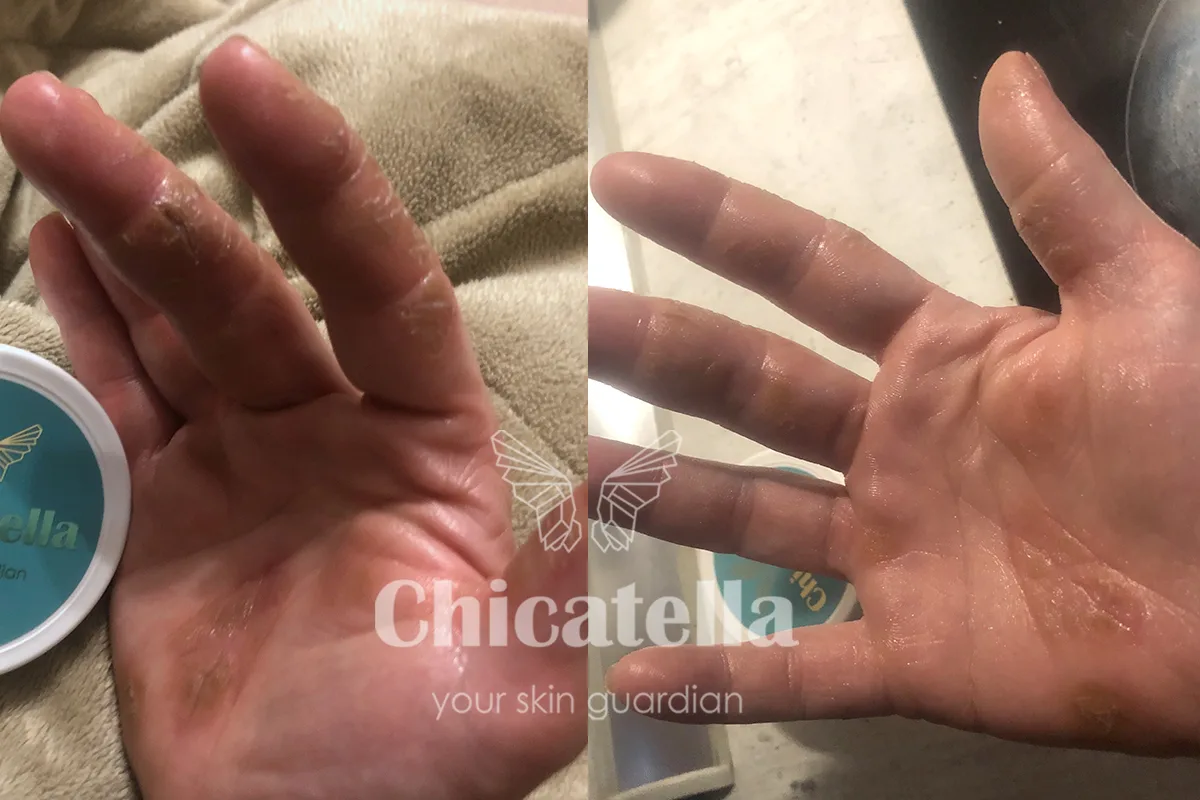
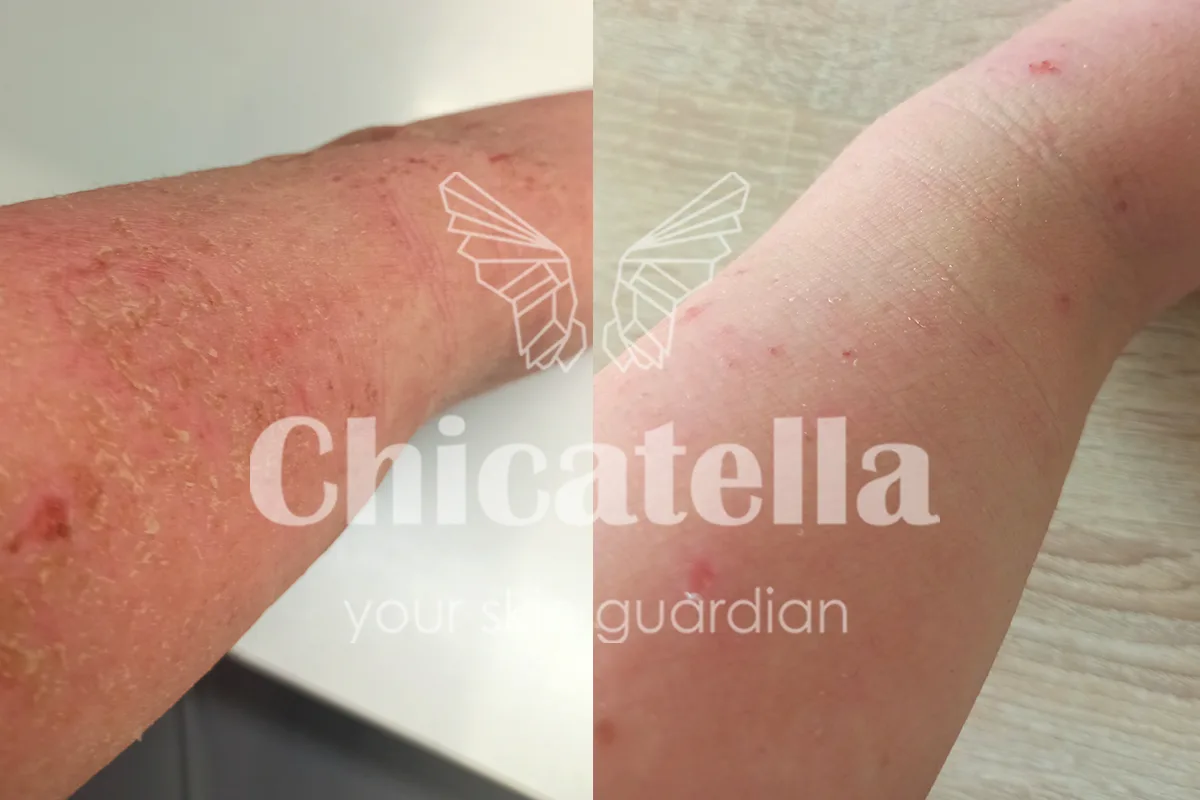
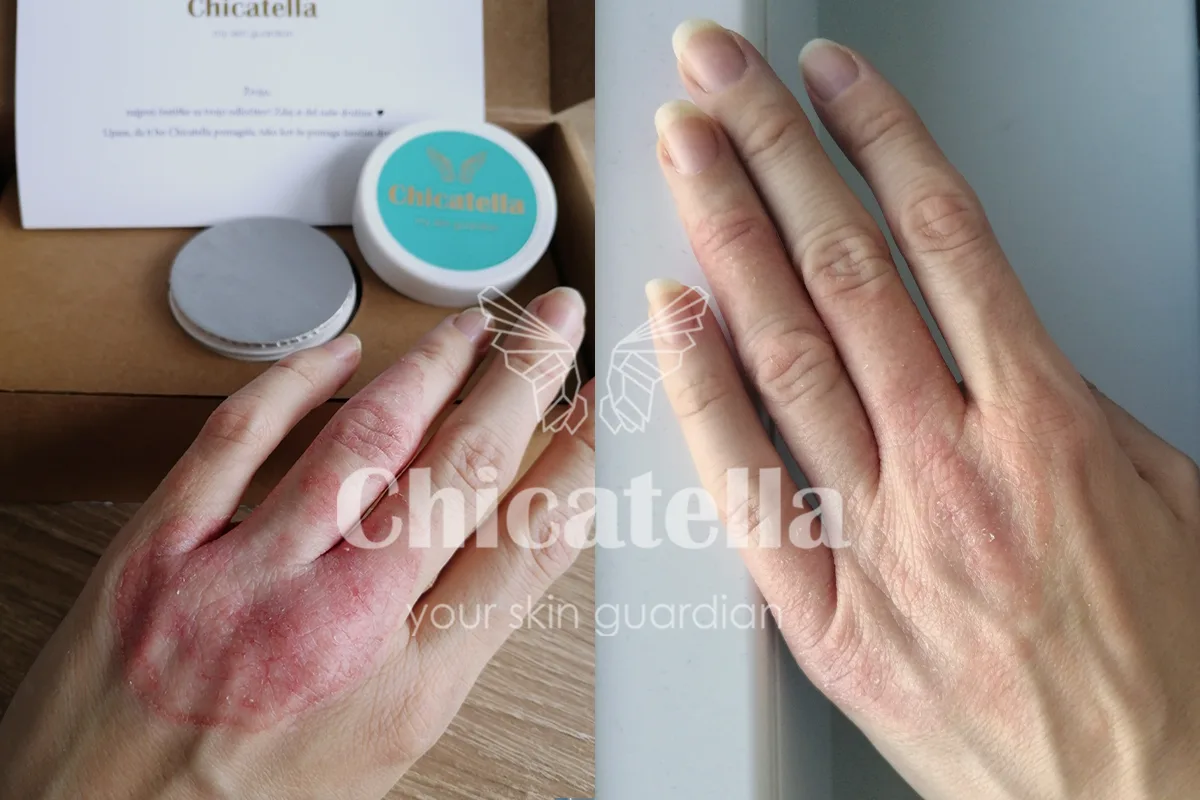
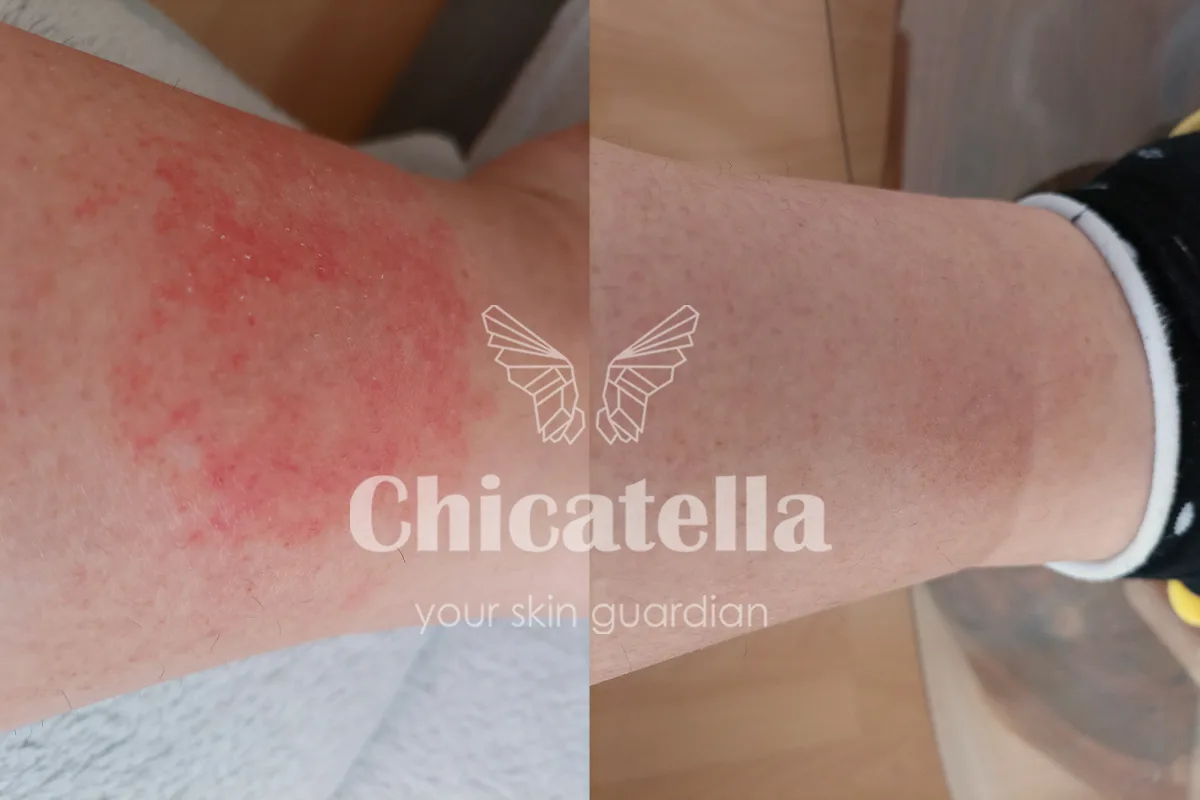
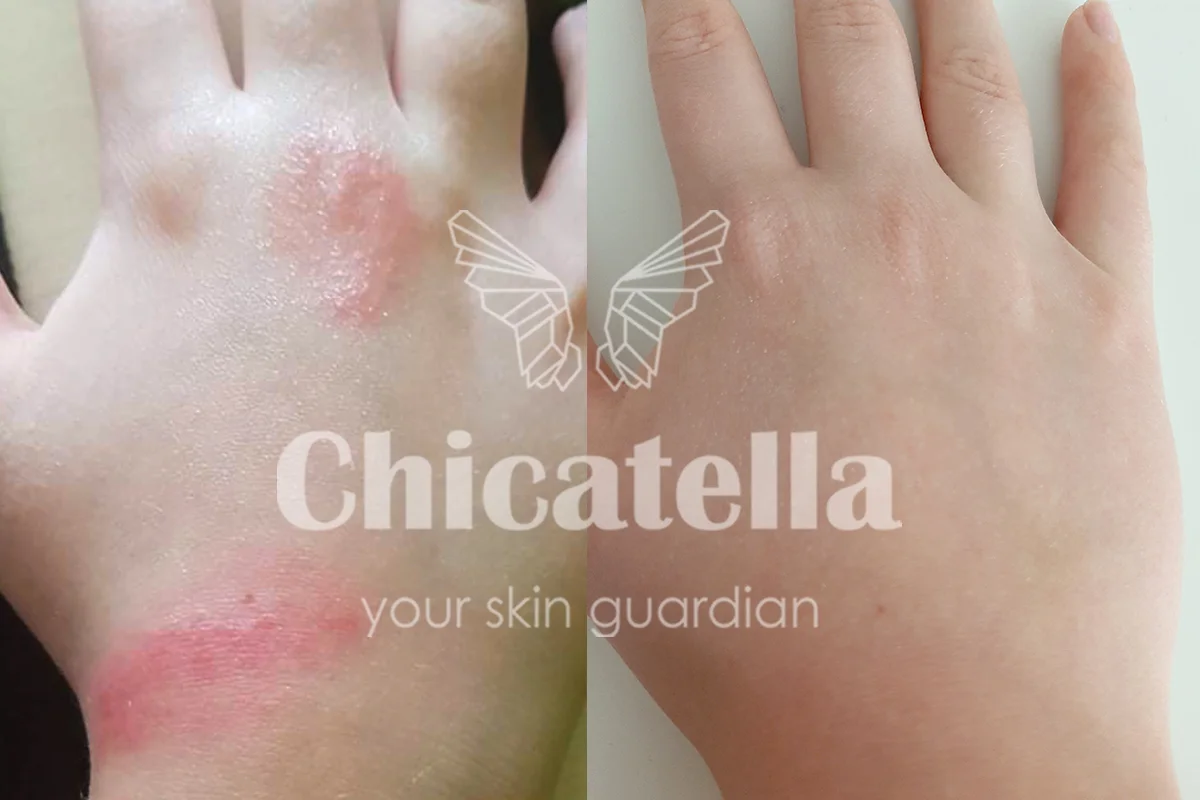
These photos show individual experiences caring for very dry or irritated skin. Our products are for cosmetic care, and individual results may vary.
Looking for something else?
Understanding what your skin really needs
Your hands won’t tell you the diagnosis, but they leave clues. Where it starts, what happened the day before and whether it gets better on your days off are often more useful than yet another cream picked at random.
If the main problem is a very dry, rough, cracked barrier, consistent emollient and occlusive care can help a lot. If an allergy, an infection or strong inflammation is keeping it going, the best results come from the right mix of finding the cause, treatment and gentle everyday care.
Find the right care for your skin in three steps
No guesswork. Answer three quick questions and we’ll tell you what your skin needs.
This article helps you understand hand eczema and choose everyday care. It can’t diagnose anything or replace a doctor’s exam. Chicatella products are cosmetic skin care products, not medicines.
- 01Guidelines for diagnosis, prevention, and treatment of hand eczema. European Society of Contact Dermatitis, 2022. ↗︎
- 02S2k guideline: diagnosis, prevention, and therapy of hand eczema, 2023. ↗︎
- 03Prevalence, incidence, and severity of hand eczema in the general population. Systematic review and meta-analysis, 2021. ↗︎
- 04Prevalence of chronic hand eczema in adults. Survey of more than 60,000 adults, 2025. ↗︎
- 05Risk of work-related hand eczema in relation to wet work exposure, 2020. ↗︎
- 06Incidence rate of hand eczema in different occupations. Systematic review and meta-analysis, 2022. ↗︎
- 07Patch testing for allergic contact dermatitis. FDA workshop, 2025. ↗︎
- 08Hand eczema and changes in the skin microbiome after topical corticosteroid treatment, 2025. ↗︎
- 09Anzupgo (delgocitinib). European Medicines Agency. ↗︎
- 10DELTA 1 and DELTA 2 phase 3 trials of delgocitinib. The Lancet, 2024. ↗︎
- 11Clinical Safety: Hand Hygiene for Healthcare Workers. CDC. ↗︎