Not every rash around the mouth is perioral dermatitis, and each one needs different care.
The skin around your mouth can get irritated from drool, lip licking, food, a pacifier, cold weather, wiping your nose or eczema. Or it can be periorificial dermatitis. These conditions can look alike, but they may need almost opposite care. A protective ointment can do a lot for a damaged skin barrier, yet it can make papular perioral dermatitis worse.
Same spot, different problems.

How we put this article together
Different problems, same spot
Eight patterns people see most often around the mouth and nose. Whether there are bumps or just a dry surface, whether a narrow strip next to the lip is spared, and whether the skin itches or burns tells you more than the redness alone. The sketches are simplified; a doctor makes the diagnosis.
This gallery isn’t meant for self-diagnosis. When a diagnosis hasn’t been confirmed by a doctor, we don’t label photos as perioral dermatitis.
Short answers before we go deeper
What is perioral dermatitis?
What does it look like?
Is every rash around the mouth perioral dermatitis?
Is it contagious?
What can trigger it or make it worse?
Can a steroid cream cause it?
Can I put moisturizer or ointment on it?
What does “zero therapy” mean?
How long does it last?
When should I see a doctor?
A rash around the mouth isn’t a diagnosis yet
In everyday talk, “perioral dermatitis” gets used for almost any red, dry or pimple-like change around the mouth. In medical terms, though, periorificial dermatitis describes a fairly specific inflammatory rash of papules or papules and pustules.
The same patch of skin can hide a lot of things:
Whether to use an ointment doesn’t depend on the name of a page, but on what’s actually going on with your skin.
A “dermatitis” that doesn’t act like classic eczema
The broader, more accurate term is periorificial dermatitis, because the rash can show up around the mouth, nostrils and eyes.
It isn’t necessarily an eczema-type process like the one in atopic dermatitis. Tiny, similar-looking papules or pustules are common.
The inflammation is often perifollicular, meaning it sits around the follicles of tiny facial hairs instead of spreading across the whole surface.
The skin can feel tight and dry. That still doesn’t mean it needs richer occlusive care. In this condition, that’s exactly what can set off a feedback loop of irritation.
Occlusion isn’t good or bad in itself. It’s a tool, and what it does depends on the state of your skin.
Where it actually shows up
This is a diagram, not a photo. Four spots worth knowing, and one that often stays clear.
The classic spot. Perioral dermatitis can show up only here, as clusters of tiny papules on the skin around the mouth, but not on the lip itself.
When the areas beside the nostrils are affected too, periorificial is the more accurate term. Wiping with tissues and a runny nose irritate the same spot, and that’s two different stories.
A rash around the eyes is a warning sign. In this area it always needs a doctor’s opinion, not home experiments.
A narrow strip right next to the red edge of the lips often stays unaffected. A useful clue, but not in everyone. Dermatitis from lip licking and drool, on the other hand, reaches right up to the edge or past it.DermNet↗︎

When an occlusive protective layer helps, and when it can become part of the problem
The comparison below is a rough guide, not a diagnostic test. It helps you see which story is closer to your skin, and what’s worth talking about with your doctor.
- The skin is mostly flat, dry, rough, flaky or cracked.
- There’s an obvious outside cause: drool, lip licking, a pacifier, food, tissues, a runny nose, cold, wind, frequent washing.
- The change reaches the red edge of the lips or goes past it.
- Dryness, tightness, itching or painful cracks are the main thing.
- The skin is damaged exactly where it touches the irritant.
- The person already has known dry or eczema-prone skin.
For skin like this, emollient or occlusive care often supports the skin barrier and reduces moisture loss. A protective layer also cuts down further contact with drool, tissues or the weather.DermNet↗︎
- There are lots of tiny, fairly uniform papules or pustules.
- Similar to acne, but usually without blackheads.
- It shows up around the mouth, and sometimes next to the nostrils or eyes.
- A narrow strip right next to the edge of the lips stays fairly clear.
- Burning, sensitivity or stinging are the main thing.
- It appeared or got worse after a face steroid.
- There are more bumps after rich creams, oils or ointments.
- The rash keeps coming back even though your care keeps getting richer.
Occlusive creams and ointments can make active periorificial dermatitis worse.JAAD 2026↗︎
You can have more than one condition at once. Someone with eczema can also develop periorificial dermatitis. The same face can have flat, cracked patches and separate clusters of papules. That leads to a practical takeaway: you don’t need to put a product on the whole rash just because it helps one dry spot. If a rash is unclear, stubborn or keeps coming back, get a professional opinion.
Which description is closer to your skin? This is a rough guide, not a diagnosis.
Two scenarios, two different mechanisms
Feeling dry the same way doesn’t necessarily mean the same mechanism, so it doesn’t always call for the same care.
So what is occlusion, really?
An occlusive is an ingredient that forms a thin film on the surface of the skin. This film doesn’t “seal” the skin or stop it from working, but it does slow down water evaporating from the skin into the air. The skin underneath stays more hydrated and gets the calm it needs to repair itself. At the same time, it acts as a barrier between your skin and whatever irritates it from outside: drool, tissues, cold.
Draws in and holds water, glycerin for example.
Smooths the surface and fills in the cracks between skin flakes.
Forms a film that slows water evaporation. The best-known examples are petrolatum (Vaseline) and lanolin.
And that’s why this explanation is here: occlusion isn’t good or bad in itself. For dry, cracked skin, it’s often the most tangible help you can give. With an active papular rash, though, the same film can make things worse. The state of your skin decides, not the product.
The feedback loop: dryness → more products → more problems
This is a proposed mechanism, not a complete explanation for every case.
The skin barrier is weakened.
Water evaporates faster, and the skin feels tight and dry.
Irritants get in more easily.
You add more creams, oils and serums.
For some people, the extra occlusion or irritating ingredients make it worse.
The skin feels even drier and seems to need even more care.
Important, so this doesn’t get misread: this loop doesn’t mean all dryness around the mouth is periorificial dermatitis. With ordinary irritation dryness from drool, tissues or cold, removing the irritant and protecting the barrier is exactly what the skin needs.
What’s a real clue and what’s just an internet theory?
- topical steroids on the face
- rich or occlusive face products in people who are prone to it
- an overloaded or irritating routine
- sticking with a product that brings on more bumps
- inhaled or nasal steroids that touch the skin
- makeup, moisturizers and some sunscreens
- masks, heat, moisture and friction
- CPAP equipment
- toothpaste or other oral care products
- hormonal factors
- that fluoride is to blame for everything
- that it’s always fungus, candida or Demodex
- that there’s a special diet for perioral dermatitis
- that one single “toxic” cosmetic ingredient is to blame
- that you can simply reset your microbiome with one product
- that stress alone explains every case
So we don’t recommend giving up fluoride toothpaste long-term without talking to your dentist, and the same goes for restrictive diets, supplements or antifungal treatment without a diagnosis.
Is one bacterium to blame?
A small 2025 study looked at which bacteria live in the tiny hair follicles on the face. Here’s what it found, and why that isn’t the answer yet.Mochizuki 2025↗︎
In people with perioral dermatitis, the mix of bacteria was different from healthy people. In some of them, one bacterium stood out that wasn’t found anywhere else.
After antibiotics there was less of this bacterium, and the rash got better.
Only 12 people. Two things showing up together doesn’t mean one causes the other. And antibiotics calm inflammation on their own, so the improvement may have come from that.
So probiotic or “microbiome” skin care is currently not a proven treatment for perioral dermatitis.
11 studies, 733 people, and still a lot of open questions
A 2022 systematic review included just 11 studies with 733 participants in total. For the outcomes that matter, the certainty of the evidence was mostly low or very low.Gray 2022↗︎
That’s why treatment has to be tailored to severity, age, past steroid use and how each person responds. And it’s exactly why this article doesn’t promise you a quick or guaranteed result.JAAD 2026↗︎JAAD Rev 2026↗︎
“Put nothing on it” isn’t universal advice for every case of dry skin around the mouth
With likely or diagnosed periorificial dermatitis, a zero therapy approach is often used: everything that isn’t essential comes off for a while. For skin damaged by irritation, though, that isn’t necessarily the right answer.
- simplify your routine: drop heavy creams, oils, ointments, scrubs, acids and retinoids
- for a while you can wash your face with lukewarm water only, and later with a very gentle soap-free cleanser
- if you really need to moisturize, choose a very simple, light, non-occlusive product
- for sun protection, fluid or gel textures may suit you better, if your skin tolerates them
- no heavy occlusion on active papules
- no experimenting with steroids on your own
- see a doctor if the rash is stubborn or widespread
- gently remove or cut back the irritant
- don’t rub the skin
- pat it dry gently, don’t wipe hard
- use targeted protective care to support the barrier
- watch for new papules, itching, swelling or anything getting worse
With this kind of irritation damage, removing the irritant and protecting the skin barrier may be exactly what the skin needs.
This overview is an informational guide, not a diagnostic quiz and not a diagnosis.
Treatment isn’t the same as skin care
Usually clinical. If it looks unusual or treatment isn’t working, a swab, skin scraping, patch test or biopsy may be needed.PCDS↗︎
Medical literature mentions metronidazole, erythromycin, pimecrolimus, azelaic acid and, for more widespread cases, oral tetracyclines. Your doctor chooses which one and the dose.StatPearls↗︎
Antibiotics are often used for their anti-inflammatory effect too. That doesn’t mean the condition is a contagious bacterial infection.
Treatment often takes several weeks. For children, during pregnancy and while breastfeeding, the options are different.
This article doesn’t list doses and doesn’t recommend specific medicines without a doctor. Cosmetic skin care is no substitute for treatment.
In babies, “dermatitis around the mouth” often means something else
Babies often have drool on their skin from feeding, teething and pacifiers. Drool, moisture, food and frequent wiping create a repeating wet-dry cycle that damages the skin barrier. The result is flat, dry, rough or cracked skin around the mouth, on the chin, cheeks, neck or chest.
It reaches the red edge of the lips and covers the whole area of direct contact. With an irritation rash like this, a protective layer makes sense, because it keeps the skin away from more drool.
It usually causes tiny papules around the mouth, nose or eyes and often leaves the skin right next to the lip fairly clear.SPD↗︎Children’s Mercy↗︎
If an ointment helped a child with “dermatitis around the mouth,” that doesn’t prove it was periorificial dermatitis. Quite possibly it helped with skin damaged by drool, food or rubbing, which is just as important and real a use for the product.
- there are lots of papules or pustules
- the rash is spreading toward the eyes
- there are yellow crusts, pus, pain or marked swelling
- your child has a fever
- it’s getting worse despite gentle care
- the diagnosis isn’t clear
- it’s a very young baby
More on caring for the little ones: atopic dermatitis in babies and baby eczema. For kids with eczema-prone skin, moisturizers and emollients are the foundation of everyday care.AAP↗︎
What else can look similar?
| Condition | Typical look | Helpful clue |
|---|---|---|
| Periorificial dermatitis | tiny, similar-looking papules or pustules | often no blackheads, and a fairly clear strip right next to the lips |
| Irritant dermatitis from drool | flat redness, dryness, flaking | follows the areas drool touches and often reaches the edge of the lips |
| Lip licker’s dermatitis | dry, burning, flaky skin | reaches as far as the tongue does and often crosses the edge of the lipsDermNet↗︎ |
| Atopic dermatitis | dry, itchy, inflamed skin | other typical eczema spots are often affected too, or there’s a history of allergies and eczema |
| Acne | blackheads and different kinds of spots | comedones are an important telltale sign |
| Rosacea | flushing, redness in the center of the face, visible blood vessels | often flushing and spider veins (telangiectasia) |
| Seborrheic dermatitis | greasier flaking | often the eyebrows, scalp and folds beside the nose |
| Contact dermatitis | itchy patches without clear edges | linked to a product, allergen or irritant |
| Impetigo | honey-colored or yellowish crusts | a contagious infection that needs a doctor’s opinion |
| Angular cheilitis | cracks in the corners of the mouth | can involve irritation, yeast or bacteria |
When do you need a doctor?
When is Chicatella SOS Ointment a good choice?
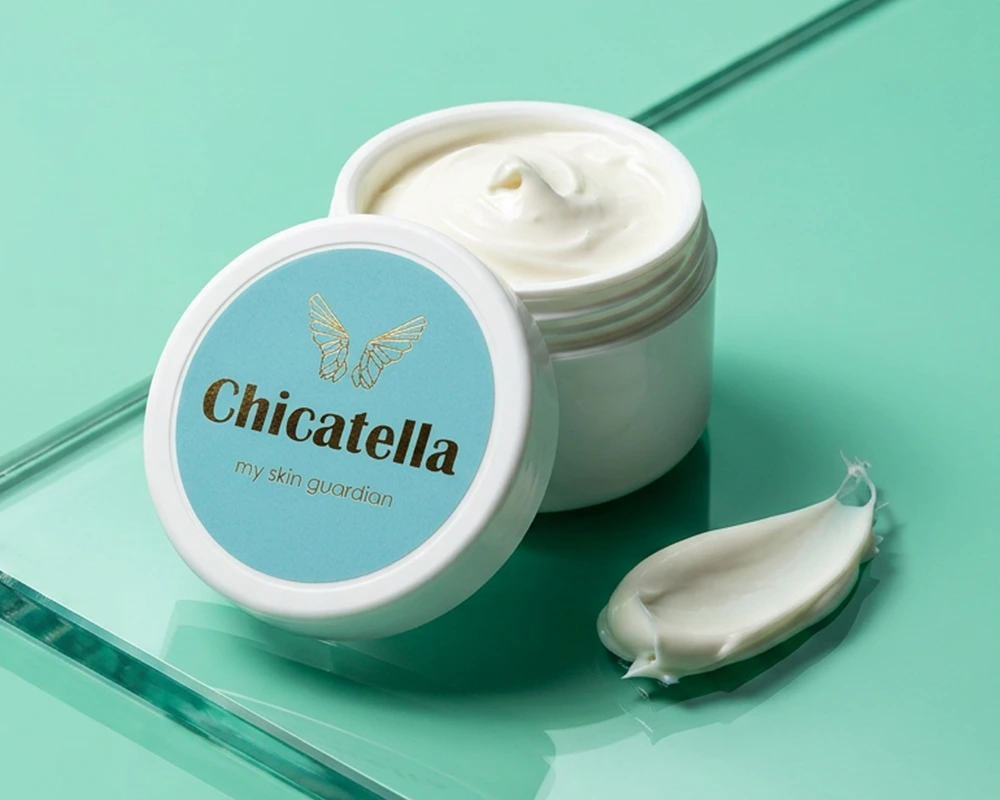
Chicatella SOS Ointment is thick and occlusive on purpose. That isn’t a flaw, it’s the whole point: on very dry, cracked skin, or skin irritated by outside factors, it forms a lasting protective layer. That’s why it can be really useful next to a nose rubbed raw by tissues and a runny nose, or around the mouth where drool, food, lip licking and cold irritate the skin.
When the problem is dry, irritated skin
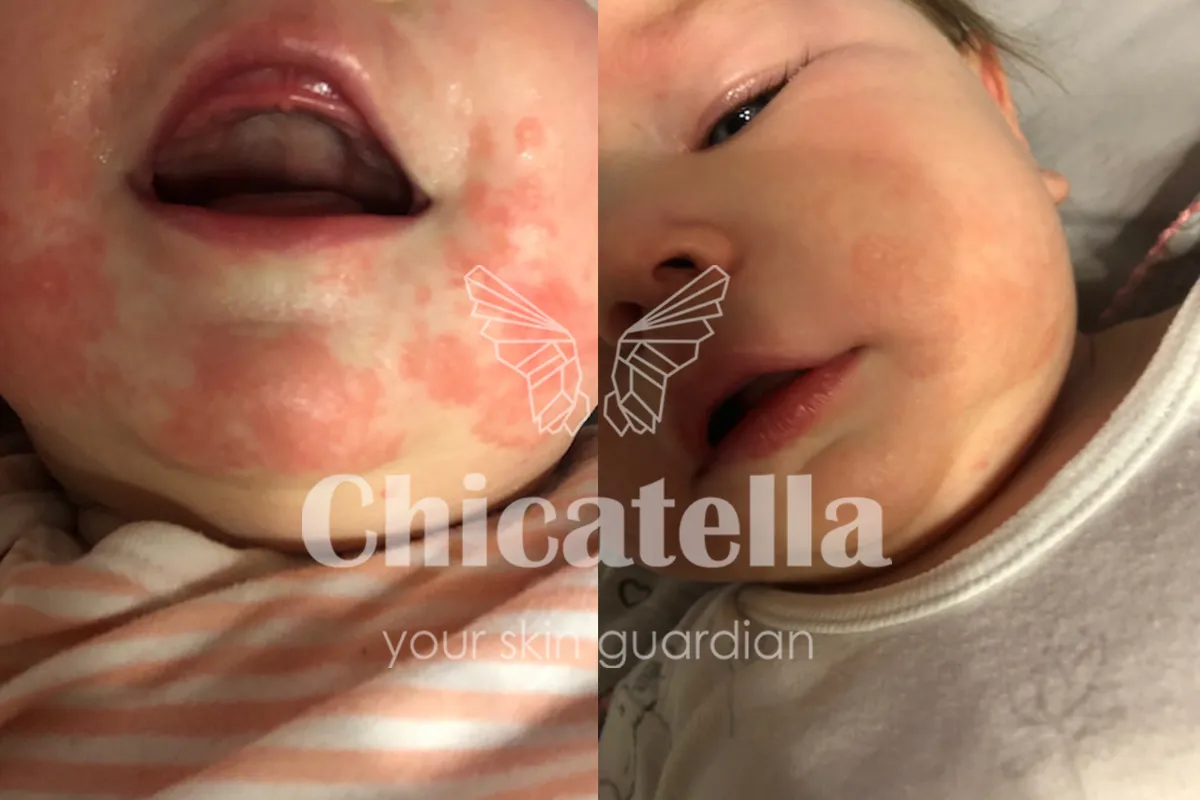
The photos below show individual customers’ experiences with cosmetic care for dry or irritated skin. Where a rash is located doesn’t confirm periorificial dermatitis on its own.
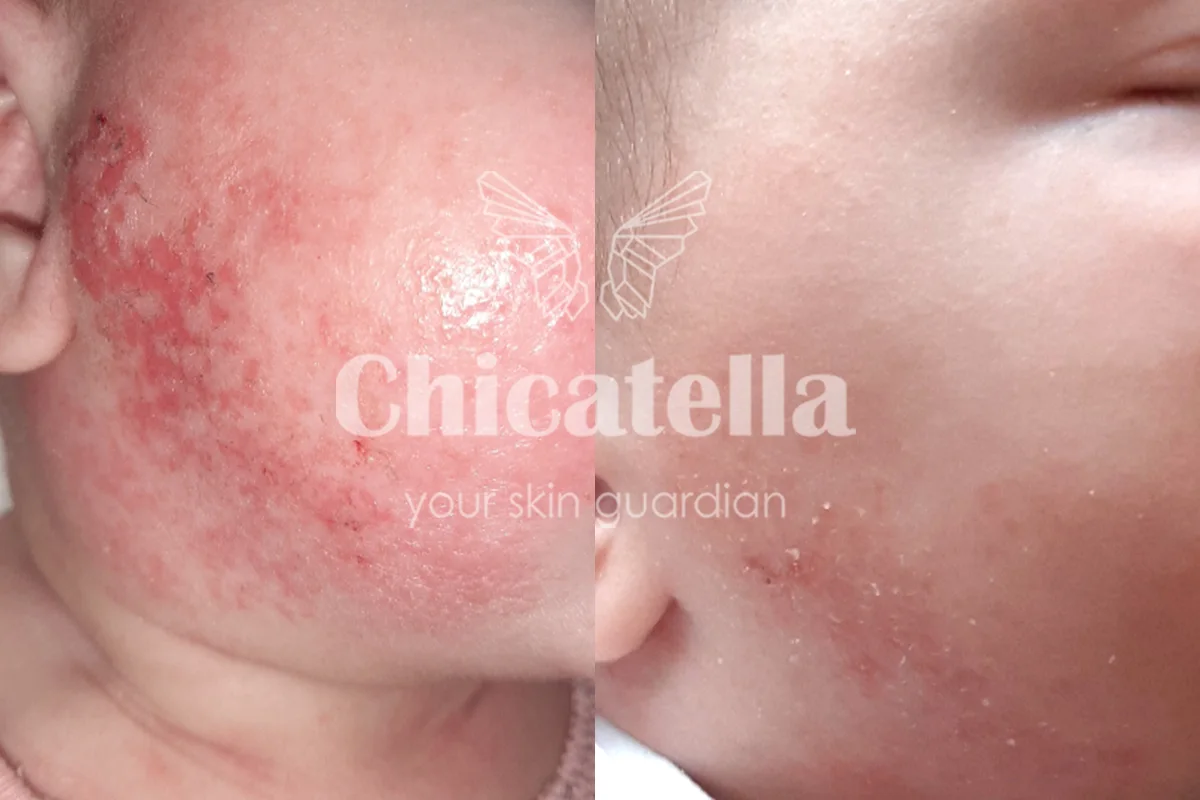
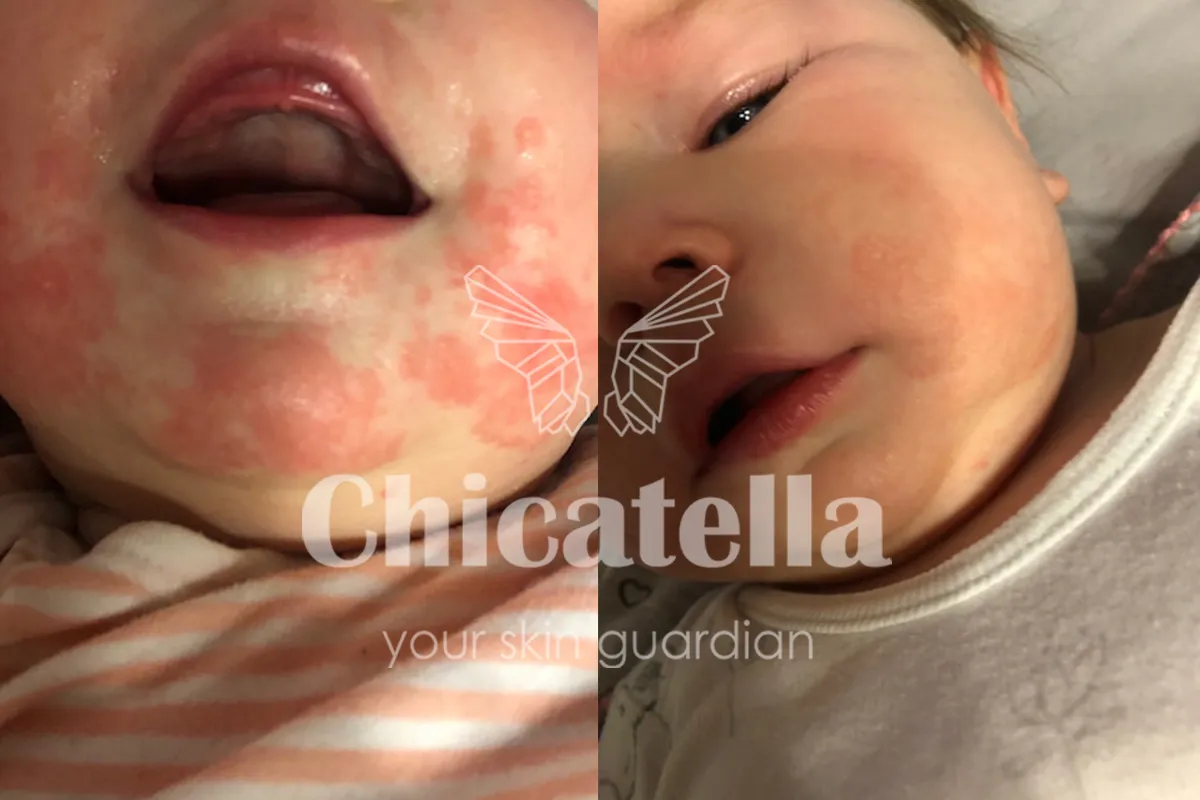
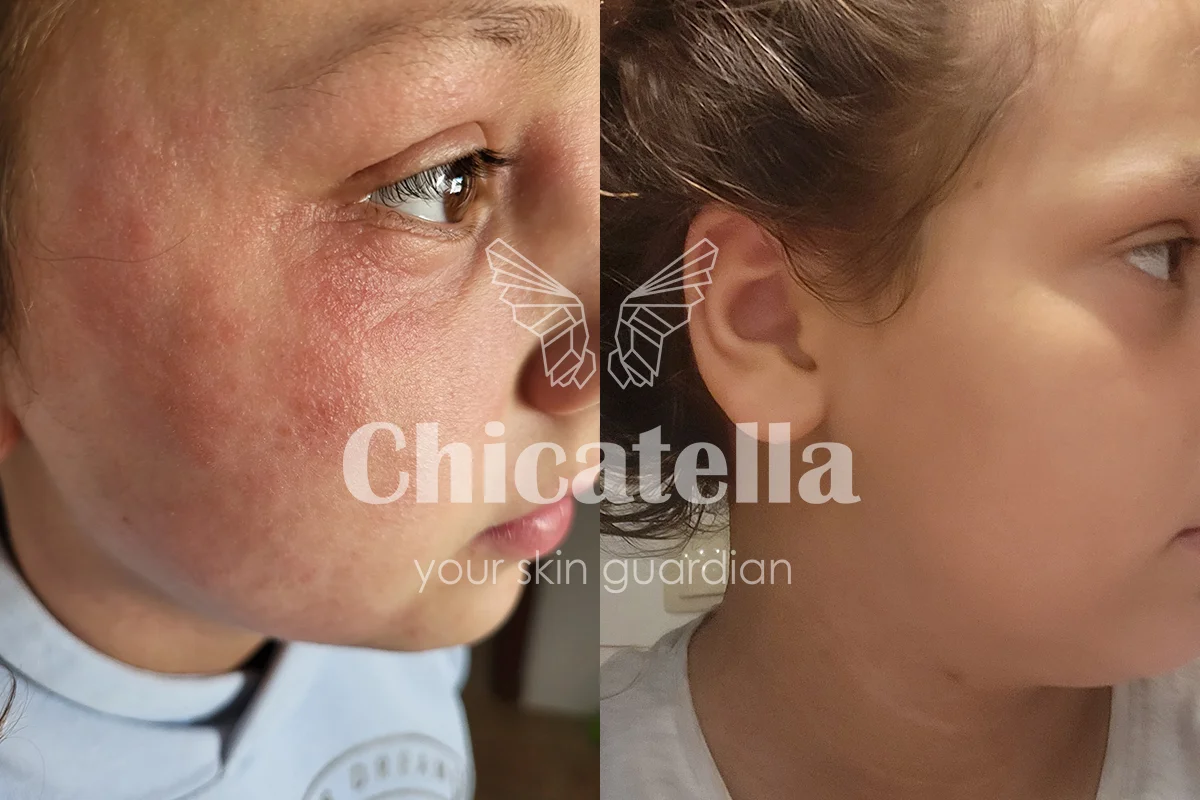
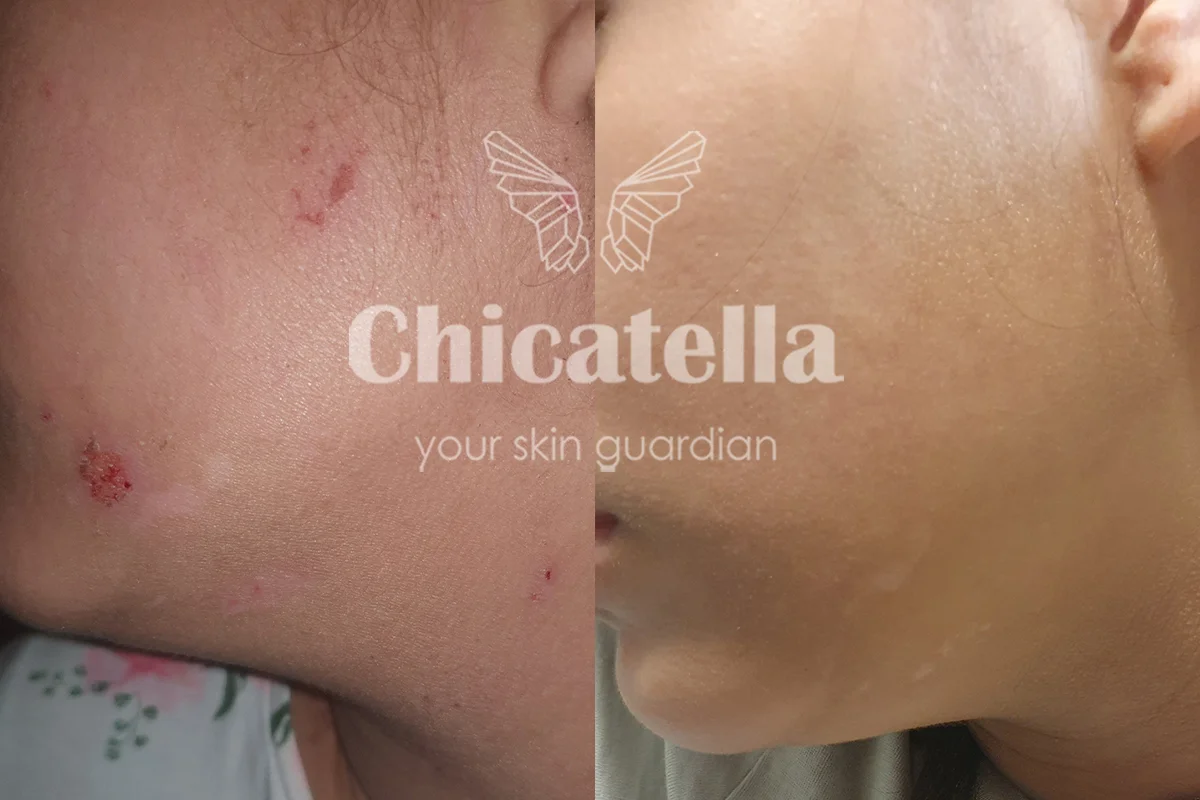
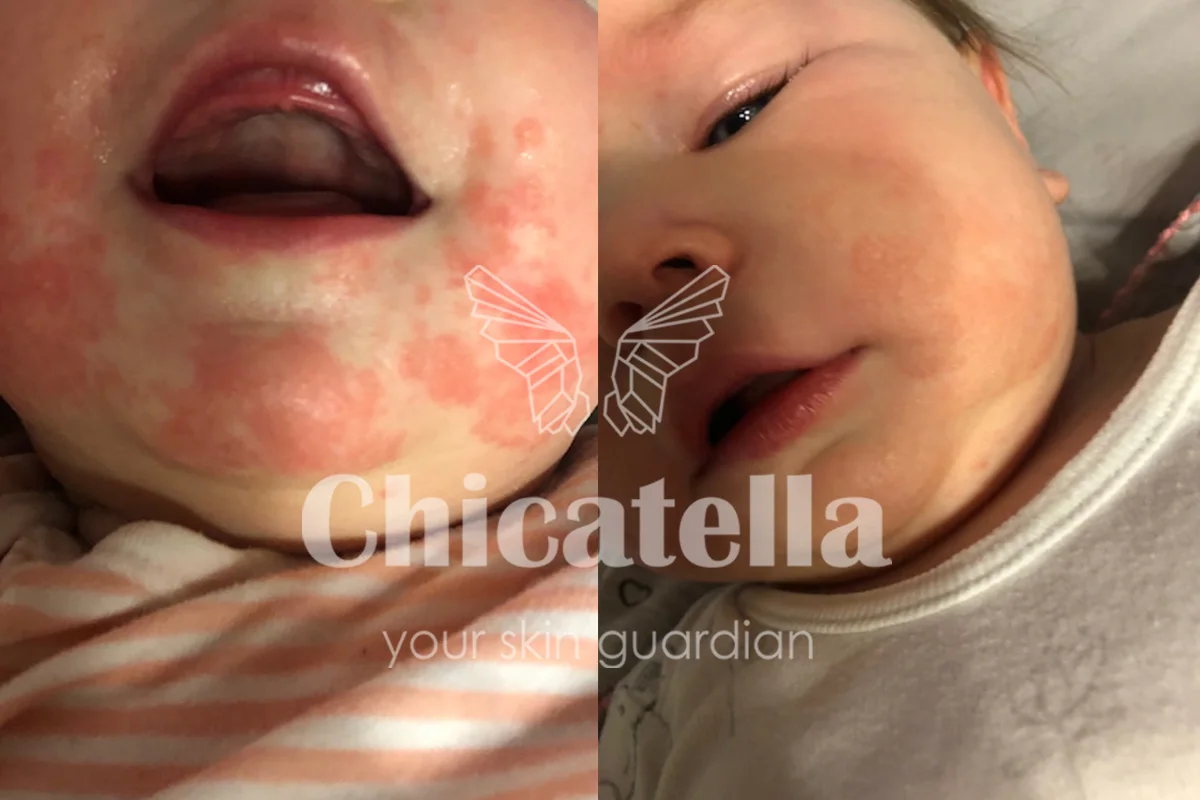
These photos show individual customers’ experiences after using Chicatella cosmetic products. They may show dry or irritated skin without a medically confirmed diagnosis. The improvement shown doesn’t mean the product treats perioral dermatitis or any other skin condition. Cosmetic skin care isn’t medicine, and results vary from person to person.
Correctly reading what your skin needs
Perioral dermatitis is a good example of why, in skin care, it isn’t enough to know where the problem is. Flat, cracked skin from drool, cold or tissues may need a lasting protective layer. Clusters of tiny papules around the mouth, nose or eyes can react to that same layer in a completely different way. So the best choice isn’t always more care or less care. It’s correctly reading what your skin needs.
Find the right care for your skin in three steps
No guesswork. Answer three quick questions and we’ll tell you what your skin needs.
Where to next
This content is for information only and doesn’t replace a doctor’s exam, diagnosis or treatment. Different skin conditions around the mouth can look alike but may need different care or treatment. Chicatella products are cosmetic skin care products, not medicines.
- 01Acevedo-Fontanez LA et al. Periorificial dermatitis: pathophysiology, diagnosis, and management. JAAD, 2026. ↗︎
- 02Park I et al. Periorificial dermatitis: an updated scoping review of therapeutic evidence. JAAD Reviews, 2026. ↗︎
- 03Gray NA et al. Pharmacological interventions for periorificial dermatitis – a systematic review. 2022. ↗︎
- 04Mochizuki A et al. Comparative analysis of the skin microbiota of rosacea, steroid-induced rosacea and perioral dermatitis. Exp Dermatol, 2025. ↗︎
- 05Neff H et al. Reassessing potential triggering factors and trends in periorificial dermatitis. SKIN, 2025. ↗︎
- 06Thang CJ et al. Incidence and prevalence of perioral dermatitis in the United States. JAAD, 2026. ↗︎
- 07Periorificial dermatitis. DermNet NZ. ↗︎
- 08Lip licker’s dermatitis. DermNet NZ. ↗︎
- 09Contact dermatitis and barrier care. DermNet NZ. ↗︎
- 10Contact reactions to lanolin. DermNet NZ. ↗︎
- 11Treatment of atopic dermatitis. American Academy of Pediatrics. ↗︎
- 12Perioral dermatitis. StatPearls (NCBI). ↗︎
- 13Perioral dermatitis. American Academy of Dermatology. ↗︎
- 14Perioral / periocular dermatitis. Primary Care Dermatology Society. ↗︎
- 15Perioral dermatitis (patient handout for children). Society for Pediatric Dermatology. ↗︎
- 16Periorificial dermatitis and how to tell it apart from lip licker’s dermatitis. Children’s Mercy, 2024. ↗︎