Nummular eczema: why skin forms itchy “coins,” and how to tell them apart from a fungal infection
Nummular eczema is named after a coin, but it often doesn’t start out as a perfect circle. It can begin as tiny bumps or blisters that merge into an itchy round patch. The tricky part: a fungal infection, psoriasis and a few other skin conditions can look very similar.
Two things worth knowing up front“It could be a fungal infection. The skin between the patches is often very dry.”
It’s also called nummular dermatitis or discoid eczema. If you’re curious about everything the broader term covers, read what “dermatitis” actually includes.

How we put this article together
Article summary
A type of eczema with very itchy round or oval patches.
It isn’t contagious and doesn’t spread from person to person.
It can start as tiny bumps or blisters that merge into a “coin”.
It can be wet and oozing or dry, rough and scaly.
A round shape alone can’t tell eczema apart from a fungal infection.
When the surface is dry, regular protective care matters. Active inflammation or an infection may need treatment.
The shape tells you where to look, not necessarily what the diagnosis is.
Seven things you can do today
Same pattern, very different looks
Seven ways to recognize it. The shape, the location, the edge and whether the patch is wet or dry tell you more than the color does. The sketches are simplified; only a doctor can diagnose it.
Short answers first
What is nummular eczema?
Is nummular eczema contagious?
How do I know if it’s eczema or a fungal infection?
Why are the patches round?
Is nummular eczema the same as atopic dermatitis?
Which ointment helps with dry nummular eczema?
Can nummular eczema ooze?
How long can it last?
Why does it come back in winter?
Can kids get it?
When should I see a dermatologist?
Does food cause nummular eczema?
The coin shape is the result of a process, not the starting shape
That’s why people often say a circle “just appeared out of nowhere.” In reality, it grew from something smaller.
The “coins” aren’t always perfectly round. Once several patches merge, you can barely make out the original shape, which is exactly why a round shape alone isn’t enough to tell you the cause.
Wet and dry nummular eczema don’t look the same
| Feature | Wetter, oozing stage | Dry stage |
|---|---|---|
| Surface | blisters, oozing, a sticky surface or crusts | rough, scaly, cracked |
| How it feels | intense itching, possibly burning | itching, tightness, dryness |
| Skin barrier | the surface is damaged and may be open | the surface is losing moisture and is less supple |
| Care | first a proper assessment and calming the inflammation | regular emollient or richer protective care |
Where it appears most often
Tap an area for a short explanation. Location is a clue, not a diagnostic test.
An important clue people often miss: the skin between the patches is often very dry. That’s why you care for the whole dry area, not just the circles. If you want to know why very dry skin needs a different texture, see our separate article.

It doesn’t always look red
The color of the inflammation depends on your natural skin tone. A patch can be:
Once it calms down, a darker or lighter mark can stay for months, especially on darker skin. Doctors call the darker version post-inflammatory hyperpigmentation. That doesn’t necessarily mean the eczema is still active.
The biggest trap: a fungal infection can look almost the same
Don’t just look at the circle. Look at the edge, the center and which way it’s spreading.
The whole surface can be inflamed, dry or oozing, not just the edge.
An active, scaly edge moves outward, while the center is often calmer.DermNet↗︎
| Clue | Nummular eczema: itchy “coins” or a fungus? | Fungal infection | Psoriasis | Contact dermatitis | Stasis dermatitis |
|---|---|---|---|---|---|
| Shape | round or oval, may be incomplete | often ring-shaped | sharply outlined areas | often follows the point of contact | mainly the lower legs |
| Edge | not necessarily more active than the center | often spreads outward | often thicker scales | may be irregular | often with swelling |
| Center | may be inflamed or start fading first | often calmer | usually similar to the rest of the patch | depends on the contact | spread-out inflammation |
| Skin elsewhere | often very dry | not necessarily dry | possible changes on the scalp, elbows, nails | depends on exposure | possible varicose veins and discoloration |
| What confirms the cause | an exam and more tests if needed | skin scraping for fungus | clinical exam | allergy patch test | checking the legs and circulation |
One feature alone isn’t enough for a diagnosis. If a round patch keeps spreading, won’t go away or doesn’t respond to everyday care, getting it checked is worth more than guessing.
For comparison, you can also look at how it compares with psoriasis and how to recognize contact dermatitis.
When medication hides what’s really going on
If an unrecognized fungal infection is treated with an anti-inflammatory cream, something misleading can happen: the itching and redness calm down for a while, the clear outer edge becomes less obvious, but the fungus keeps spreading. Doctors call this tinea incognito.Source↗︎
The right anti-inflammatory medication is very helpful for eczema. The problem starts when it’s used without a diagnosis on something that isn’t eczema at all.
Why nummular eczema happens in the first place
There’s no single confirmed cause. It’s more useful to think of three layers that work together.AAD↗︎
1 · A damaged skin barrier
When the skin’s surface holds on to water less well:
- →the skin turns dry and less supple;
- →tiny cracks let irritants in more easily;
- →itching leads to scratching;
- →scratching damages the barrier even more.
We explain the same mechanism in more detail in our article on the damaged skin barrier in atopic dermatitis.
2 · The inflammatory response
Nummular eczema isn’t just dry skin. The inflammatory response causes itching, redness or a change in color, swelling, blisters or scales.
Good care helps repair and protect the roof. Prescription anti-inflammatory treatment, when needed, puts out the fire underneath. Often both jobs matter.
3 · Triggers
What isn’t true: that stress, diet or a “bad microbiome” cause the condition on their own. They can be part of the picture, but they aren’t a proven cause.
What role the microbiome plays
Lots of microorganisms live naturally on healthy skin. So the goal isn’t “sterile skin.” But a damaged surface, oozing and scratching can change the environment on your skin.
A varied community. That’s normal.
A bacterium is present. That isn’t an infection yet.
Pain, warmth, swelling, pus or honey-colored crusts. You need to get it checked.
Gentle cleansing and protecting the barrier make sense. But cosmetics shouldn’t promise to “balance your microbiome” or treat an infection.
Why it can start after a single scratch
A small skin injury can trigger the first patch in someone who’s prone to it. Think of a scratch, a scrape, a bug bite or a small burn.
Is nummular eczema its own condition, or a relative of atopic dermatitis?
A 2023 study compared skin samples from people with nummular eczema, atopic dermatitis and psoriasis. In nummular eczema it found overlap with atopic dermatitis, but also some different inflammatory features. The authors suggested it could be a variant of atopic dermatitis with a mixed type 2 and type 3 immune signature.Böhner 2023↗︎
A similar look on the surface doesn’t mean the same thing is happening under the skin in everyone. That’s why researchers are still studying whether nummular eczema is one clearly separate condition or a pattern that can show up in different types of eczema.
This debate isn’t settled. The immune terms here are meant to help you understand the research, not to classify you or choose a treatment.
Who it affects most often
In 2022, researchers in Germany looked through health insurance records. Here’s what they found, in plain terms.Hagenström 2025↗︎
Uncommon, but not rare. In a town of 100,000 people, a few hundred have it.
Mostly middle-aged adults, slightly more often men.
So most people with nummular eczema don’t have atopic dermatitis.
For most people, it stays manageable with good care and targeted treatment.
These numbers come from Germany, not the US, and only count people who saw a doctor and got a recorded diagnosis. The real number is probably a bit higher.
What happens at the doctor’s office
The first two steps always happen. The other four only if something on your skin doesn’t fit the usual picture.
When it started, whether it itches, whether it’s spreading, what you’ve been putting on it and what your skin has been in contact with.
The edge, the center, the surface of the patch, and how dry the skin around it is.
A few scales from the surface show whether fungus is involved.
A cotton swab run over the patch shows whether bacteria have moved in.
Patches on your back look for a contact allergy over two days. It’s not a blood test and it doesn’t test for food.
Only if the patch is unusual or won’t calm down even with treatment.
A patch test looks for a contact allergy. It isn’t the same as a blood test or food testing.AAD↗︎
What usually helps
With a mild case, good cosmetic care is sometimes enough. But often it takes a mix of the jobs below.
Depending on the diagnosis and how strong the inflammation is, your doctor may prescribe a topical anti-inflammatory treatment.
Using a moisturizing cream or ointment regularly helps reduce dryness, tightness and water loss. On dry skin, richer creams and ointments often make more sense than very light lotions.AAD↗︎
An antibiotic only makes sense when a doctor recognizes a bacterial infection. Bacteria on the skin aren’t automatically a reason for antibiotics.
If the test shows a fungal infection, you need antifungal treatment, not an eczema routine.
With widespread eczema or eczema that keeps coming back, a dermatologist may consider light therapy or another systemic treatment.
A simple daily routine
- check whether the surface is dry or wet;
- apply suitable care to the dry areas;
- protect exposed areas before friction or cold.
- use lukewarm water;
- don’t rub your skin;
- gently pat it dry;
- apply your moisturizer while the skin is still slightly damp.
- care for the very dry areas again;
- keep your nails short;
- choose soft clothes that don’t rub.
When it’s a good idea to see a doctor
Points marked in red mean don’t put off seeing a doctor. With the yellow ones, a checkup makes sense, but it isn’t urgent.
Soft skin without that tight feeling, from the very first use
Light creams disappear from a dry “coin” within a minute. Chicatella stays on your skin, locks in moisture and softens rough patches, day after day.
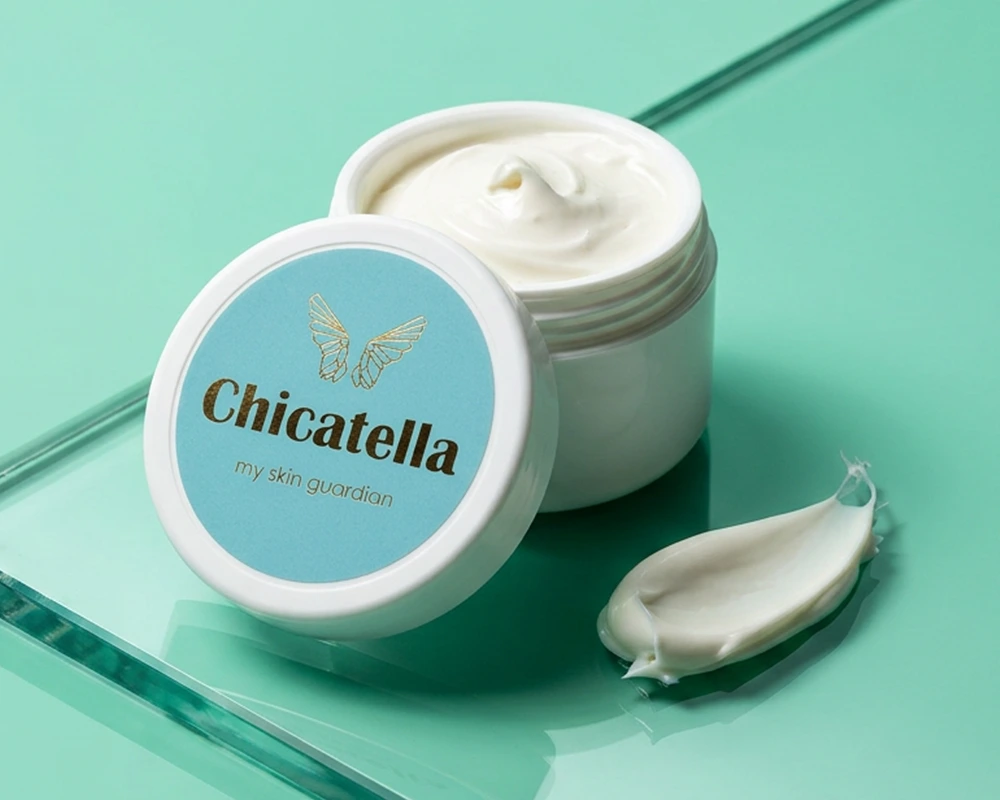
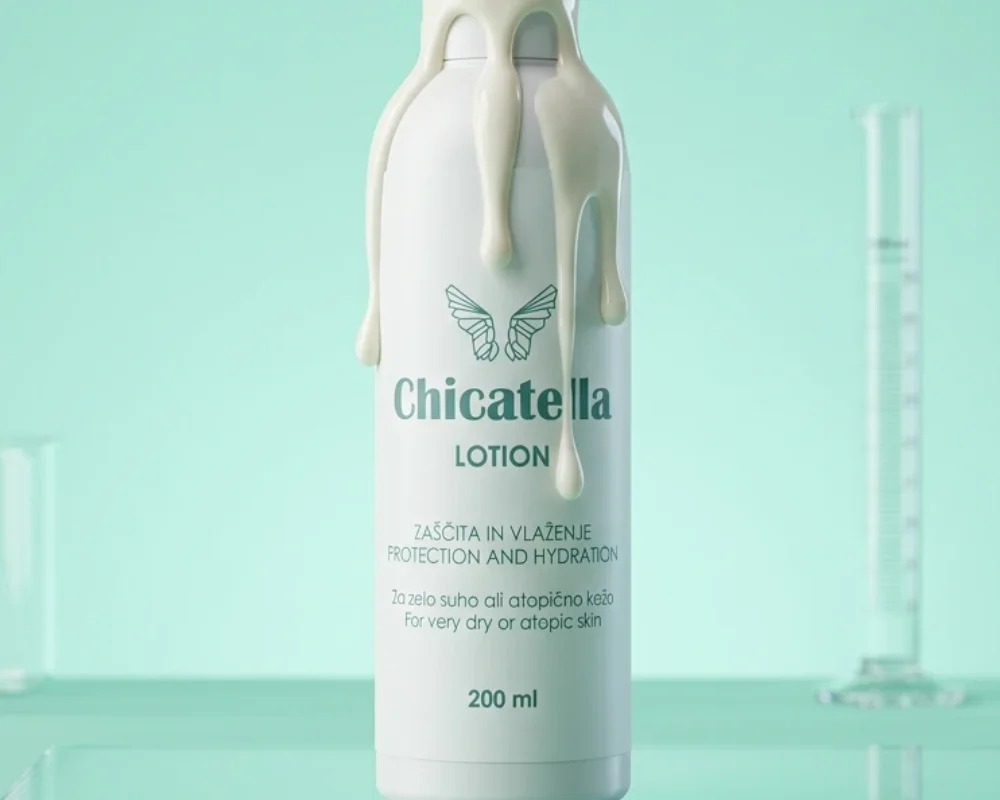
Chicatella is cosmetic care for dry, irritated skin. Active inflammation or an infection should be handled by a doctor.
When supportive care helps dry, irritated skin with round patches
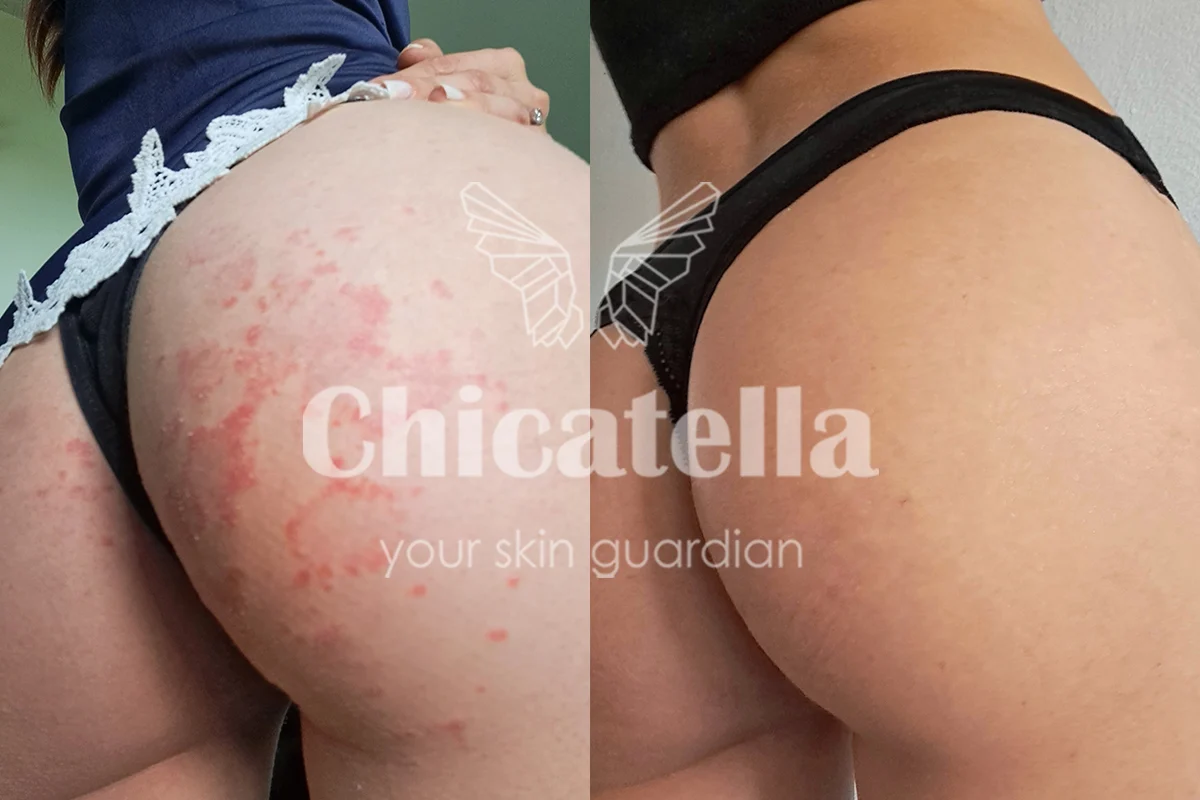
The same skin before and after care. Customer photos, shared with permission.
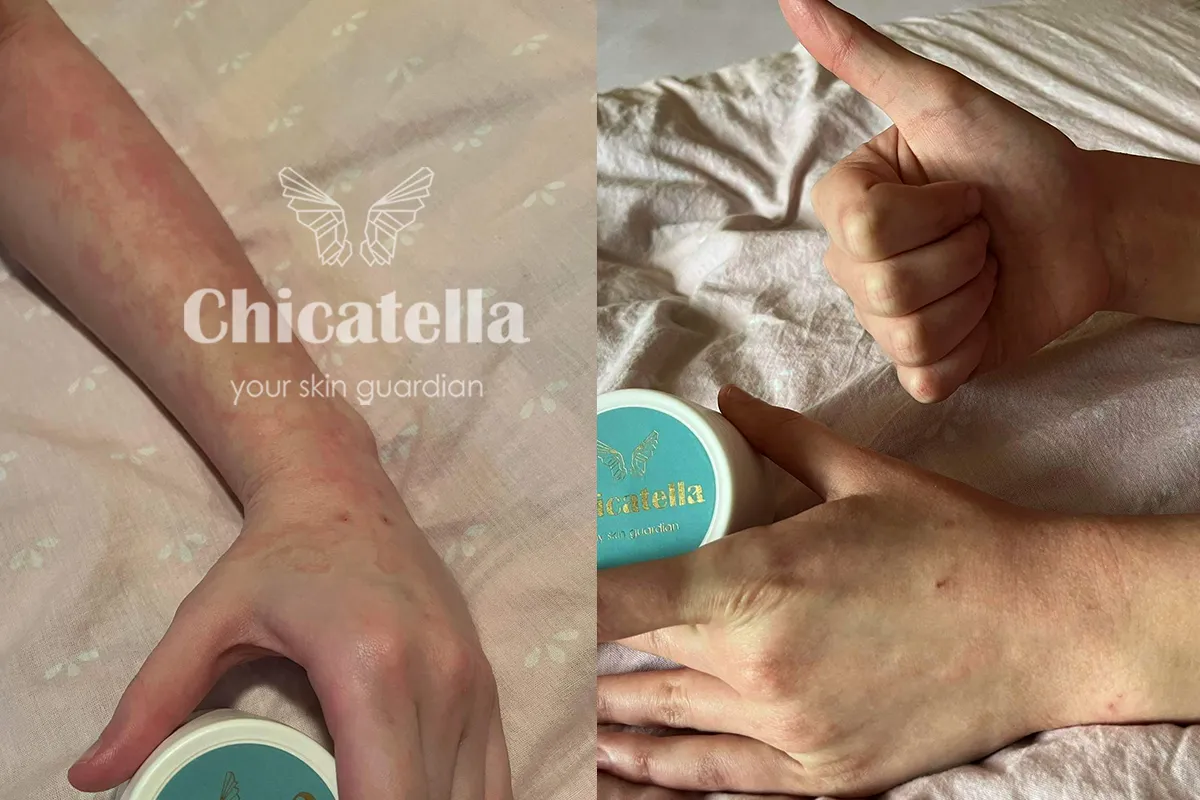
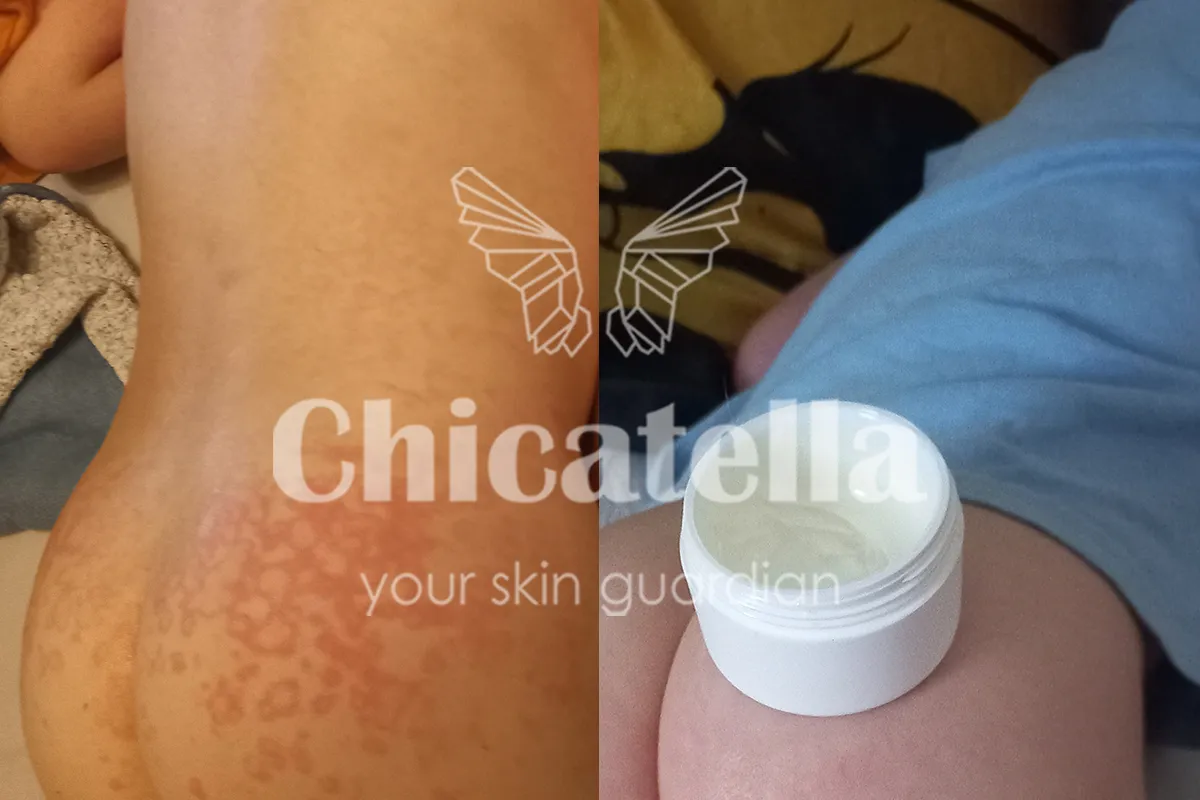
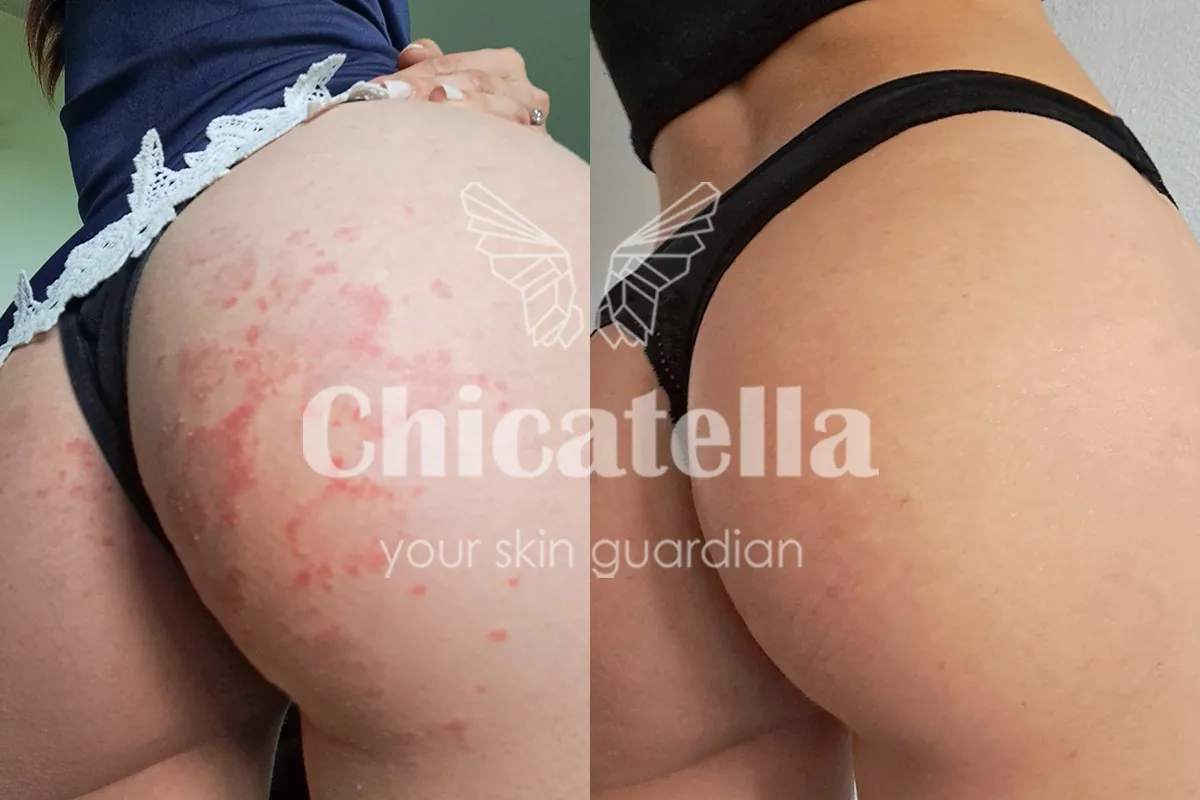
These photos show individual experiences with cosmetic care for very dry or irritated skin. Chicatella isn’t a medicine for nummular eczema, the photos don’t confirm a diagnosis, and results vary from person to person.
First understand what your skin needs
A round patch on your skin is a clue, not a diagnosis. If it’s dry and rough, regular protective care helps it most. If it spreads at the edge, oozes, hurts or won’t go away, have a doctor take a look. Once you know whether your skin needs gentler washing, more moisture or richer protection, choosing your care is simple.
Related articles
Find the right care for your skin in three steps
No guesswork. Answer three quick questions and we’ll tell you what your skin needs.
This article helps you understand nummular eczema and conditions that can look similar, but it can’t diagnose you or replace a checkup. You can’t reliably tell the cause from a photo. Chicatella products are cosmetic skin care products, not medicines.
- 01Skin and sexually transmitted diseases (PDF, in Slovenian). Slovenian Association of Dermatovenereologists. ↗︎
- 02Nummular eczema: Overview. American Academy of Dermatology. ↗︎
- 03Signs and symptoms. AAD. ↗︎
- 04Causes. AAD. ↗︎
- 05Diagnosis and treatment. AAD. ↗︎
- 06Self-care. AAD. ↗︎
- 07Discoid eczema. DermNet. ↗︎
- 08Discoid eczema. NHS. ↗︎
- 09Nummular Dermatitis. StatPearls. ↗︎
- 10Nummular eczema: An updated review. Leung et al. ↗︎
- 11Nummular eczema and the TH2/TH17 immune response, 2023. Böhner et al. ↗︎
- 12Epidemiology of nummular eczema, 2025. Hagenström et al. ↗︎
- 13Apremilast phase IIb trial, 2025. Böhner et al. ↗︎
- 14Lebrikizumab in adults with nummular eczema. ClinicalTrials.gov. ↗︎
- 15Tinea corporis. DermNet. ↗︎
- 16Tinea incognito: Challenges in diagnosis and management. ↗︎