Stasis dermatitis: the rash that starts in your veins
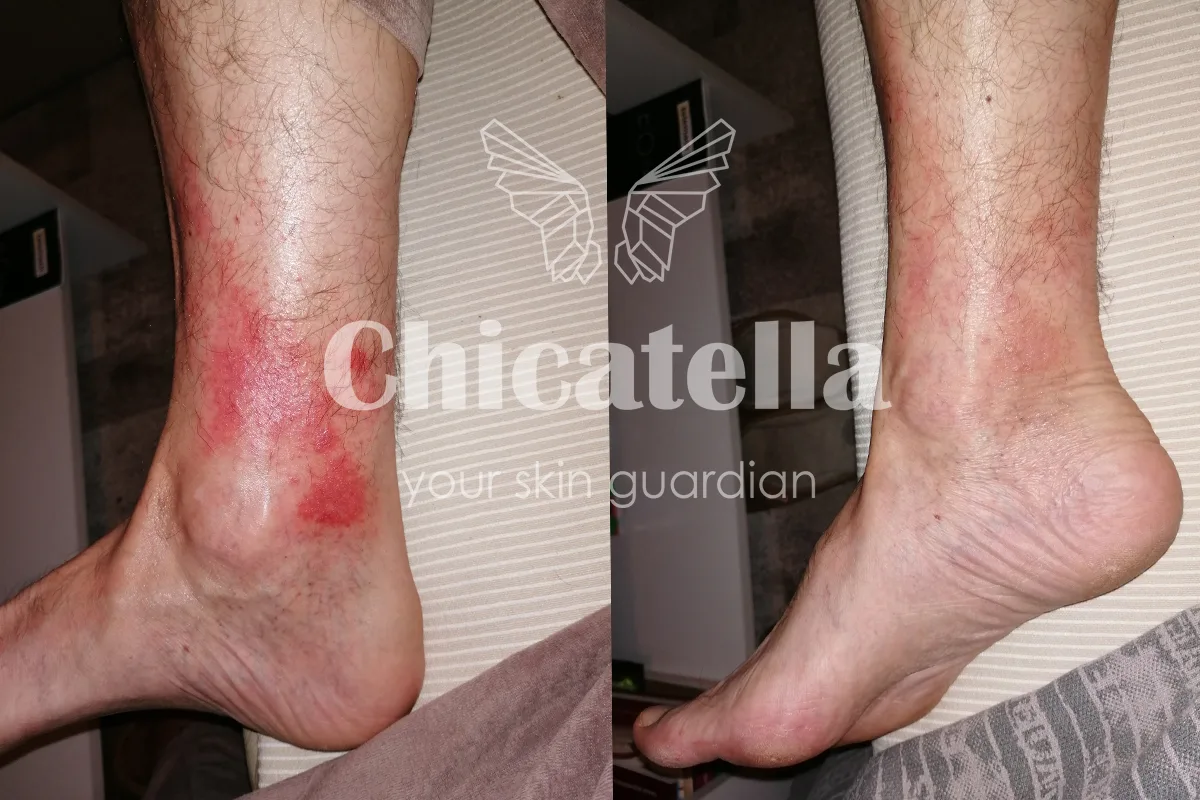
In the morning, your ankle looks almost normal. By evening, your sock leaves a deep line in it. Over time, the skin starts to itch, darkens and turns dry or inflamed. With stasis dermatitis, the rash often isn’t the first problem. It’s the visible trace of pressure that has been building up in the veins of your legs for a long time.
It happens because blood and fluid don’t flow back up the veins well enough, so they pool in the lower leg. That’s why it starts around the ankle, where the pressure is highest. And that’s why putting something on your skin won’t fix the vein problem behind it. Still, good skin care is an important part of managing it, because the skin there is dry, sensitive and easily hurt.

How we put this article together
Four things worth knowing
Around the ankles and on the lower shins.
Because of poor blood flow back through the veins, blood and fluid pool in the legs.
Red blood cells leak into the surrounding tissue, and their pigment can stay in the skin for a long time.
Care for the pressure in your veins and, at the same time, daily protection for dry skin.
If one leg suddenly becomes much more swollen, hot or painful, that’s not something to figure out online.
What the skin around your ankle shows over time
Seven cards: how the changes begin, why the skin darkens, what happens underneath and what really helps. Swelling, dryness and a brown band around the ankle are three signs worth knowing. The drawings are simplified; a doctor makes the diagnosis.
Quick questions before you read on
Is stasis dermatitis contagious?
Can it show up on just one leg?
Is a brown patch just a bruise?
Can a cream fix the cause?
Can I just start wearing strong compression stockings on my own?
Is stasis dermatitis the same as a bacterial skin infection?
Can the brown color go away completely?
Don’t start with the rash. Start with the clock.
With vein problems, swelling follows the clock. There’s little in the morning, it grows during the day and peaks in the evening. If your ankle does the same, that’s an important clue.
After a night lying down, blood has drained out of the leg. Swelling is at its lowest, and the skin isn’t tight.
When I don’t move, my calf muscles don’t help. Blood and fluid slowly collect low in the leg.
The swelling is obvious. Shoes feel tighter, the skin feels tight and may start to itch.
The peak of the day. The sock line is deep and takes longer to fade.
Now gravity is working for me: blood drains back toward the heart and the ankle partly settles. In the morning, the cycle starts again.
Simplified diagram. Early on, the swelling disappears overnight. As the problem progresses, it no longer goes away completely by morning.
This pattern is a clue, not a diagnosis. Legs can also swell because of the heart, kidneys, medications, the lymph system or a blood clot. That’s why a doctor should find the cause.
Blood has to travel from your leg back up. Two things help it get there.
Your heart pushes blood down into your leg, but on the way back it has to fight gravity. That’s why your leg has a pump (your calf muscles) and little doors (the valves in your veins) so blood doesn’t flow back down.
Your calf muscles are resting, so blood gets no push upward. It collects low, around the ankle. This is the position that’s hardest on your ankle.
With every step, your calf muscle squeezes and pushes blood upward. The valves close behind it like one-way doors so it can’t flow back. That’s why walking helps.
If the valves don’t close tightly, blood flows back down after every step. Pressure stays low in the leg for months and years. Over time, that constant pressure damages the tiny blood vessels and the skin around the ankle.Source↗︎
In plain words: whatever helps the pump and the doors helps your skin. Walking, raising your legs and compression stockings do exactly that. A cream can’t, but it can take care of the skin that the pressure keeps drying out.
Valves aren’t the only possible cause. The same thing can happen after a deep vein thrombosis, with a blocked vein, a stiff ankle or weak calf muscles.
A brown patch isn’t dirt, and it isn’t necessarily a bruise
The color comes from inside. It forms from iron left in the skin when red blood cells break down. Here’s how it happens, in five steps.
Long-term pressure in the veins carries over to the smallest blood vessels in the skin around the ankle.
The vessel wall gives way. Red blood cells and fluid pass into the surrounding tissue.
Outside the vessel, blood cells don’t survive. They break down, but their iron stays behind.
Iron-containing pigment (hemosiderin) settles in the skin. From the outside, we see it as a brown band.
Immune cells carry the pigment away, but very slowly. That’s why the color lasts a long time, even after the skin calms down.
Simplified diagram of the process, not a picture of blood.
- The color doesn’t fade as quickly as dryness or itching.
- The skin can calm down while the pigment stays for a long time.
- An ointment doesn’t repair vein valves and doesn’t erase pigment that sits deep in the skin.
Consistent care keeps the surface of your skin softer, less dry and better protected. Less dryness means less itching, less scratching and less chance of the skin breaking open.
“Poor circulation” goes two ways. They’re not the same.
Blood travels down to the foot through the arteries and up back to the heart through the veins. Stasis dermatitis is a problem with the road up. The signs are different, so it’s worth telling them apart.
- •the ankle swells, more in the evening
- •the leg feels heavy and warm
- •the skin around the ankle turns brown
- •better when I raise my leg
- •the foot is cold, pale or bluish
- •it hurts when walking or at night
- •small sores on the toes heal poorly
- •worse when I raise my leg
Why this matters: with a vein problem, compression stockings help a lot. But if the arteries are also weak, strong compression can do harm. That’s why, before prescribing it, a doctor does a simple test comparing blood pressure at the ankle and the arm (ABPI).ESVS↗︎
A person can have both problems at once. This diagram doesn’t make a diagnosis.

Five messages your skin sends over time
Swelling in the evening, a heavy, tight feeling. Often the first sign, and one people put down to being tired or to hot weather.
The skin barrier becomes drier and more vulnerable. This is the first point where regular care really pays off. More on that in our article on dry skin.
Pigmentation from blood products passing into the tissue. This color is the slowest to fade.
Long-term inflammation can change the tissue under the skin, so the lower leg becomes hard, painful and sometimes shaped like an upside-down bottle. The medical term is lipodermatosclerosis.Source↗︎
A venous ulcer is no longer a job for everyday cosmetic care. It needs professional wound care and treatment of the veins.Slovenian Ministry of Health↗︎
For the curious: a simplified CEAP scale
This scale helps doctors describe the condition. It’s not an online test for grading yourself. The medical term for the white, scar-like patches is atrophie blanche.
A red leg isn’t always an infection
A red, warm, swollen shin looks a lot like a bacterial skin infection. But often it isn’t one.
people diagnosed with a “skin infection of the leg” got a different diagnosis when they were checked again.
Review of 9 studies with 1,600 people. Results varied a lot between studies.Nightingale 2023↗︎
More than half of these “infections” were stasis dermatitis or swelling caused by lymph not draining well.
Why this matters: antibiotics don’t help dermatitis, but skin care and compression do. And the other way around: a real infection must not be missed.
One leg, suddenly, hot, painful or with a fever: see a doctor right away. This table isn’t a calculator; if in doubt, get checked. More about reactions to products in our article on contact dermatitis.
When you need help fast
A doctor doesn’t just look at the rash. They look at the whole leg.
- Is the swelling from my veins, my lymph system or another condition?
- Do I need a vein ultrasound?
- Is compression right for me, and what kind?
- How should I care for my skin under compression?
- What should I do if oozing or a wound appears?
Treat only the skin, and the pressure stays. Treat only the veins, and the skin stays vulnerable.
No single key opens both. A cream doesn’t lower the pressure in your veins. Compression doesn’t nourish dry skin. You need both.
- properly fitted compression;
- walking and moving your ankle;
- breaking up long stretches of sitting or standing;
- raising your legs;
- support with body weight, without judgment;
- a vein checkup;
- if needed, procedures such as closing a faulty vein, sclerotherapy or other vascular treatments.
- gentle washing;
- lukewarm water instead of very hot;
- a suitable skin care product every day;
- reducing moisture loss;
- protecting the skin from scratching and bumps;
- treating badly inflamed skin with a medication your doctor prescribes, if needed;
- professional care if the skin is broken or oozing.
A stocking that squeezes your ankle does what a cream can’t
A compression stocking presses on your leg from the outside and helps blood flow back up. What do the 2025 medical guidelines say about it?
Here the evidence is clear. Wounds heal much better with compression.
Compression is still recommended, but there’s less evidence for each individual symptom. It helps many people, but there’s no guarantee.
Source: SCAI 2025 guidelines and a review of studies on venous wounds. These results apply to compression, not to cosmetic products.SCAI 2025↗︎PubMed↗︎
lightly
tightest
What you can do today, without turning your life into a medical project
- take a quick look at both legs;
- check for a new small wound, unusual swelling or a change in color;
- put on prescribed compression when the swelling is lowest;
- if you use a skin care product in the morning, let it absorb well before putting on the stocking, and follow the stocking’s instructions.
- don’t stay completely still for hours;
- take a few steps often;
- move your ankle up and down;
- rise up onto your toes now and then, if you can do it safely;
- when sitting, don’t tuck your legs tightly under the chair;
- protect your shins from bumps.
- take off compression as instructed;
- wash your skin gently with lukewarm water;
- don’t rub it with a towel;
- apply suitable care to dry, unbroken skin;
- give very dry spots extra protection with a richer ointment;
- raise your legs comfortably for a while.
We deliberately don’t give a universal number of repetitions or time for raising your legs. The examples above are general examples; anyone with a more serious heart or vascular condition should plan this with their doctor.
Soft, comfortable shins, even under compression stockings
Your veins are a job for your doctor. But dry, tight skin around your ankle is something you can start caring for tonight. Chicatella locks moisture into the skin, so it’s less flaky and more comfortable.
Related articles
Good to know about contact dermatitis: a damaged skin barrier and trying lots of different topical products raise the chance of an extra contact allergy. That’s no reason to fear skin care. It’s a reason to stick with a product your skin tolerates well instead of trying a new one every week.
Find the right care for your skin in three steps
No guesswork. Answer three quick questions and we’ll tell you what your skin needs.
This article helps you understand stasis dermatitis and the difference between vein and artery problems, but it can’t diagnose anything or replace a checkup. Chicatella products are cosmetic skin care products, not medicines.
- 01SCAI Clinical Practice Guidelines for the Management of Chronic Venous Disease, 2025. ↗︎
- 02SCAI guideline. PubMed. ↗︎
- 03SCAI Technical Review on Management of Chronic Venous Disease, 2025. ↗︎
- 04European Society for Vascular Surgery 2022 Clinical Practice Guidelines. ↗︎
- 05Stasis Dermatitis: Clinical Presentation, Pathogenesis, and Management, 2023. ↗︎
- 06Narrative Review of the Pathogenesis of Stasis Dermatitis, 2023. ↗︎
- 07The Role of Emollients in Managing Stasis Eczema, 2026. ↗︎
- 08Misdiagnosis of Uncomplicated Cellulitis: Systematic Review and Meta-analysis, 2023. ↗︎
- 09Lipodermatosclerosis: From Pathophysiology to Treatment, 2025. ↗︎
- 10Venous eczema. British Association of Dermatologists. ↗︎
- 11Varicose eczema. NHS. ↗︎
- 12Stasis dermatitis: diagnosis and treatment. American Academy of Dermatology. ↗︎
- 13Standard procedures for acute and chronic wound care (PDF, in Slovenian). Ministry of Health of the Republic of Slovenia. ↗︎