Ichthyosis: when your skin’s renewal rhythm doesn’t work the way it should
What you see on the skin is scales. But very different stories can hide underneath: missing building blocks of the skin barrier, fats that don’t get laid down properly, cells that don’t shed on time, or skin that renews itself on the wrong rhythm.
That’s why ichthyosis isn’t one disease, and why the same care isn’t the answer for everyone.
Three things worth knowing up front“It’s not contagious. It’s not about hygiene. The age it starts is key.”
This article helps you understand what’s going on under the scales. It doesn’t diagnose anything. If you’re looking for general care for very dry skin, see dry skin.
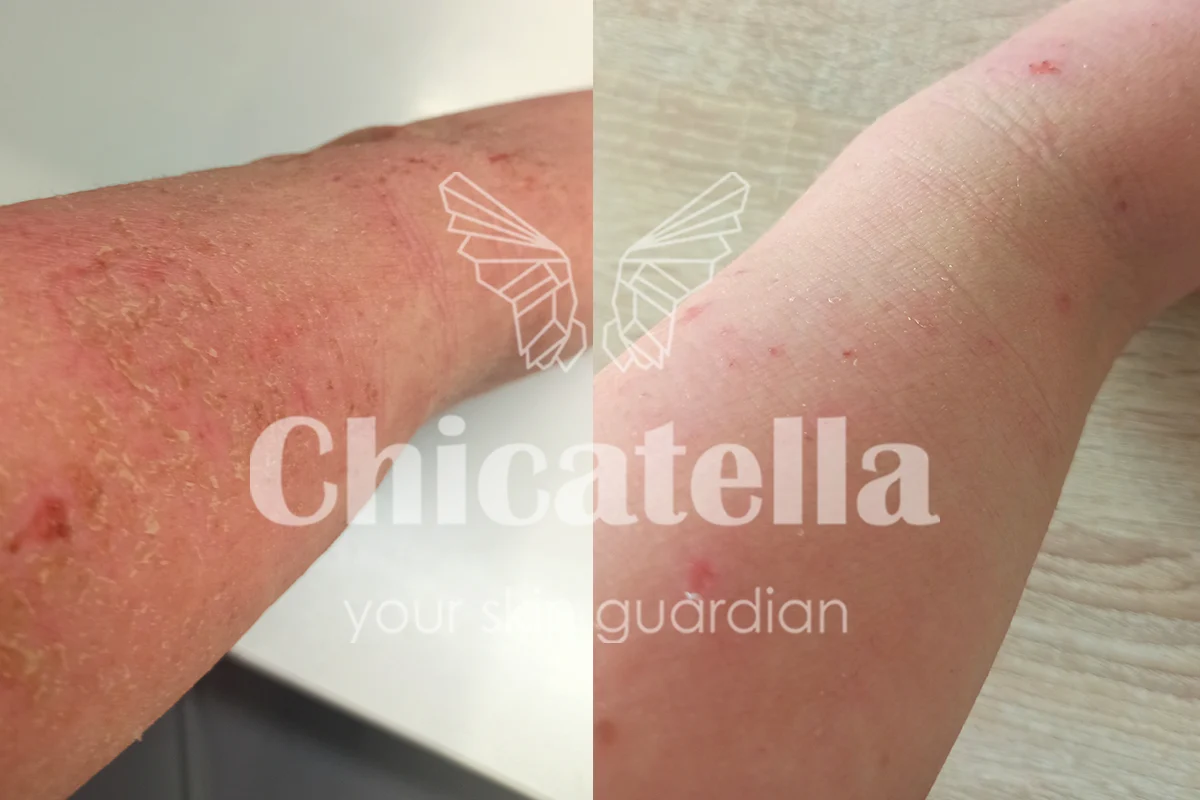

How we wrote this article
Article summary
Ichthyosis is an umbrella term for more than 30 different skin conditions, not one single diagnosis.NIAMS↗︎
The most common form is ichthyosis vulgaris; estimates range from about 1 in 100 to 1 in 250 people.NCBI↗︎
It’s not contagious and it has nothing to do with poor hygiene.
Some forms are present at birth, but the most common one usually shows up only in the first years of life.
If similar flaking appears for the first time in adulthood, it makes sense to see a doctor.
Everyday care does three different jobs: it softens scales, adds moisture to the skin and slows down how fast that moisture evaporates.
The patterns skin draws
Eight cards: what it looks like, where it shows up, what comes with it and when it’s worse. A net-like pattern of scales on the shins, deep lines on the palms and a flare in winter are three signs worth knowing. The sketches are simplified; only a doctor can diagnose it.
Quick answers first
What is ichthyosis?
Is ichthyosis contagious?
How is it different from very dry skin?
Is ichthyosis always inherited?
Can it appear for the first time in adulthood?
Can ichthyosis be cured?
What kind of cream or ointment makes sense for ichthyosis?
Scales are the result. The cause sits one step earlier.
Your skin has its own production line: cells are made, they mature, fill up with structural proteins, fats get laid down between them, and finally they shed at the right time. In different types of ichthyosis, things can get stuck at different stations.
new skin cells form in the deeper layers and start moving up toward the surface.
cells may be made faster than the surface can get rid of them.
a buildup of cells and a thickened outer layer of skin.
on its way up, the cell matures and gets ready for its protective role.
maturing is incomplete, so the cells can’t do their job.
a fragile surface that peels off in larger sheets.
the cell fills up with structural proteins that make it sturdy and help it hold water.
proteins like filaggrin are present in smaller amounts or are built differently.
dry, tight skin with fine scales and strongly marked lines on the palms.
skin fats spread out between the cells and act as both mortar and a seal against water loss.
making or moving these fats is disrupted, so the seal isn’t tight.
more water escaping through the skin, cracks and sensitivity.
at the surface, cells separate at the right time and shed without you noticing.
the bonds between cells don’t break down on time, so they stay stuck together.
visible scales that build up, even though cell production may not be sped up at all.
In the most common form, things get stuck at station 3 (less filaggrin). Rarer forms have a problem somewhere else.
So the result isn’t just scales. It’s also more water escaping through the skin (doctors call it transepidermal water loss), tightness, cracks, itching and sometimes redness.Nature↗︎
The most important clue isn’t the color of the scales, it’s their “birthday”
When the scales first showed up tells a doctor more than their color. Each stage of life points to a different group.
A tight, see-through membrane or very widespread changes at birth need specialist care. The newborn needs close monitoring of body temperature, fluids, feeding, eyes and skin.
The X-linked form often shows up in boys in the first months, with larger, sometimes darker scales on the neck, trunk and legs. The most common form also often starts showing in this period.
Ichthyosis vulgaris often isn’t visible at birth and usually develops in the first months or years. It often comes with strongly marked palm lines, keratosis pilaris and overlap with atopic dermatitis.
Brand-new, widespread flaking in adulthood raises the question of acquired ichthyosis. That doesn’t automatically mean a serious illness, but it’s a good reason to see a doctor.
This timeline is for information only and isn’t an online diagnostic test.Guidelines↗︎
Same word, very different skin stories
| Group | When it often shows up | Typical pattern | What matters most |
|---|---|---|---|
| Ichthyosis vulgaris (FLG-nEDD) | first months or early childhood | fine, light or grayish scales, often on the shins and outer sides of the limbs; creases may be less affected | strongly marked palm lines, keratosis pilaris, often overlaps with atopic dermatitis |
| X-linked ichthyosis (STS-sEDD) | usually in boys, in the first months | larger, sometimes darker scales on the neck, trunk and legs | how it’s inherited and possible signs outside the skin |
| Rare congenital forms | at birth or right after | widespread flaking, redness, a tight membrane, thicker plates or fragile skin | eyes, ears, feeding, growth, body temperature and genetic testingGeneReviews↗︎ |
| Acquired ichthyosis | new in adulthood | widespread flaking with no typical childhood history | a review of medications and a search for an underlying cause |
The look guides the exam, but it can’t pin down the type on its own. That’s why, with ichthyosis, talking about when it started and your family history matters more than comparing photos.

Why the word “ichthyosis” is no longer precise enough
The mechanism matters more than the old name.
- →The term comes from an old comparison between these scales and fish scales.
- →Modern medicine is increasingly moving away from naming people’s conditions by how they look.
- →In 2025, an international group proposed grouping them under the broader term epidermal differentiation disorders (EDD).BJD 2025↗︎
- →The new classification names each disorder after the affected gene and the job that gene does.
- →The nonsyndromic EDD category describes 53 genetically distinct disorders. That’s not the same as saying there are exactly 53 types of classic ichthyosis.
- →We still use the word “ichthyosis” because it’s what people know and search for.
Filaggrin: a small protein with a big impact
Filaggrin is a protein that lines up and packs together the cells at the skin’s surface, and its breakdown products hold water in the skin. In the most common form of ichthyosis, there isn’t enough of it.
Skin isn’t just a wrapper. It’s also a cooling system.
More severe forms can affect sweating and cooling down, closing the eyelids and keeping the eyes moist, scale buildup in the ear canal, how easily fingers and joints move, hair and nails, and in more severe congenital forms also feeding, growth and energy use. Not every type of ichthyosis comes with these complications.
A biopsy often isn’t the main detective
when the changes first appeared
which areas are affected and which aren’t
whether anyone else in the family has had similar changes
whether there are signs outside the skin
a physical exam
genetic testing if needed
selected additional tests
For many congenital forms, a standard microscope exam of the skin is not specific enough. A genetic result, on the other hand, can confirm the subtype, help assess related problems, allow more precise genetic counseling and keep different diseases with the same scales from being handled the same way.Source↗︎
One changed copy of the gene can be enough.
Two changed copies are needed, one from each parent.
The change is on the X chromosome, so boys are affected more often.
The diagrams show a general example. The real risk depends on the confirmed gene and is assessed by a genetic counselor.
When scales show up for the first time in adulthood, the question changes
- →Acquired ichthyosis develops later in life and isn’t caused by an inherited change in the same way the congenital forms are.
- →It can be linked to medications or another health condition.
- →New flaking doesn’t automatically mean a serious illness.
- →Still, it’s worth getting checked, especially if the flaking is new, widespread, getting worse quickly or comes with other symptoms.
- →Treating the underlying cause can improve the skin too.NCBI↗︎
Skin care and medical treatment aren’t the same thing, but both matter
Softening scales, adding moisture and slowing evaporation. This stays at the center of care.
For thicker scales, marked inflammation or more severe forms, a dermatologist may prescribe keratolytics, retinoids or selected targeted medications.
Eyes, ears, overheating and other related problems need their own care.
Three jobs of a good routine: soften → moisturize → seal
Soften the scales first so they come off more easily. A short lukewarm bath and gentle rubbing, or ingredients that loosen scales (like urea or lactic acid). No scraping.
Then give water back to your skin. Put on a moisturizer right after bathing, while your skin is still slightly damp. Humectants draw in water, emollients fill in the rough gaps.
Finally, lock the water in. An occlusive layer (an ointment with petrolatum or lanolin) slows evaporation. It does the most over slightly damp skin or over a moisturizer.
Why the order matters: an occlusive holds in the water that’s already in your skin. On completely dry skin it doesn’t add much new water, but it’s very good at keeping what you added in steps 1 and 2.
- a lukewarm bath or shower, as your skin tolerates it;
- with thicker scales, a longer soak can help;
- remove scales only gently, once they’re softened;
- no dry rubbing, scratching or removing them until it hurts.
- apply right after bathing, while your skin is still a little damp;
- for large areas, pick a texture you can apply quickly and regularly;
- humectants draw in and bind water;
- emollients fill in rough gaps and help skin feel more supple.
- an occlusive layer slows water loss;
- it works best over slightly damp skin or a moisturizer;
- it makes the most sense on the shins, arms, elbows, knees, heels and dry cracks;
- people who don’t sweat well often find a lighter texture more comfortable on large areas.
What new microbiome research actually tells us
- →A study of 22 adults with congenital ichthyosis and 16 healthy people found a different mix of bacteria and fungi on the skin of different subtypes.2022↗︎
- →A study published in 2026 shows that the microbiome is shaped by the gene, the level of water loss, skin moisture, scales, age and the care used, all together.2026↗︎
- →So with ichthyosis, the microbiome shouldn’t be presented as a single cause.
- →Right now there’s no cosmetic test or probiotic product that can identify the subtype of ichthyosis or remove its genetic cause.
- →Sensible skin barrier care, though, changes the environment these microorganisms live in.
A routine that survives real life
- a lighter lotion or cream on large areas;
- extra protection for the driest spots;
- clothes that don’t rub.
- gentle washing or soaking;
- gently removing scales that have already softened;
- moisturizing care;
- an occlusive ointment on target spots.
- apply more often;
- a richer final layer;
- protect your arms and shins from dry air.
- lighter care on large areas;
- ointment only where you need it;
- a cooling plan;
- enough fluids and breaks.
A 2025 study of adults found that people often mention time-consuming care, pain, itching, overheating, extra housework and the feeling that others judge them for how their skin looks. So ichthyosis isn’t only about scales.BJD 2025↗︎
Soft skin that doesn’t feel tight: soften, moisturize, seal
We can’t change a gene. But every day, you can help your skin hold on to the water it has. Three steps, three textures: easy to spread where there’s the most skin, rich where it cracks the most.
Related reading
Find the right care for your skin in three steps
No guesswork. Answer three quick questions and we’ll tell you what your skin needs.
This article helps you understand the mechanisms behind ichthyosis and how to care for it, but it can’t diagnose it or identify the subtype. See a doctor for changes at birth, problems with overheating, eyes or hearing, painful cracks, signs of infection, growth problems or new widespread flaking in adulthood. Chicatella products are cosmetic skin care, not medicines.
- 01Management of congenital ichthyoses: guidelines of care, Part one — 2024 update. BJD. ↗︎
- 02Management of congenital ichthyoses: guidelines of care, Part two — 2024 update. ↗︎
- 03Ichthyosis. NIAMS. ↗︎
- 04Ichthyoses. Nature Reviews Disease Primers. ↗︎
- 05Nonsyndromic epidermal differentiation disorders: new 2025 classification. BJD. ↗︎
- 06Autosomal Recessive Congenital Ichthyosis. GeneReviews. ↗︎
- 07Hereditary and Acquired Ichthyosis Vulgaris. NCBI. ↗︎
- 08A Practical Approach to the Diagnosis and Management of Inherited Ichthyoses. ↗︎
- 09Distinct skin microbiome community structures in congenital ichthyosis. ↗︎
- 10Genotype-Environment-Driven Dysbiosis in the Skin Microbiome of Ichthyosis. ↗︎
- 11The perceived quality of life in adult patients with inherited ichthyosis. BJD. ↗︎
- 12ASCEND Phase III trial. ClinicalTrials.gov. ↗︎
- 13Official ASCEND trial update. LEO Pharma. ↗︎
- 14Patient-friendly European guidance for congenital ichthyosis (PDF). ERN Skin. ↗︎