Atopic dermatitis in babies: when skin itches, nobody sleeps
Your baby can’t tell you “I’m itchy.” Instead, they may rub their cheeks, sleep restlessly and cry. This guide helps you tell dry skin, active inflammation and possible signs of infection apart, because each one needs a different response.
Two things worth knowing up front“Food usually isn’t the direct cause. Skin care and medical treatment have different jobs.”
If you’re not sure yet whether it’s atopic dermatitis or something else, start with baby eczema and rashes. For older kids, see atopic dermatitis in children.

How we put this article together
Article summary
Atopic dermatitis (the most common type of eczema) is a very itchy, recurring inflammatory skin condition that often starts in the first year of life.
In babies, it often affects the cheeks, scalp, trunk and the outer sides of the arms and legs.
Dryness and inflammation can show up together, but they’re not the same problem: skin care supports the surface, medication calms the inflammation.
A short, lukewarm bath followed by skin care right away usually makes more sense than avoiding every bath.
Food allergy and eczema can go hand in hand, but food rarely directly causes long-lasting eczema.
Yellowish crusts, pus-filled bumps, fast spreading, pain, fever or clusters of similar blisters need a doctor to take a look.
First figure out whether the skin is dry, inflamed or possibly infected. Only then choose what to put on it.
10 steps you can take now
Where it shows up and what it looks like
Eight patterns parents see most often in the first year. Where it is, how the surface feels and whether your baby is itchy tell you more than color alone. The drawings are simplified; your pediatrician confirms whether it’s really atopic dermatitis.
Short answers first
What does atopic dermatitis look like in babies?
At what age can it start?
Is atopic dermatitis contagious?
Do I have to bathe my baby every day?
Is a cream, lotion or ointment better?
Are steroid creams dangerous?
Is atopic dermatitis caused by a milk allergy?
Should a breastfeeding mom cut out certain foods?
What helps the skin around the mouth when drool is the problem?
When should a pediatrician see my baby?
Three factors that work together
It holds on to water less well, so the skin dries out faster and reacts more easily to irritants.
It overreacts, even when there’s no real reason to. That drives inflammation and itching.
Their balance shifts. That’s not the same as an infection. More in the section on the microbiome.
Atopic dermatitis isn’t only the result of a damaged protective layer, and it can’t be explained by a single gene change. Filaggrin, a protein that helps build this layer, is one possible factor, but it doesn’t explain every baby’s eczema.
Why is the itch often a bigger problem than the rash itself?
In pediatric research, disrupted sleep is reported in about two out of three children with atopic dermatitis. That figure isn’t specific to babies.AAP↗︎ And not every bad night is because of the skin.
Where does it most often show up in babies?
Tap an area for a short explanation. These are common patterns, not rules without exceptions.
Where it shows up changes as your child grows, and later it more often moves into the skin folds. The diaper area is often calmer in classic atopic dermatitis because it’s a more humid environment, but that’s not a diagnostic test. A baby can have atopic dermatitis and a completely separate diaper rash at the same time.
What does inflammation look like on different skin tones?
- →On lighter skin, it may look pink or red.
- →On darker skin, it may look purple, grayish or darker brown.
- →What may stand out more are tiny raised bumps, dryness and changes in pigment.
- →No bright red color doesn’t mean there’s no inflammation.
- →Once it calms down, a lighter or darker mark may stay behind. That doesn’t necessarily mean the inflammation is still active.

Dry, inflamed or possibly infected?
These states can overlap: skin can be dry and inflamed at the same time. This chart isn’t a diagnostic tool. It just helps you decide whether the next step is skin care, a doctor’s plan or a checkup.
What else can look like atopic dermatitis?
| Condition | Useful clue |
|---|---|
| Seborrheic dermatitis or cradle cap | Often greasier, yellowish flakes on the scalp, usually less itchy. |
| Irritation from drool | Mostly around the mouth, on the chin and cheeks, where the skin keeps getting wet and drying out. |
| Contact dermatitis | The flare is limited to where the skin touched a product or material. |
| Diaper rash | Mostly under the diaper, linked to moisture, urine, stool or rubbing. More in our article on baby eczema and rashes. |
| Scabies | Intense itching, possible changes on the palms and soles, and other family members itching too. |
| Psoriasis | More sharply outlined patches, thicker scales; in babies, the diaper area can be affected too. |
| Bacterial infection | Crusts, pus, pain, oozing or fast spreading. |
Related reading: atopic dermatitis, eczema, eczema in children and dry skin.
A simple 24-hour routine
If drool or food irritates the skin around the mouth, a suitable protective product on the outer skin can cut down on direct contact with moisture. Only use a product whose age range and directions allow it.
Gently pat the skin with a soft, damp washcloth, then pat it dry. Don’t rub, and don’t use scented wipes.
Reapply a well-tolerated skin care product to dry areas as needed. Don’t let your baby overheat: sweating makes itching worse.
A short, lukewarm bath, gentle cleansing of only the areas that need it, and no sponges or scrubbing.
Use prescribed medication as your doctor directed. Apply skin care to the rest of the dry skin, or follow your doctor’s plan. Don’t mix products together in your palm unless you’ve been told to.
Make sure your baby isn’t too warm, trim sharp nails and choose soft clothes without scratchy seams.
This routine isn’t a strict rule. A plan you can stick to beats a perfect plan your family can’t keep up. If you manage two of the six above, that’s still progress.
Water isn’t the enemy, but how you bathe matters
The evidence on the ideal frequency isn’t complete. Current pediatric advice often supports short baths every day or every other day, but not every baby has to be bathed every single day. Adjust the routine to how the skin responds and to your doctor’s plan.AAD↗︎
Lotion, cream or ointment?
| Texture | Advantage | Best for | Limitation |
|---|---|---|---|
| Lotion | Light and spreads quickly | Larger areas, if the skin is only moderately dry | May not protect enough when skin is very dry |
| Cream | More oils and easy to use every day | Dry skin over larger areas | Preservatives or other ingredients can sting for some |
| Ointment | Very good at slowing water loss | Small, very dry and cracked areas | Can be too heavy for hot, damp or oozing skin |
“Natural” doesn’t automatically mean less irritating. Fragrances, essential oils and some plant extracts can be contact allergens, even if they come from plants.
Atopic dermatitis, or mostly drool?
Drool, leftover food, a pacifier and constant wiping create a cycle that slowly wears the skin down.
drool, milk, pacifier: the skin is always damp
the moisture evaporates and takes some of the skin’s own moisture with it
wipes, wiping, your baby rubbing their chin
a red half-moon under the lip that comes back with every meal
The layer goes only on the outer skin, never inside the mouth or nostrils or on mucous membranes.
- dry;
- rough;
- irritated by drool;
- not oozing;
- free of pus-filled bumps and yellow crusts.
- badly inflamed;
- affected over a large area;
- wet or oozing;
- infected;
- painful;
- not getting better despite gentle care.
Atopic dermatitis can show up in this area, but not every rash around the mouth is atopic dermatitis. More on telling them apart in our article on perioral dermatitis.
Triggers aren’t the same as the cause
Picture a bucket. Every factor adds a little water. When the bucket overflows, the skin flares, which is why there’s rarely just one “culprit.”
You didn’t cause this with one wrong bath or the wrong cream.
Your pet or your laundry detergent isn’t automatically to blame.
Remove likely irritants one at a time, or you won’t know what helped.
Without evidence, don’t overhaul your whole home and your family’s diet.
The link isn’t that simple
Kids with atopic dermatitis have a higher risk of food allergy. The AAP cites estimates of up to about 40%, but the risk varies a lot depending on how severe the eczema is and on the population.AAAAI↗︎
Even so, food rarely directly causes long-lasting atopic dermatitis.
The skin condition and food allergy often show up together. That’s not the same as saying food caused every flare.
A test shows antibodies, or sensitivity. The medical term is “sensitization.”
Real symptoms appear when the food is eaten.
From an AAP clinical report: more than half of kids with atopic dermatitis may have raised antibodies to certain foods without having a true food allergy. That’s why broad testing without a clear history of reactions can give misleading positive results.
Why isn’t an elimination diet a harmless experiment?
That’s why we don’t advise breastfeeding moms to cut out milk, eggs, gluten or other food groups just because of eczema.EAACI↗︎
When these keep happening after eating:
- hives;
- swelling of the lips or face;
- repeated vomiting;
- coughing, wheezing or trouble breathing;
- sudden, unusual sleepiness or not responding.
Trouble breathing, a swollen tongue or throat, collapse or a severe reaction need emergency help. Call 911 (112 in Europe).EU 112↗︎
The goal is preventing allergy, not treating eczema
In higher-risk babies, the LEAP study showed about an 81% relative reduction in the risk of peanut allergy by age five.LEAP↗︎NIH↗︎ But that doesn’t mean peanuts treat atopic dermatitis.
Don’t rub food on the skin as a home allergy test. It’s not a way to diagnose anything.
With severe eczema, a known egg allergy or a previous reaction, the plan should be led by a pediatrician or allergist.
The atopic march isn’t destiny
The term describes how food allergies, asthma or hay fever can later join atopic dermatitis. People often picture it as a staircase, but in reality it’s more like a path that branches.
Microorganisms on the skin and Staphylococcus aureus (staph)
A diverse community. That’s normal; the goal isn’t sterile skin.
Less diversity, and often more S. aureus during flares. Still not an infection.
Crusts, pus, pain, fever. Now a doctor is needed.
Routine antibiotics or antiseptics on eczema that isn’t infected aren’t the answer. Likewise, a probiotic or a cosmetic with an unproven claim about “balancing the microbiome” shouldn’t be presented as a treatment.
How to spot an infection
If you suspect eczema herpeticum, your baby needs to see a doctor the same day. If your baby seems very sick, has trouble breathing or isn’t responding normally, call 911.NICE↗︎
Skin care can’t replace them
A “steroid-free” product isn’t a better substitute for prescribed treatment. They’re two different kinds of products with different jobs.
Other options when the basics aren’t enough
Another option for sensitive areas like the face and skin folds.
On areas that flare often, following your doctor’s plan.
For selected older children, not for babies.
For severe atopic dermatitis that other treatments can’t control.
Age limits for individual medications differ between products and countries. For example: in the European Union, dupilumab is also approved for severe atopic dermatitis in children from six months of age who are candidates for systemic treatment.EMA↗︎Study↗︎ This isn’t a recommendation or treatment advice, just a note that modern specialist options exist even for very severe cases.
Be careful with wet wraps and various solutions
- →Wet wraps can increase hydration, but also how much medication passes through the skin.
- →In babies, there’s an added risk of getting chilled and the medication acting too strongly.
- →They’re used only with clear instructions from a doctor.
- →Dilute bleach baths are used in babies rarely, and only in special cases.
That’s why we deliberately don’t publish recipes, amounts or instructions for making these yourself. These methods belong in your doctor’s plan, not on a website.
When to see the pediatrician
If you’re not sure which box your baby fits in, pick the more urgent one. Asking is never overreacting.
Three problems, three solutions
Wash without drying, lock in moisture after the bath, protect the most cracked spots.
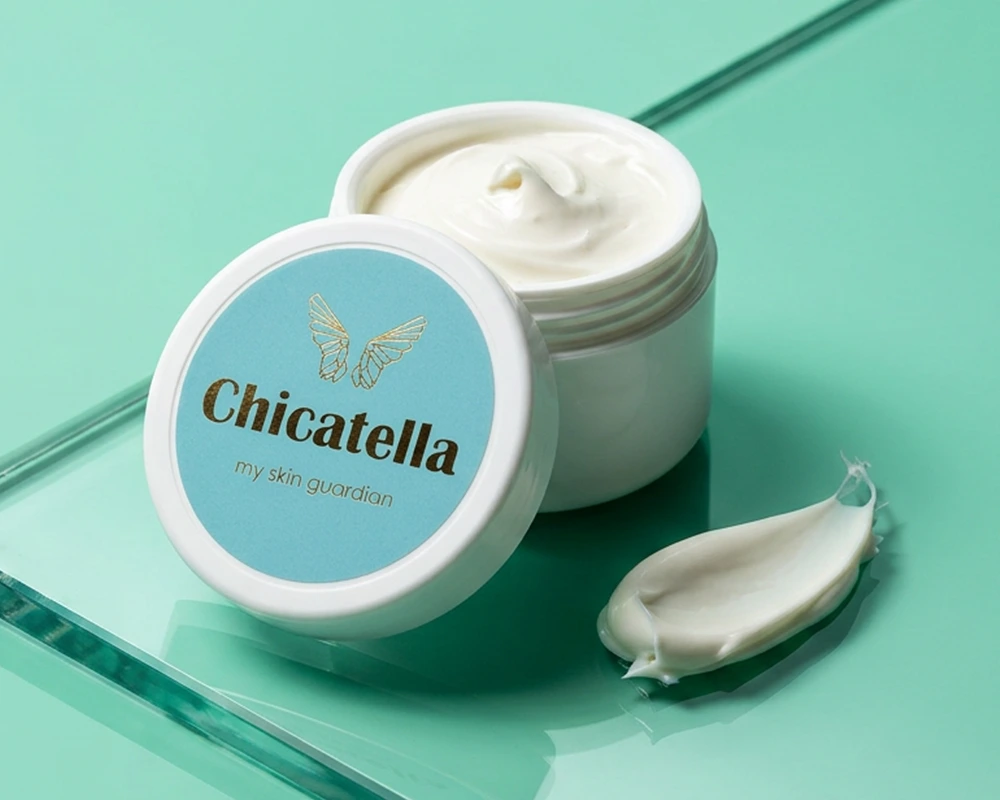
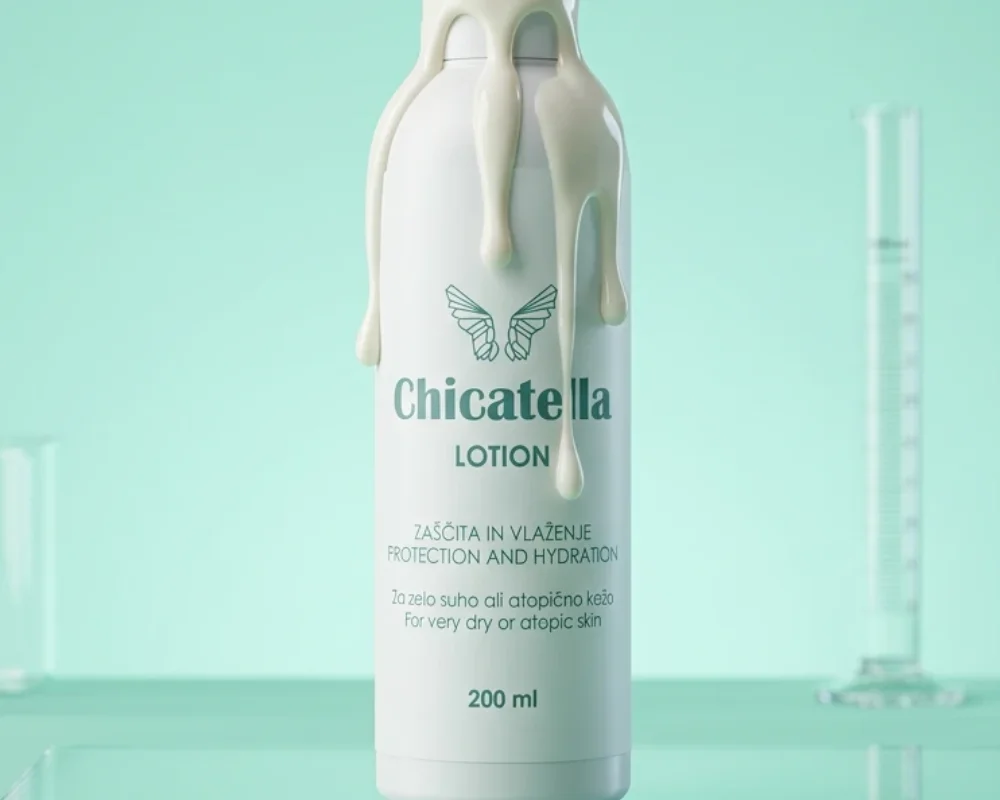
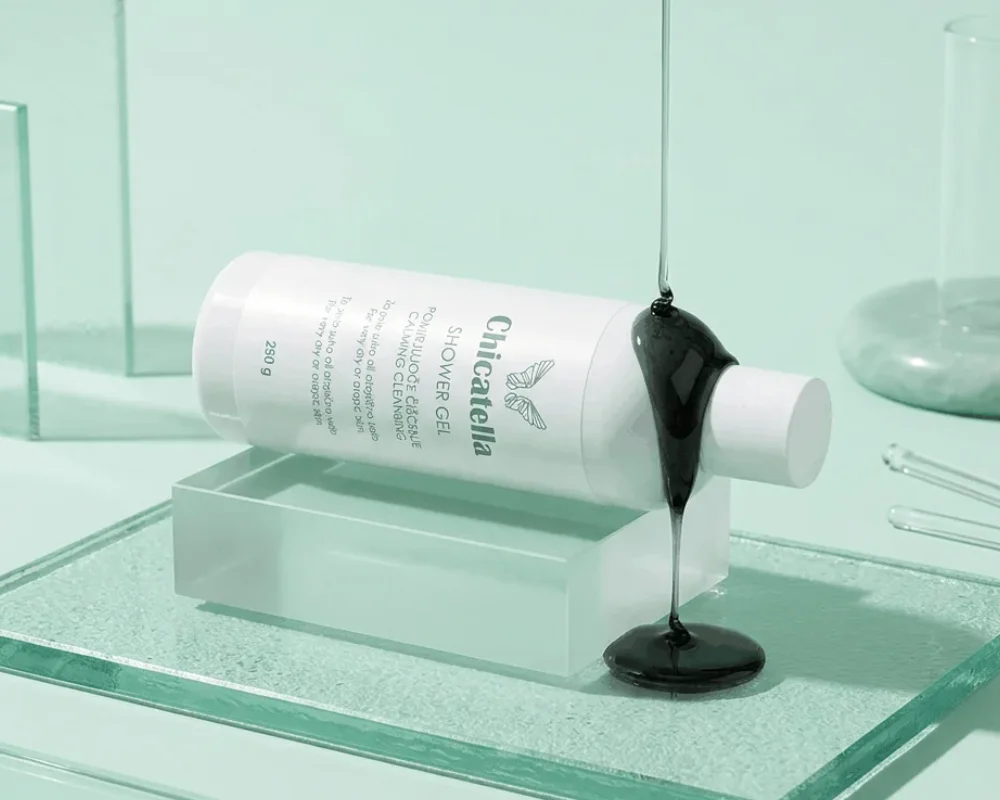
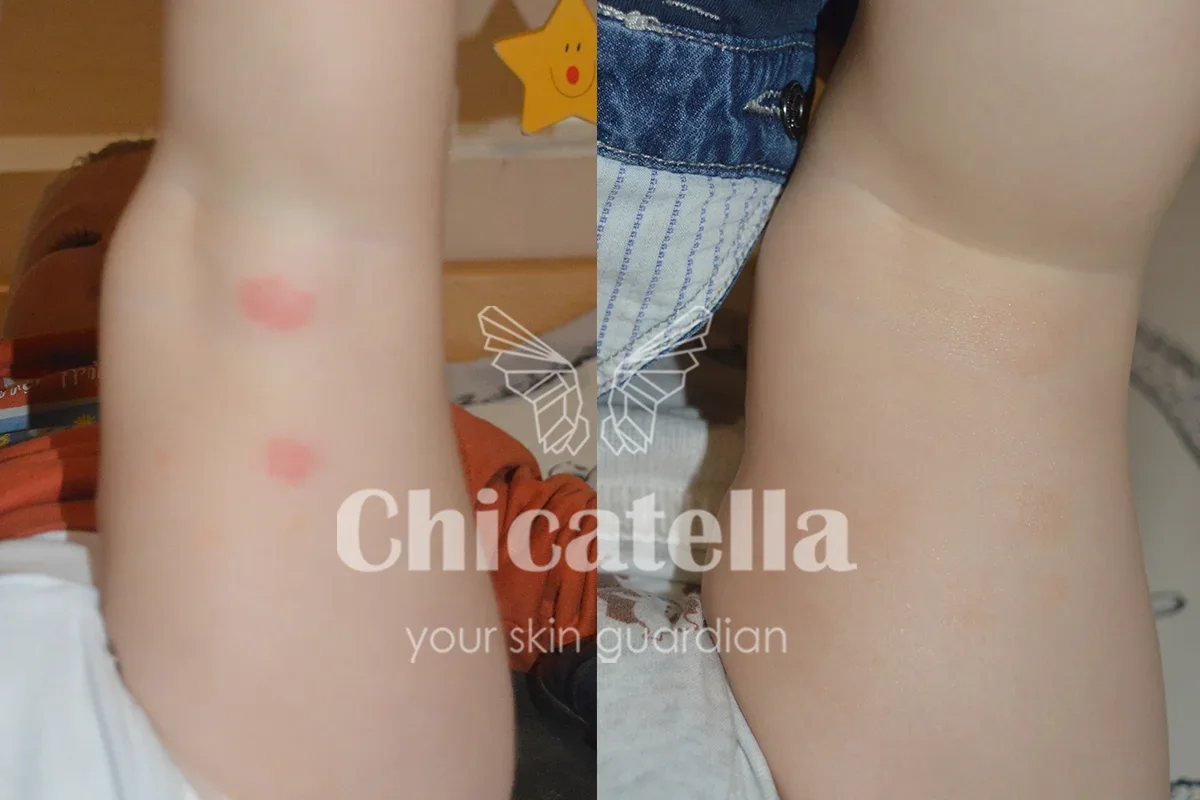
When supportive care helps very dry, irritated skin
The same skin before and after care. Photos from parents, shared with permission.
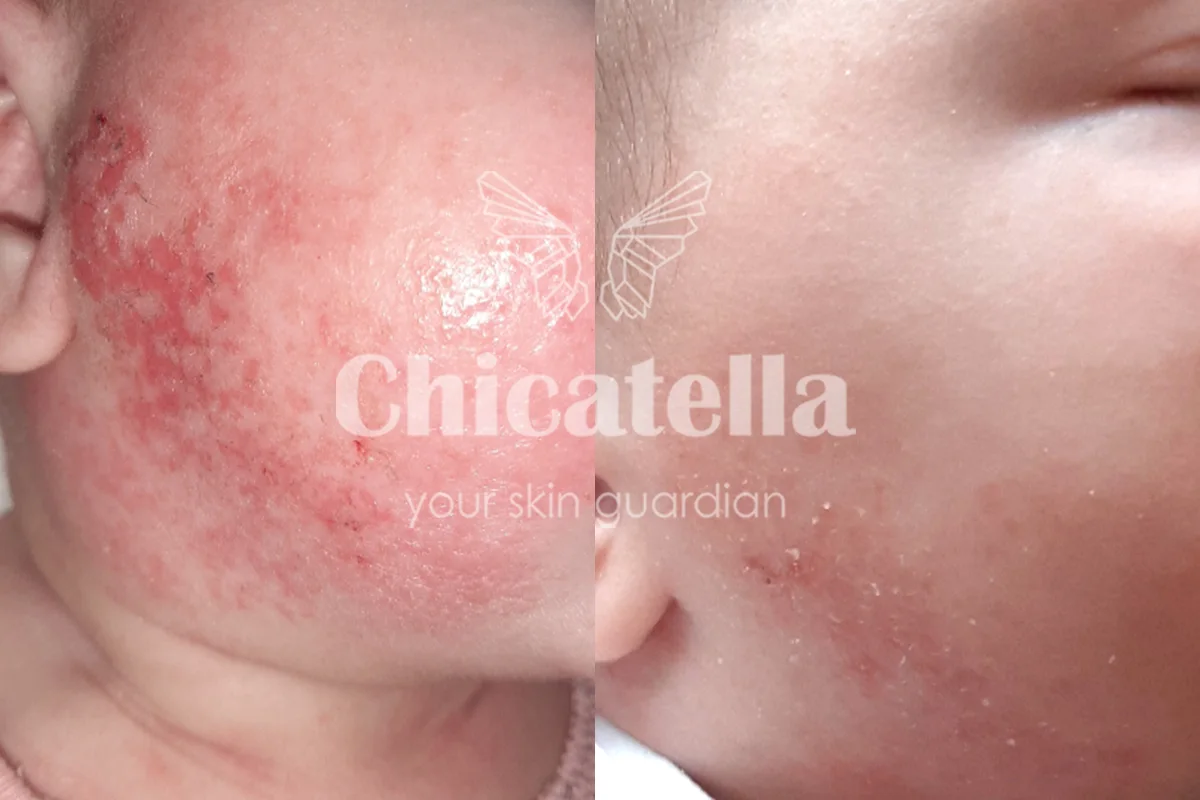
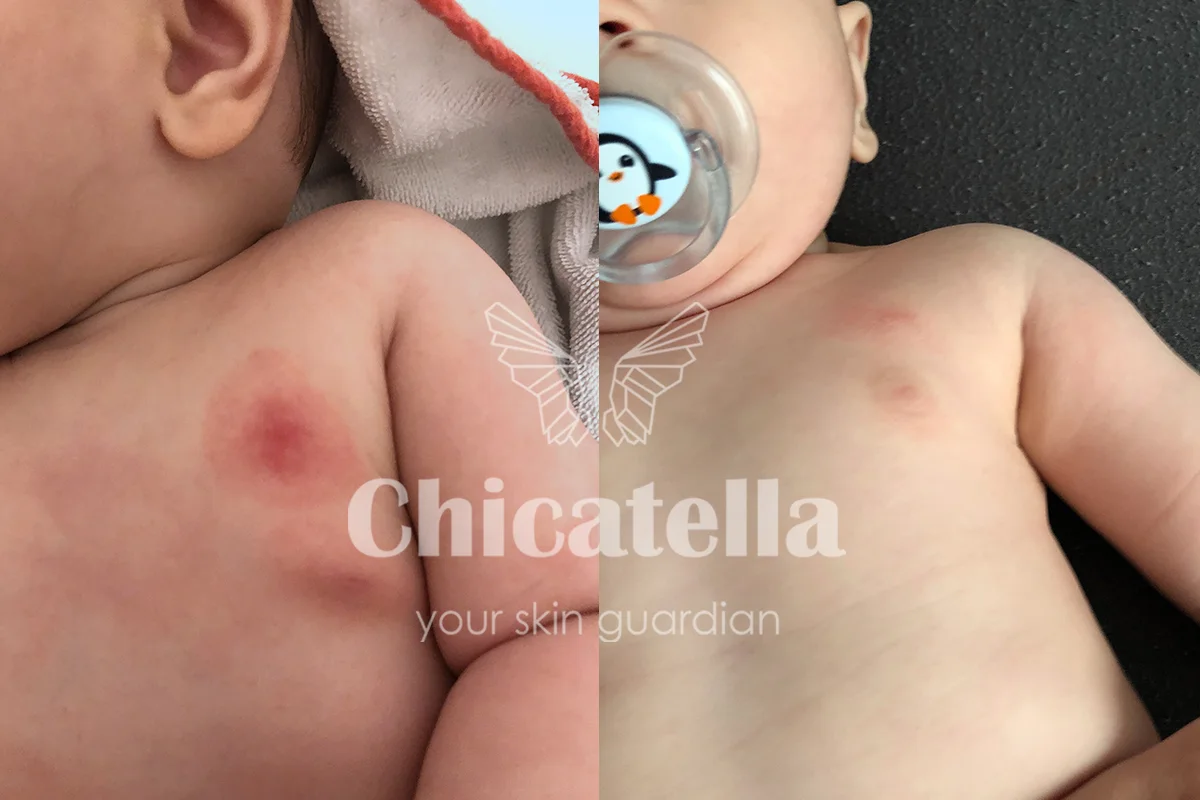
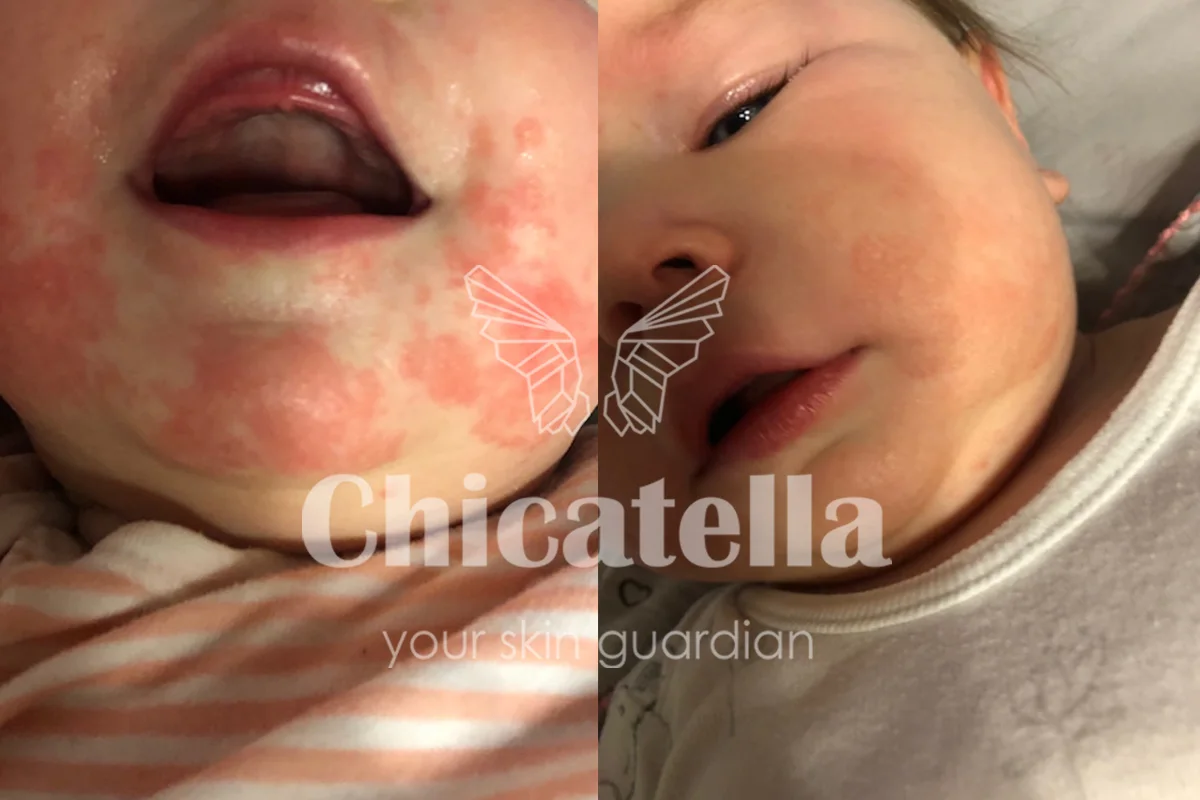
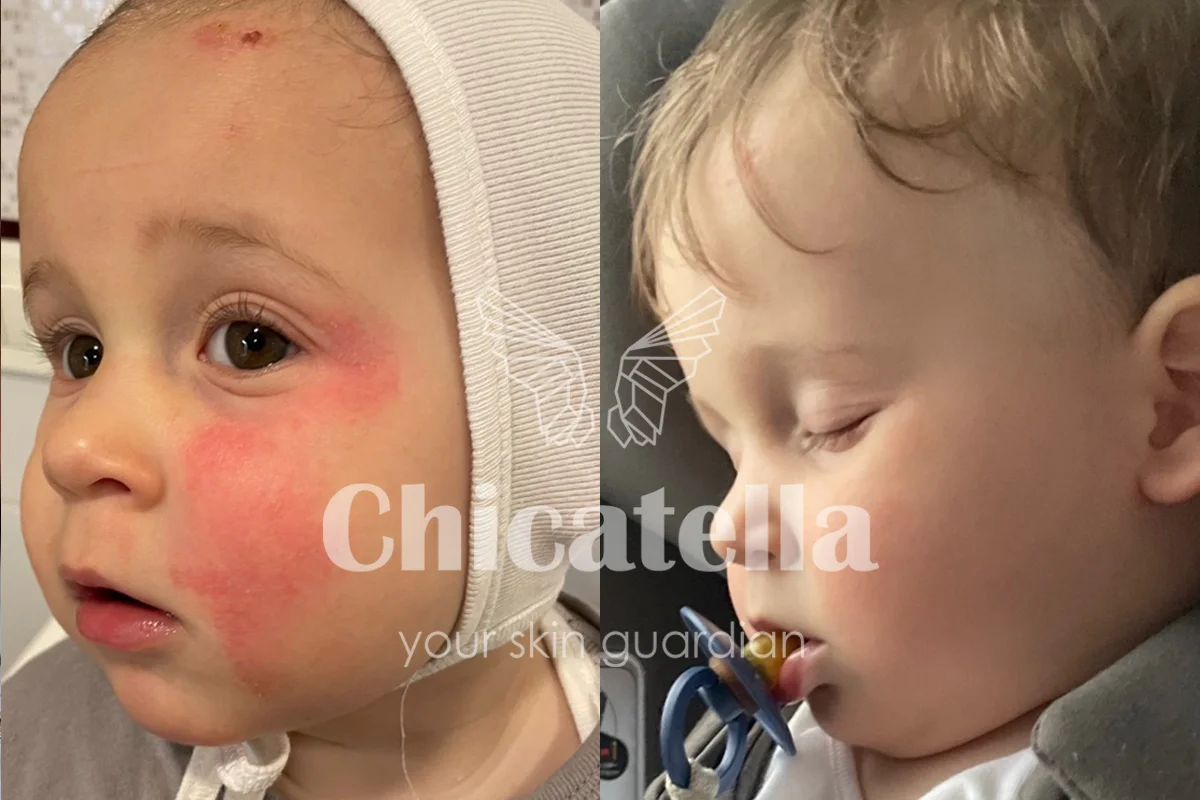
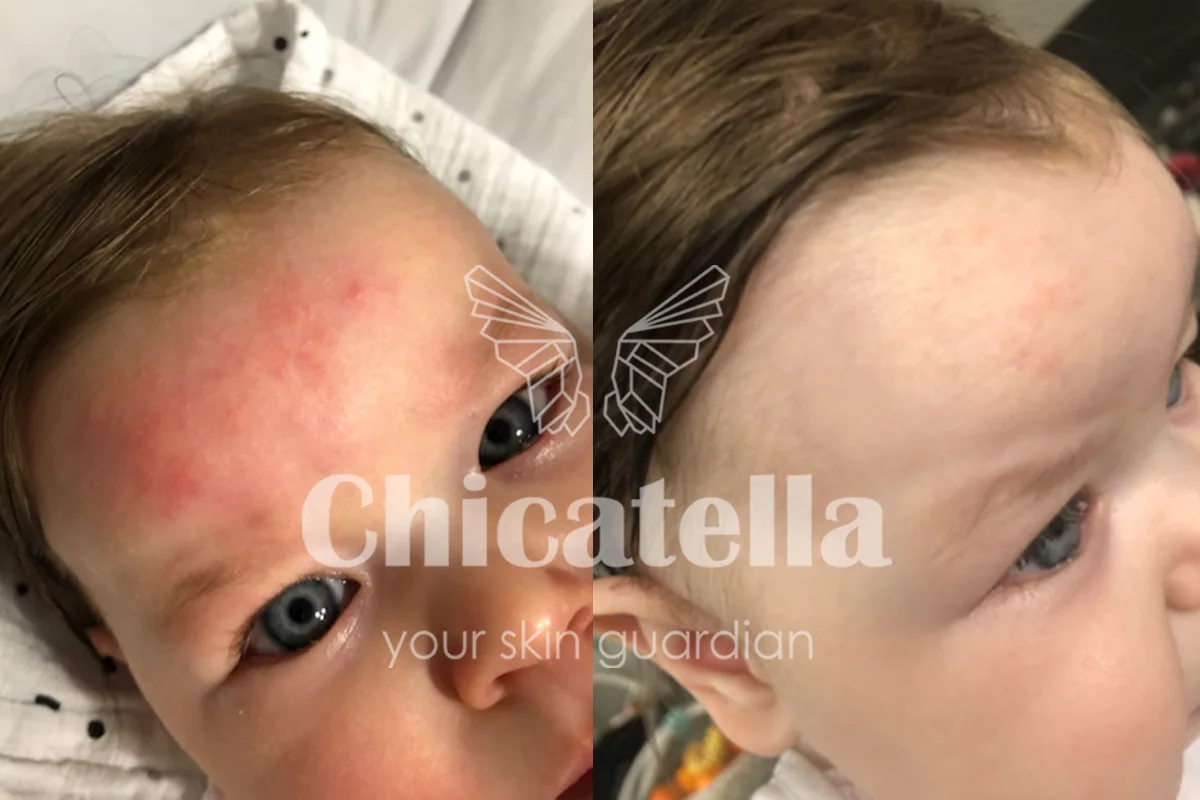
These photos show individual experiences with cosmetic care for very dry or irritated skin. Chicatella isn’t a treatment for atopic dermatitis, a photo doesn’t confirm a diagnosis, and individual results may vary.
Related guides
Reading your baby’s skin correctly
With a baby’s skin, the most important thing isn’t finding the strongest or the most natural ointment. It’s recognizing whether the skin is mostly dry, actively inflamed or possibly infected. Skin care supports repair. Medication calms inflammation. And a doctor has to assess the signs that go beyond what cosmetics can do.
Find the right care for your skin in three steps
No guesswork. Answer three quick questions and we’ll tell you what your skin needs.
This article helps you understand atopic dermatitis in babies and safe skin care, but it can’t diagnose anything or replace a checkup. A photo isn’t enough for a diagnosis. Chicatella products are cosmetic skin care products, not medicines.
- 01Atopic Dermatitis: Update on Skin-Directed Management, 2025. American Academy of Pediatrics. ↗︎
- 02Treatment of Atopic Dermatitis. AAP. ↗︎
- 03Diagnosis of Atopic Dermatitis. AAP. ↗︎
- 04How to treat eczema in babies. American Academy of Dermatology. ↗︎
- 05Atopic dermatitis clinical guideline. AAD. ↗︎
- 06Atopic eczema in under 12s: diagnosis and management (CG57). NICE. ↗︎
- 07Treatment of eczema herpeticum (QS44). NICE. ↗︎
- 08European EuroGuiDerm guideline on atopic eczema, 2025. PubMed. ↗︎
- 09Atopic Dermatitis and Food Allergy: Best Practices and Knowledge Gaps (PDF). AAAAI. ↗︎
- 10Preventing food allergy in infants and young children. EAACI guideline. ↗︎
- 11LEAP randomized trial — early peanut consumption in high-risk infants. PubMed. ↗︎
- 12Long-term results of early peanut introduction. NIH. ↗︎
- 13BEEP randomized trial — daily emollient for prevention of eczema. PubMed. ↗︎
- 14BEEP five-year research report. NIHR. ↗︎
- 15PreventADALL randomized trial. PubMed. ↗︎
- 16Dupixent. European Medicines Agency. ↗︎
- 17Dupilumab in children aged 6 months to 5 years with severe atopic dermatitis. PubMed. ↗︎
- 18Atopic dermatitis: a guide for parents (PDF, in Slovenian). Ljubljana Community Health Center, Slovenia. ↗︎
- 19Emergency number 112 (EU). Government of Slovenia, GOV.SI. ↗︎