Why your child’s eczema keeps coming back, even when you moisturize every day
Because it isn’t just dryness. The skin barrier, inflammation, itch and the skin microbiome keep feeding each other. Once you understand that cycle, it’s easier to know what you can do at home and when skin care alone isn’t enough.

How we put this article together
It’s not just dry skin. It’s a cycle that keeps itself going.
That’s why one cream can’t always break all of it. You need to step in at two points at once: the dryness and the inflammation.
Inflammation of the skin that keeps coming back, not just dryness. And it’s not contagious.
Skin care and medicine aren’t the same thing. Skin care supports the skin barrier. Inflammation often needs treatment from your doctor.
Scratching feels good at first, then it does harm. It damages the skin and makes the itch worse. At night it’s often not even on purpose.
The best cream isn’t the priciest or the greasiest one. It’s the one your child tolerates well and you can use every day.
Food isn’t automatically to blame. For some kids it plays a part, but it isn’t behind every flare-up.
Gentle washing, regular moisturizing, less rubbing and overheating.
Follow your doctor’s plan and keep up the skin care.
Skin getting worse fast, pain, blisters, pus, thick crusts, fever, or your child seems unwell.
One more thing. It isn’t a fact from a study, but it still matters: a flare-up doesn’t mean you did something wrong.
Six steps that can help, starting today
Give your child a short, lukewarm bath or shower.
Use a cleanser only where it’s needed, and only if the skin tolerates it well.
Don’t rub the skin. Gently pat it dry.
Apply the moisturizer you’ve chosen while the skin is still slightly damp.
If your child has a flare-up plan from the doctor, follow it. Skin care products don’t replace prescribed treatment.
If things are getting worse fast or you notice warning signs, don’t try new products. Call your doctor.
When you start a new skin care product: only one new product at a time, and first on a small patch of skin for a few days. That’s how you carefully test whether the skin tolerates it.
It looks a little different on every child
Six illustrations of where and how it shows up at different ages. An illustration can’t diagnose anything. Your doctor does that during an exam.
Questions parents ask
What is atopic dermatitis?
Is it contagious?
Will my child outgrow it?
Is an allergy to blame?
Can my child take a bath every day?
Are steroid creams dangerous?
Which cream is best?
When should my child see a doctor?
It’s not just dry skin
You moisturize your child in the evening, the skin looks calmer, and then they’re scratching again at night.
That doesn’t necessarily mean you picked the wrong cream. Skin care helps with one part of the problem: the skin barrier. The inflammation and itch can still stay active.
Atopic dermatitis (the most common type of eczema) is a chronic, meaning long-lasting and recurring, inflammation of the skin. The American Academy of Pediatrics says it affects roughly one in five to one in four children. So if you feel like the only parent dealing with this, you’re not.AAP 2025↗︎
children have atopic dermatitis, roughly one in five to one in four.AAD 2026↗︎
Reduces dryness, smooths the surface and slows down water loss through the skin.
It doesn’t always calm active immune inflammation, and it doesn’t stop every itch cycle.
For the condition at every age, see our page on atopic dermatitis. If you’re not sure yet whether it really is atopic dermatitis, start with how to tell kids’ rashes apart.
Four processes that keep feeding each other
Click through the steps. Each one makes sense on its own. The trouble is that they make each other stronger.
Picture a brick wall: skin cells are the bricks and the fats between them are the mortar. Eczema-prone skin has less of that mortar, so there are more gaps between the bricks. Water escapes through the skin faster (doctors call this TEWL, water loss through the skin), and irritants get in more easily.
These aren’t four separate problems. They’re one connected system. That’s exactly why one cream can’t always break the whole cycle, and exactly why it’s not your fault when it keeps coming back.
How it looks as your child grows
This isn’t a diagnostic atlas, just a pattern pediatricians often describe. Not every child gets it in the same places.
It often affects the face and cheeks, the scalp, and the outer sides of the arms and legs. The diaper area often looks better, because the skin there is more moist and protected. More about the littlest ones: atopic dermatitis in babies.
A flare-up doesn’t mean you did something wrong
Often there’s no single trigger you can pin down. Weather, sweating, rubbing, being sick, stress, irritating products and dry air can all play a part, and sometimes skin gets worse for no obvious reason at all. Hunting for the one perfect culprit leads to needless restrictions and guilt.
A tendency toward a weaker skin barrier and an overactive inflammatory response. It isn’t caused by anything a parent did wrong.
Something that sets off a flare-up in this child again and again. “Again and again” is the key part: one coincidence isn’t proof.
A wool sweater, sweat, rubbing or a hot room don’t cause the condition, but they can make it worse. These are the easiest things to change.
The useful question isn’t “what did I do wrong?” It’s “what kept happening this week, and what can I calmly change?”

Your child needs two plans
One is for when the skin is calm. The other is for when it flares. If you only have the first, you’ll be improvising every flare-up.
- gentle washing;
- regular moisturizing;
- less rubbing and overheating;
- keeping an eye on itch and sleep;
- avoiding known, proven triggers.
- follow your doctor’s instructions for anti-inflammatory treatment;
- keep up suitable skin care;
- watch for signs of infection;
- get help if it isn’t settling down or is getting worse fast.
Supports the skin barrier: less dryness, less water loss, less extra irritation.
Calms active inflammation. A doctor prescribes it and decides the strength, amount and how long to use it.
Needed when an infection settles into damaged skin. That’s for a doctor to judge, not a skin care product.
A moisturizer and a medicine don’t do the same job. Skin care supports the skin barrier, medicine calms active inflammation. Your child may need both: together, not one instead of the other.
For spots where flare-ups keep coming back, your doctor may suggest continuing anti-inflammatory treatment now and then, even once the skin looks calm. The goal is fewer new flare-ups. This isn’t advice to treat on your own. A plan like this is always set by a doctor.AAD↗︎NICE↗︎
Wet wraps can be a helpful option for stronger flare-ups, but the first time you do them on your child, a trained health professional should show you how or guide you. The same goes for medicated baths. Don’t use home recipes.
Bath time isn’t the enemy
Lots of parents hear that a child with atopic dermatitis should hardly ever be washed. There’s no evidence that cutting down on baths alone clears up atopic dermatitis. What matters more is water temperature, how long, which cleanser, and what you do right after the bath.NICE↗︎
Hot water is harder on the skin and often makes the itch worse.
Baths and showers shouldn’t go on too long. Water play can wait for a calmer stretch.
Just pat the skin dry with a towel. Rubbing is mechanical irritation.
Apply moisturizer soon after washing, while the skin is still slightly damp.
You don’t need cleanser on every part of the body every time. The best bathing frequency varies from child to child; there’s no one rule for everyone. We don’t present bath additives as essential treatment, and bleach baths are only for selected children on the advice of a health professional, never from a home recipe.
Which texture is best?
It’s the most common question at the pharmacy counter, and the BEE trial gave a surprising answer. Comparing a lotion, cream, gel and ointment in 550 children aged 6 months to under 12 years, researchers found no clear overall winner.BEE↗︎
An illustration of the “no clear difference” finding, not a chart of measured values.
Greasier isn’t automatically better for every child and every spot.
A lighter texture can feel nicer during the day or in warm weather.
A more protective texture can make sense on very dry, cracked and non-oozing areas.
Your child may refuse a product that stings, feels sticky or just feels unpleasant, and that’s useful information.
A product that sits unused in the cabinet can’t help.
Using a well-tolerated product consistently helps more than chasing one supposedly perfect ingredient.
An ingredient that draws in and holds water.
An ingredient that softens skin.
A protective film that slows down water loss.
From here on, we stick to plain words.
At night, it’s not only about the skin
How severe eczema is isn’t just about how big the red patch is. The American Academy of Pediatrics reports that about 50–80 % of children with atopic dermatitis have trouble sleeping, and during flare-ups the share can be even higher.AAP↗︎
of children with atopic dermatitis have trouble sleeping.
Poor sleep means crankier moods, less focus and more crying.
A tired child has a harder time joining in, and sometimes misses days because of their skin.
Parents sleep less too. Exhaustion isn’t a side issue. It’s part of the condition.
Don’t just tell your doctor how much skin is affected. Also tell them how often your child wakes up at night and how much the itch gets in the way during the day.
No skin care product can promise to fix sleep. But less dry, less itchy skin can help sleep, together with treatment that calms the inflammation.
Food: a link isn’t the same as a cause
Atopic dermatitis and food allergies can show up in the same child. That still doesn’t mean food causes every flare-up.AAAAI↗︎
Broad allergy panels without a clear history can show positive results that don’t mean anything in real life.
Cutting out several foods on your own can lead to nutritional gaps, slower growth and, in some cases, even losing a tolerance your child had already built.
First, get the basic skin care and treatment right. Only then does it become clearer what’s still unexplained.
Seeing an allergist makes sense mainly when there are repeated immediate reactions after a specific food, or when a professional recommends it.
So food is never ruled out as a factor, but don’t start an elimination diet on your own. Always decide together with your doctor.
Microbiome, colonization and infection aren’t the same thing
These three words often get used as if they meant the same thing, but they mean very different things and lead to very different decisions.
| Term | Plain explanation | What it means in practice |
|---|---|---|
| Microbiome | The community of microorganisms that normally live on the skin. | Normal and healthy. It doesn’t need to be “sterilized.” |
| Colonization | A certain bacterium is present, but your child doesn’t necessarily have an infection. | Being present alone isn’t a reason for antibiotics. |
| Infection | The microorganism causes additional illness and noticeable warning signs. | A doctor needs to take a look and choose the right treatment. |
A 2026 meta-analysis of seven studies with 929 participants found a moderate link between colonization with Staphylococcus aureus and how severe atopic dermatitis is (about r = 0.42).Frontiers 2026↗︎
In plain words: where the condition is more severe, this bacterium shows up more often. But that’s not proof that the bacterium directly causes the condition, and it’s no basis for claiming a skin care product “fixes the microbiome.”
Routinely using antimicrobial products isn’t an automatic fix for atopic dermatitis. Don’t start antibiotics, antiseptics or antibacterial products without a doctor’s advice.
The atopic march isn’t a conveyor belt
The term “atopic march” means that some children later develop a food allergy, asthma or hay fever. So the links are real, but it isn’t a conveyor belt that inevitably moves a child from one condition to the next.
It doesn’t unfold the same way in every child.
Atopic dermatitis doesn’t mean your child will definitely get asthma or allergies.
So you don’t need to live waiting for some unavoidable future. What counts today is keeping the skin as calm as possible.
When it might not be just atopic dermatitis
One or two telltale features are often enough to know where to keep reading. The diagnosis, though, comes from a doctor.
| Condition | What often sets it apart | Read more |
|---|---|---|
| Contact dermatitis | The pattern follows where the skin touched a product or material. | Contact dermatitis → |
| Seborrheic dermatitis | Greasier scales on the scalp, eyebrows and beside the nose, often less itchy. | Seborrheic dermatitis → |
| Diaper rash | Limited to the diaper area, where moisture, rubbing and irritation come together. | Baby skin care → |
| Perioral dermatitis | Tiny bumps around the mouth, often with a narrow strip of clear skin right next to the lips. | Perioral dermatitis → |
| Very dry skin without clear inflammation | Dryness and flaking without constant itch or inflamed patches. | Dry skin → |
| Fungal or bacterial infection | Sharply outlined ring-shaped patches, pus, oozing or crusts that form fast. | A doctor needs to take a look. |
- it’s mostly limited to spots that touch a certain product or material;
- it keeps getting worse after using a certain product;
- it shows up in an unusual pattern;
- it doesn’t improve despite proper skin care and treatment.
A contact allergy is confirmed with a skin patch test. Patch testing is the standard way to check this in children too; a dermatologist decides when it makes sense.Pediatric review↗︎
Treatment today is more than just one cream
This chapter isn’t a list of medicines. It has one message: if your child’s eczema is severe, you don’t have to keep searching for yet another skin care cream.
Regular skin care plus anti-inflammatory treatment for flare-ups. This stays the foundation at every age.
Besides corticosteroids, there are other topical medicines that may suit sensitive areas.
Phototherapy and targeted medicines are options. A specialist makes that call.
Based on age, severity, the areas involved, sleep, and how much it affects the life of your child and family.
Corticosteroid pills or injections are generally not a good long-term solution for atopic dermatitis. Every treatment decision is made by a doctor.EuroGuiDerm 2025↗︎AAD↗︎
Warning signs
- treatment isn’t working;
- the itch keeps disturbing sleep;
- flare-ups are very frequent;
- your child misses daycare or school because of their skin;
- you suspect a contact allergy;
- you’re not sure it really is atopic dermatitis.
- the skin suddenly gets worse fast;
- it becomes very painful;
- you see pus, oozing or yellowish crusts that form fast;
- your child has a fever or looks sick;
- clusters of blisters appear, or small open sores that all look about the same size;
- the changes spread quickly toward the eyes.
A rare but urgent viral infection of damaged skin. It can show up as pain, blisters that form fast or small sores of similar size, and your child feeling unwell. It isn’t common, but it’s worth knowing about because it needs care right away.NICE↗︎
Which kind of care can make sense, depending on how the skin is doing right now
Disclosure: Chicatella publishes this article and sells the products below. They are cosmetic skin care products. They don’t treat atopic dermatitis, don’t get rid of inflammation and don’t replace prescribed treatment.
Skin care for babies is a little different: atopic dermatitis in babies.
Product claims are cosmetic claims and follow EU Regulations 1223/2009 and 655/2013: the products help reduce water loss, soften the skin and leave a protective film on its surface. No skin care product works for every child, and none can guarantee it will never cause an allergy in anyone. The current ingredient list is always on each product’s page. Check it before using a product on your child for the first time.
When regular care calms the skin
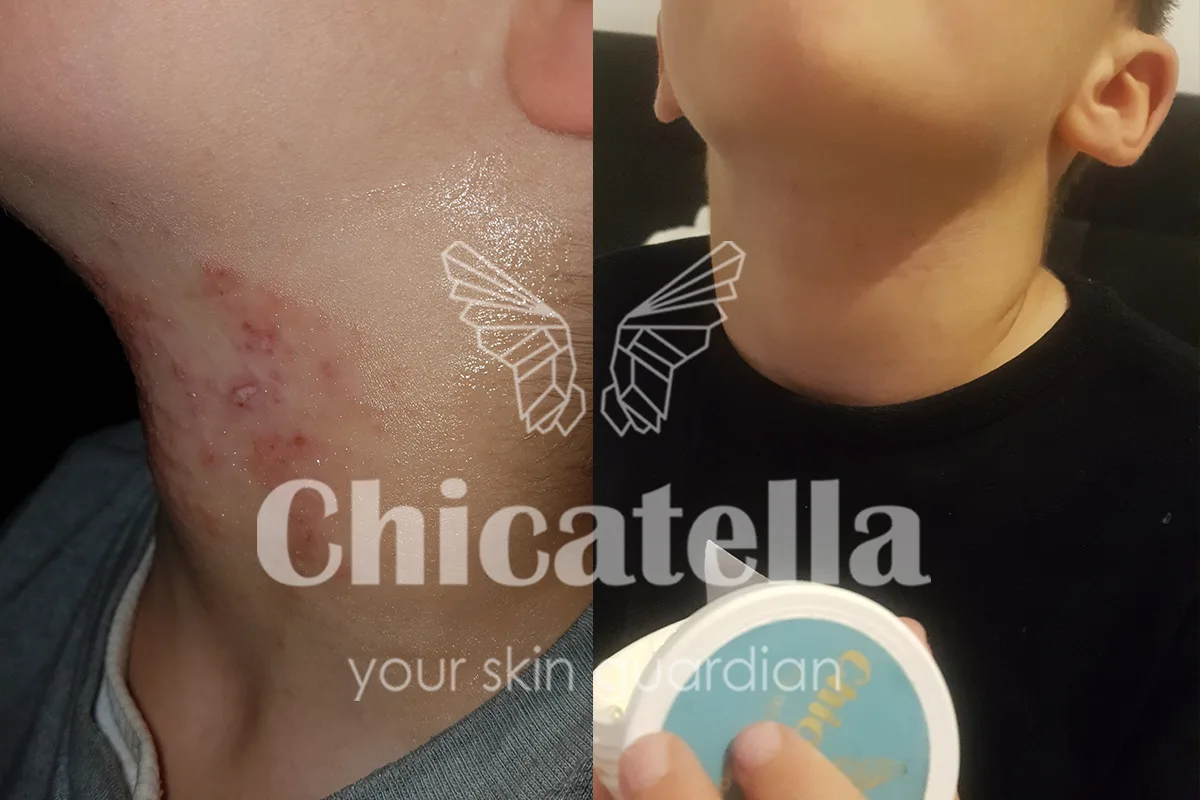
Photos shared by parents with their permission. Results vary from child to child.
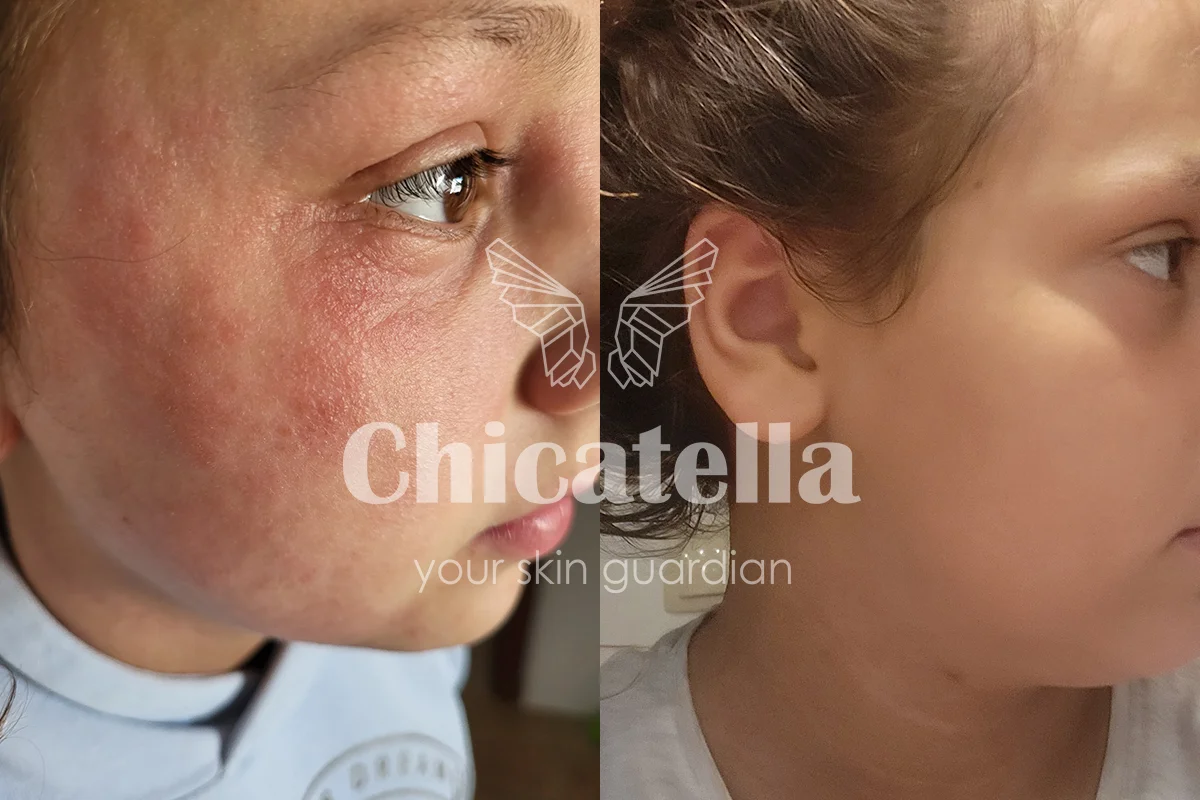
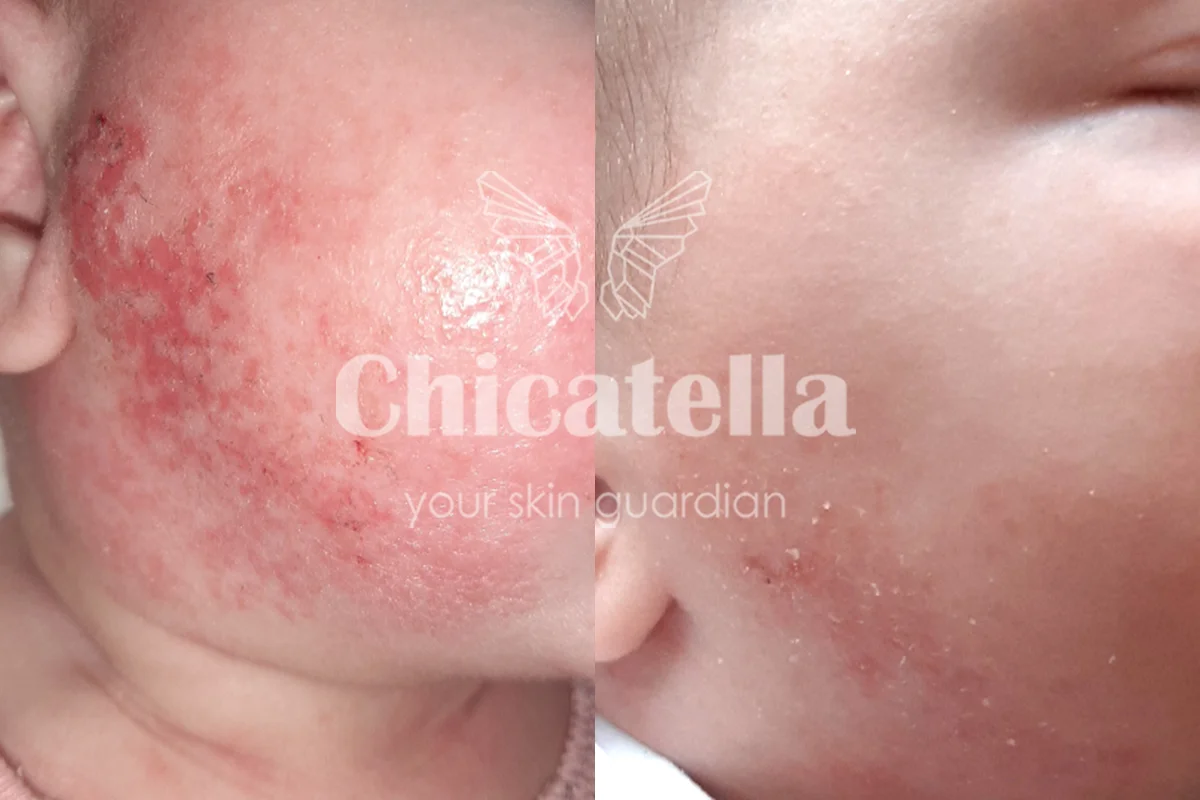
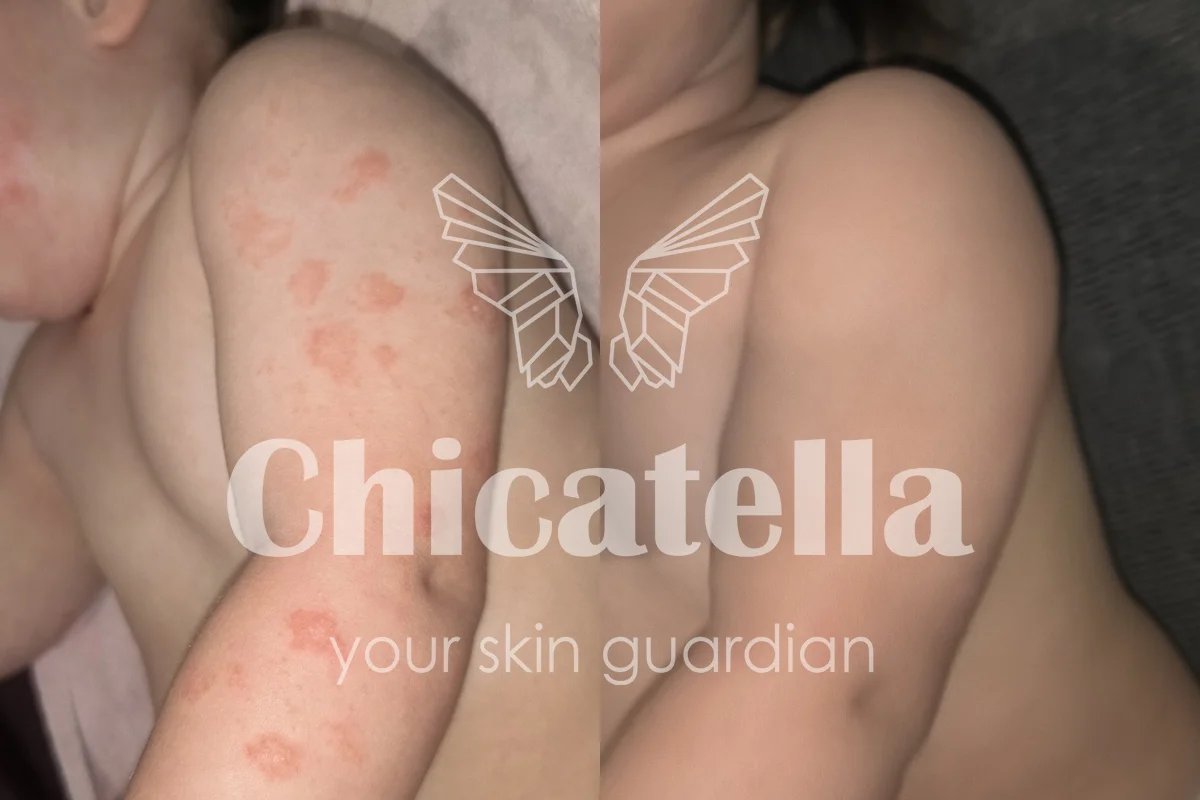
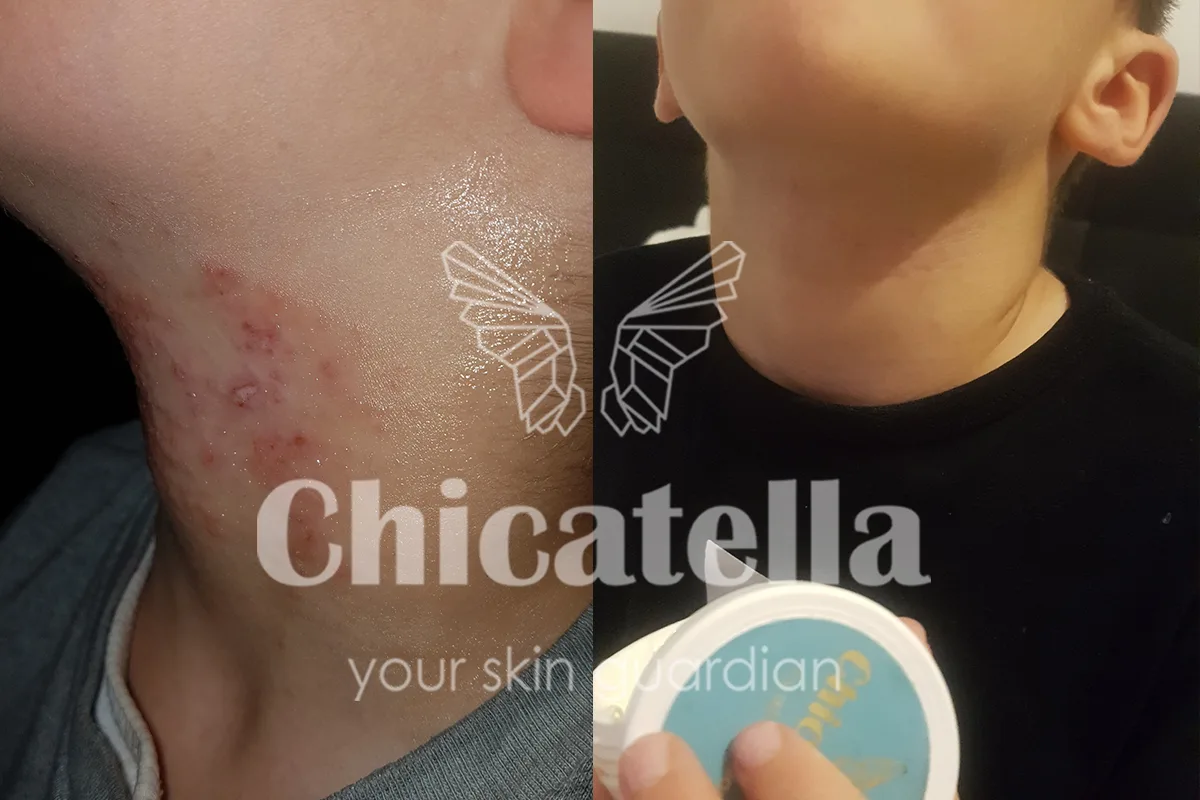
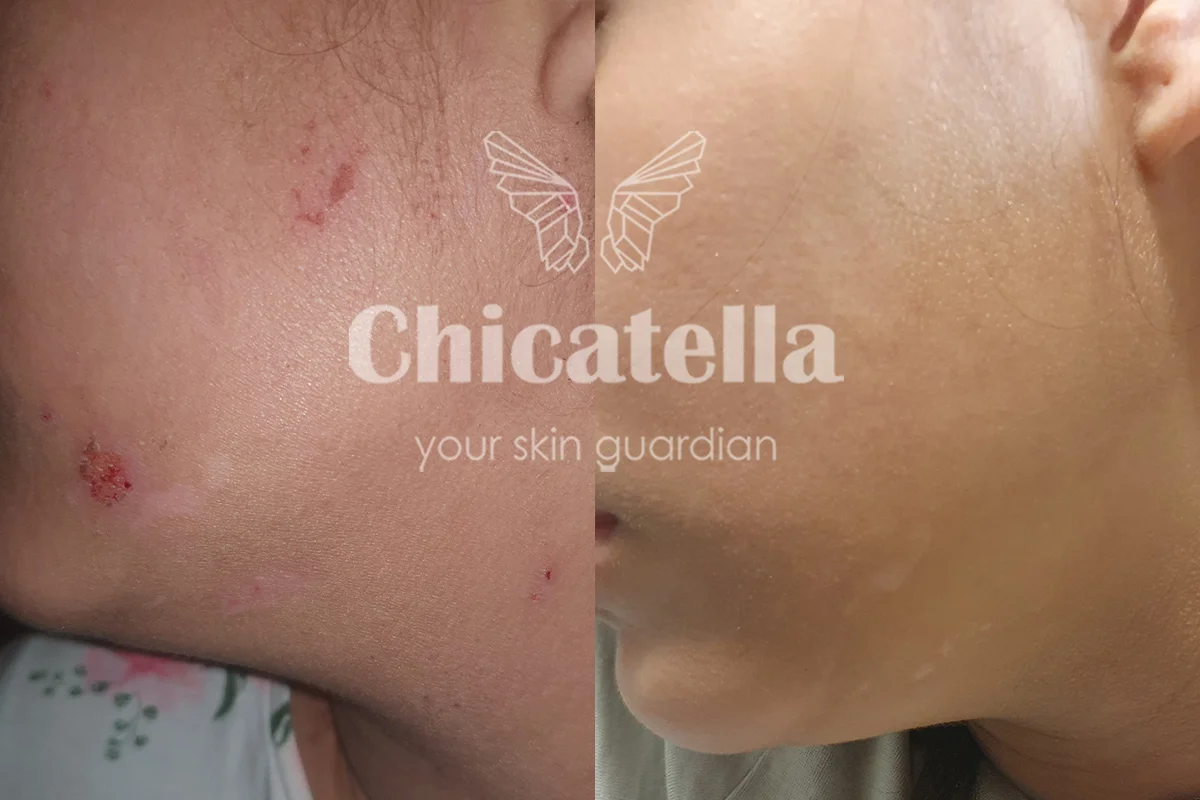
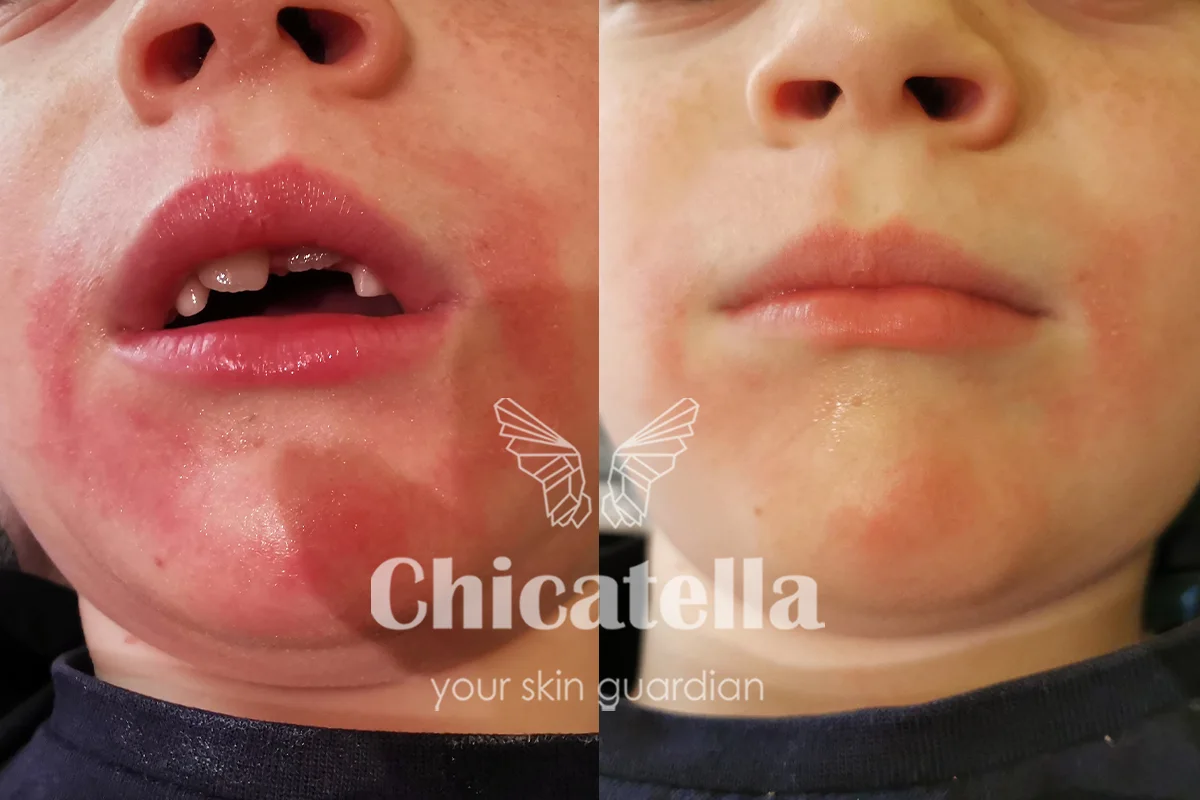
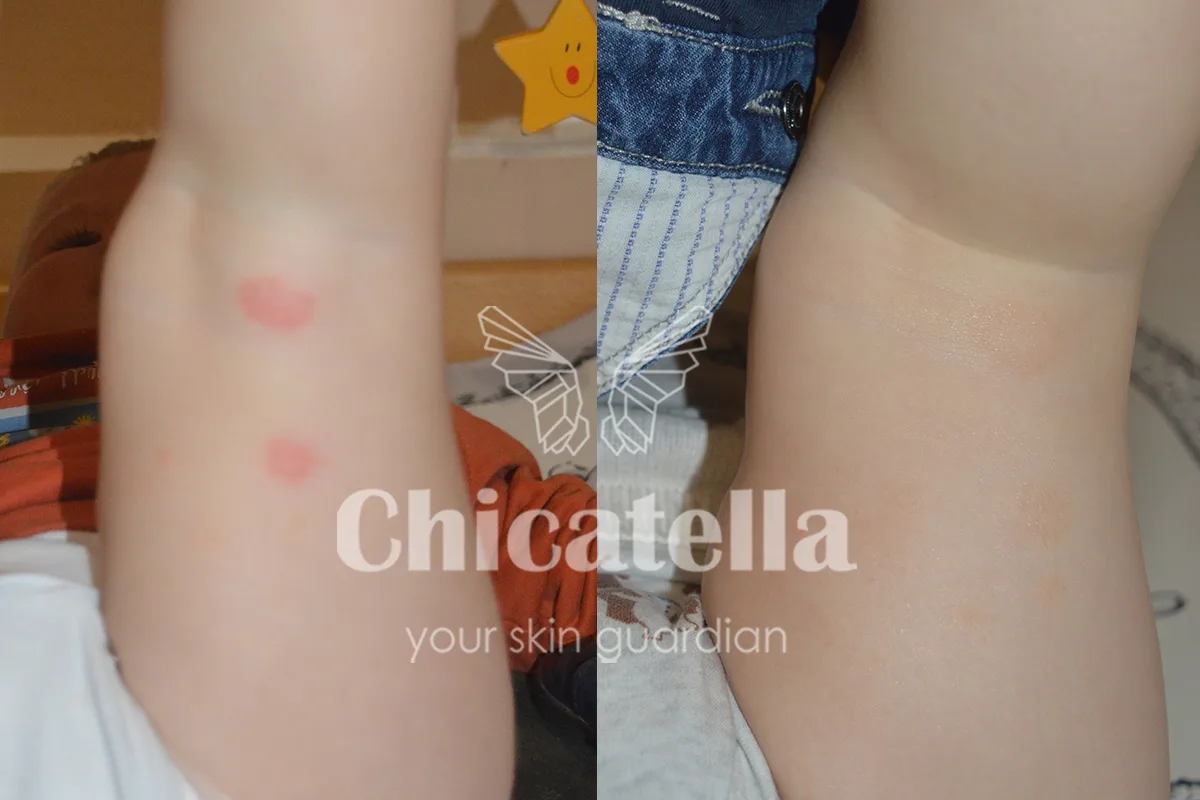
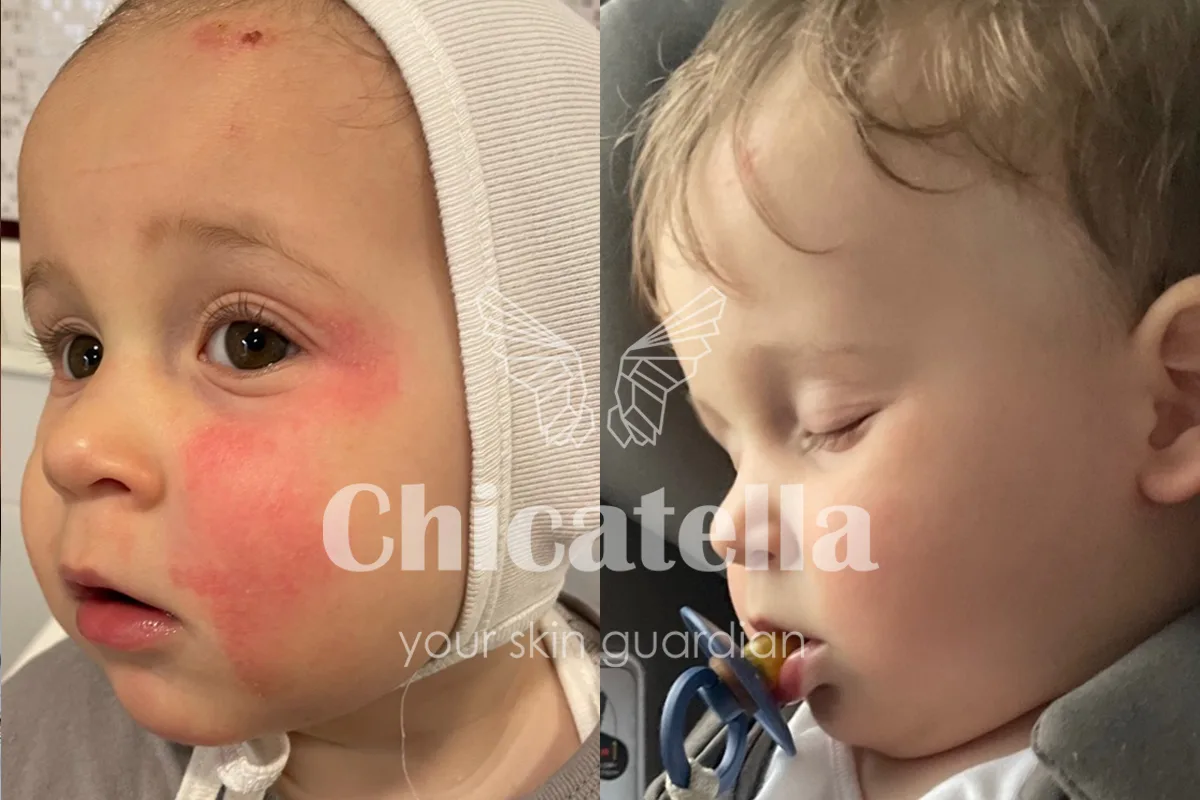
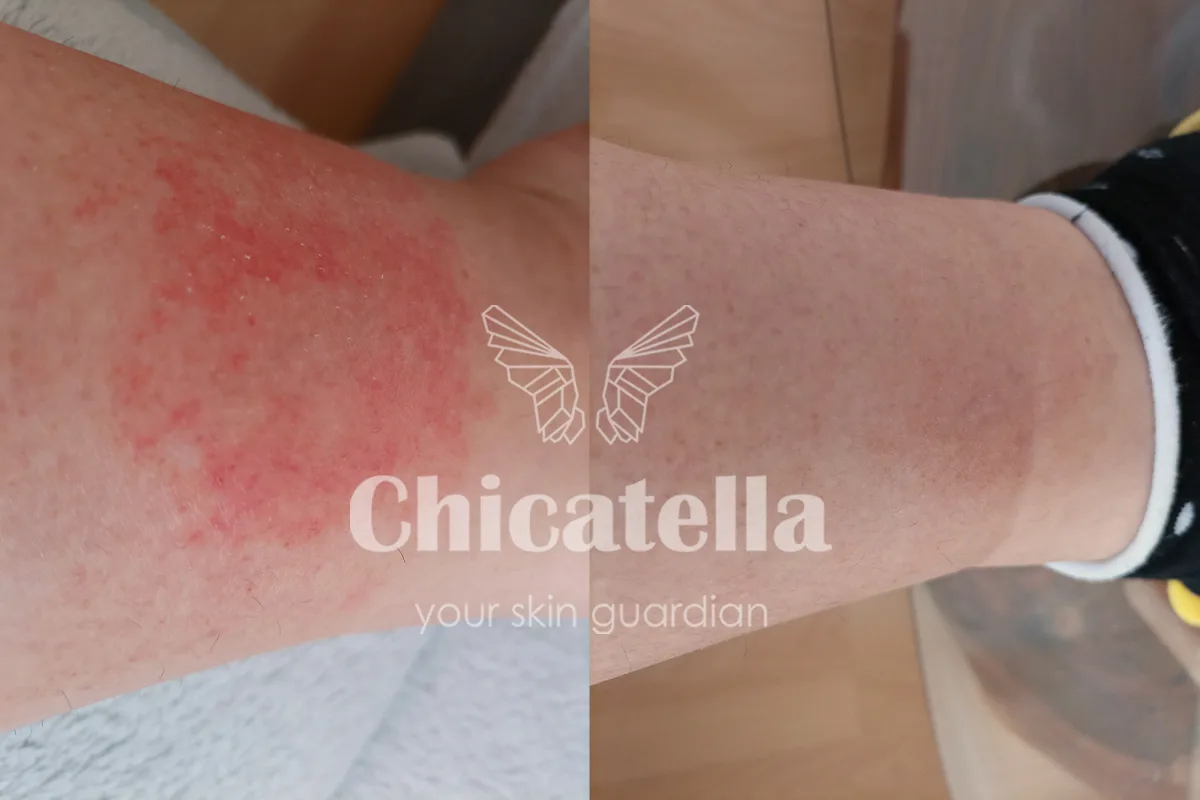
These are individual experiences with cosmetic skin care. The products aren’t a medicine for atopic dermatitis, and results can vary from person to person.
Want to know more?
Knowing what the skin really needs
Dry, calm skin needs different care than badly inflamed skin. A very cracked but dry area isn’t the same as an oozing or infected one. Cosmetic skin care can support the skin barrier, but active inflammation and infection need a different approach. So the goal isn’t to find one miracle product. It’s to recognize what your child’s skin needs today, and to know when the next step is talking to a doctor.
Find the right care for your skin in three steps
No guesswork. Answer three quick questions and we’ll tell you what your skin needs.
This article is for education only. It doesn’t diagnose anything and doesn’t replace a visit to the doctor. Chicatella products are cosmetic skin care products, not medicines.
- 01First pediatric atopic dermatitis guidelines. American Academy of Dermatology, 2026. ↗︎
- 02Atopic dermatitis clinical guidelines. AAD. ↗︎
- 03Atopic Dermatitis: Update on Skin-Directed Management. American Academy of Pediatrics, 2025. ↗︎
- 04Treating Eczema: Updated Recommendations. AAP / HealthyChildren. ↗︎
- 05Atopic eczema in under 12s. NICE, CG57. ↗︎
- 06Burden of Atopic Dermatitis. AAP. ↗︎
- 07BEE trial – comparing four types of moisturizer in 550 children. Lancet Child & Adolesc Health, 2022. ↗︎
- 08Atopic Dermatitis and Food Allergy – Work Group Report. AAAAI, 2022. ↗︎
- 09Pediatric skin microbiome – a review. ↗︎
- 10Microbiome dynamics in atopic dermatitis. AAIR, 2025. ↗︎
- 11S. aureus colonization and severity – a meta-analysis. Frontiers in Immunology, 2026. ↗︎
- 12Atopic dermatitis – symptoms on different skin tones. AAD. ↗︎
- 13EuroGuiDerm guideline update. 2025. ↗︎
- 14Pediatric allergic contact dermatitis and patch testing. ↗︎
- 15Atopic eczema in under 12s – evidence review (eczema herpeticum). NICE / NCBI. ↗︎