FREE SHIPPING ON 2 OR MORE·30-DAY GUARANTEE, KEEP THE PRODUCT·MICROBIOME-FRIENDLY CARE·FREE SHIPPING ON 2 OR MORE·30-DAY GUARANTEE, KEEP THE PRODUCT·MICROBIOME-FRIENDLY CARE·
Guide · skin conditions

Baby eczema isn’t one single problem. Where the rash is gives you the first clue

Dry cheeks, greasy flakes on the scalp, redness under the neck and a rash under the diaper can look alike, but they don’t always need the same care. Here are four clues to help you understand what your baby’s skin may need, and when a pediatrician matters more than a new cream.

Three things worth knowing up front

“Dermatitis isn’t one condition. First check how your baby is doing, then the skin. One cream isn’t the answer for everything.”

For older kids, see eczema in children, and for a wider look at skin inflammation, see dermatitis.
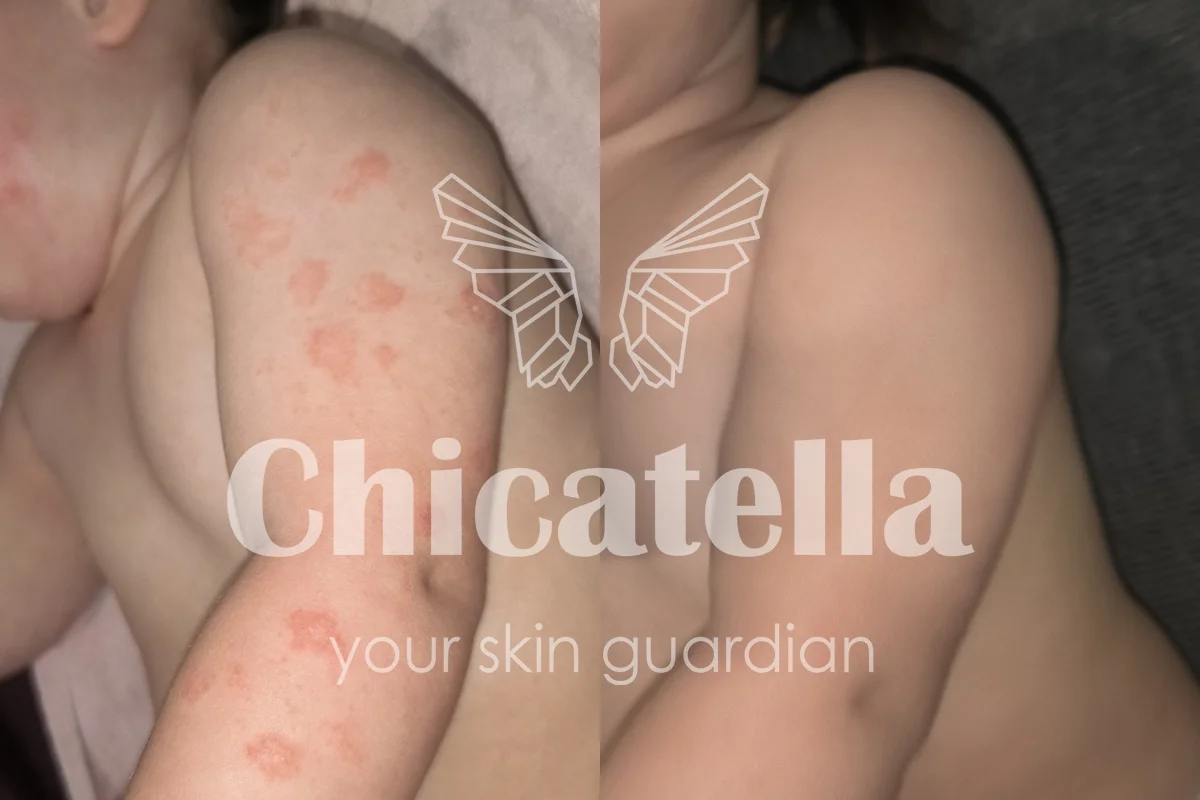

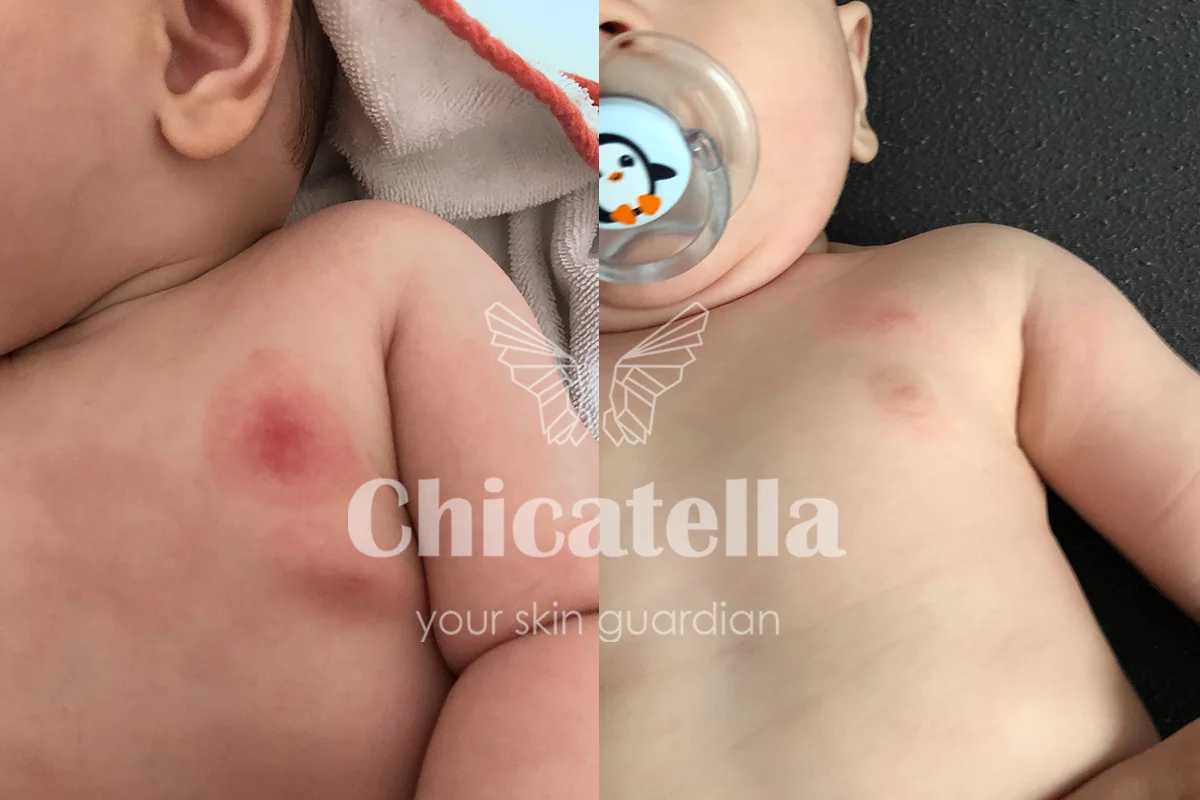
Baby eczema before and after: red patches all over a toddler’s upper arm and shoulder
A baby’s skin before and after care. The photo shows how the skin looks and is not a diagnosis.
Reading time
≈ 24 min
Published
August 2026
Medically reviewed
August 2026
How we put this article together
We base our articles on pediatric and dermatology guidelines and peer-reviewed research. Every claim links to its source, both in the text and in the list at the bottom of the page. This content is educational and doesn’t diagnose anything. Chicatella publishes this article and sells the products shown near the end.
The essentials in 30 seconds

Article summary

01

Dermatitis means inflamed or irritated skin, not one single condition.

02

Dry, itchy cheeks can point to atopic dermatitis (the most common type of eczema), while greasier, yellowish flakes on the scalp point to cradle cap.

03

With ordinary irritant diaper rash, the skin folds are often less affected. With a yeast infection, it can be the skin folds themselves and the skin around the main patch that are affected.

04

A barrier ointment can help with dry skin or as a shield against drool and what’s in the diaper, but it doesn’t treat an infection.

05

Food usually isn’t a direct cause of atopic dermatitis. Don’t cut foods from your baby’s diet, or from your own if you’re breastfeeding, without a professional assessment.

06

A baby younger than three months with a temperature of 38 °C (100.4 °F) or higher needs to be seen urgently. The same goes for a rash that spreads fast, painful blisters, trouble breathing or a baby who seems very sick.NICE↗︎

First check how your baby is doing. Then look at the pattern on the skin. Only then choose the care.

What you can do today

Steps toward calmer skin

01
Take their temperature and watch whether your baby is feeding, breathing and responding normally.
02
Take a photo of the rash in daylight, without filters.
03
Write down where it started and whether it reaches into the skin folds.
04
Check whether, just before it appeared, you switched wipes, detergent, cream, shampoo or diapers.
05
Wash the skin with lukewarm water and gently pat it dry; don’t rub.
06
Keep damp skin folds, the drool area and the diaper area clean and dry.
07
Don’t pick off or scratch cradle cap.
08
On dry skin that isn’t infected or oozing, use only a product that’s approved for your baby’s actual age.
09
Don’t use essential oils, fragrance, alcohol, talc, antiseptics or homemade mixtures.
10
Don’t stop any food, formula, breastfeeding or prescribed medicine on your own.
11
If things get worse or you see warning signs, don’t keep trying new creams.
What it looks like

Similar look, different stories

Eight patterns parents see most often in the first year. They’re all red and they’re all worrying, but where it is, what the edge looks like and whether your baby is itchy tell you more than the color alone. The sketches are simplified; a pediatrician checks whether it’s inflammation, an infection or something else.

Browse→
ATOPIC · CHEEKS
Atopic: cheeks

Dry, rough, red cheeks, often the scalp and the outer sides of the arms and legs too. It itches, so your baby sleeps badly.

not itchySEBORRHEIC · CRADLE CAP
Seborrheic: cradle cap

Yellowish, greasy flakes on the scalp, eyebrows and behind the ears. Usually doesn’t itch or bother your baby.

DROOL · AROUND THE MOUTH AND CHIN
Drool: around the mouth and chin

A half-moon of redness under the lips and on the chin. It comes from moisture and frequent wiping, not an allergy.

damp foldINTERTRIGO · NECK FOLD
Neck fold

Soft, shiny redness deep in the fold, where moisture and milk get trapped. It needs to stay dry, not get a thicker layer.

fold sparedDIAPER · RAISED AREAS
Diaper rash: raised areas

Red skin where the diaper presses against it. The deep folds are spared, because urine and stool don’t reach them.

fold bright red + satellite dotsYEAST · FOLD AND SATELLITES
Diaper rash: possible yeast infection

The opposite: the fold is bright red, with tiny “satellite” dots around it. A pediatrician should see this pattern.

ATOPIC · SKIN FOLDS (TODDLER)
Atopic in toddlers

After the first year, the pattern moves to the inside of the elbows and the backs of the knees, the wrists and ankles.

shape of a snap or wipeCONTACT · SHARP EDGE
Contact: a sharp edge

The redness exactly matches the shape of what touched the skin: a onesie snap, a diaper edge, a scented wipe. The edge is the most important clue.

Common questions

Short answers first

What does dermatitis mean in a baby?
It just means the skin is inflamed or irritated. It isn’t a final diagnosis. A similar look can hide atopic, seborrheic, contact or diaper dermatitis, drool rash, an infection or a rash that isn’t dermatitis at all. More in the section Dermatitis is a description.
What does atopic dermatitis look like in a baby?
A common pattern is dry, rough, inflamed cheeks, often the scalp and the outer arms or legs too. The skin often itches, so your baby is fussy and sleeps worse. More in the section on atopic dermatitis.AAP↗︎
What’s the difference between atopic and seborrheic dermatitis?
Atopic dermatitis is often dry, rough and very itchy. Seborrheic dermatitis, or cradle cap, shows up as white or yellowish, often greasier flakes on the scalp, eyebrows and behind the ears, and usually doesn’t bother your baby.
What is cradle cap?
A form of seborrheic dermatitis on the scalp. The flakes can be white or yellowish and greasier. It isn’t caused by poor hygiene, usually isn’t contagious and often doesn’t bother your baby. Don’t pick off the flakes. You’ll find safe steps in the section on cradle cap.NHS↗︎
What helps with a rash around the mouth?
Most often it’s irritation from drool and frequent wiping. It helps to keep drool on the skin for less time, pat instead of rub, and, if needed, use a very thin, age-appropriate protective layer that doesn’t go into the mouth. More in the section on the area around the mouth.
How do I recognize ordinary diaper rash?
It’s usually the raised areas in direct contact with the diaper that are affected, while the deeper folds may be less affected. The skin is red, rough and can hurt when you clean it. You’ll find the patterns compared in the section on the diaper area.NHS↗︎
What does it mean if the rash is in the skin folds too?
When it’s the deeper folds that are most affected, and small bumps show up around the main patch, a yeast infection is one possible explanation. That needs to be correctly identified and properly treated, not just covered with barrier cream.
What cream can I use?
On dry skin that isn’t infected or oozing, use a product that’s approved for your baby’s actual age. A barrier ointment can help with dry skin or as a shield, but it doesn’t treat an infection. In a hot, damp skin fold, thick occlusion isn’t always the right choice. Textures are compared here.
Is dermatitis caused by a food allergy?
Food usually isn’t a direct cause. Babies with more severe eczema do have a higher risk of food allergy, but a link isn’t the same as a cause. Don’t cut out foods without a professional assessment. More in the section on food.NICE↗︎
Are steroid creams dangerous for babies?
When correctly prescribed and correctly used, they’re an important and effective part of treating atopic dermatitis. The doctor chooses the strength, the area and how long to use it. Using too little or stopping too soon can mean the inflammation stays out of control. More in the section on corticosteroids.AAD↗︎
When should a pediatrician see my baby?
Urgently if your baby is younger than three months and has a temperature of 38 °C (100.4 °F) or higher, if painful blisters are forming fast, if the rash is near the eyes, if it spreads fast or is very painful, or if your baby is feeding less and not responding well. The full three-level system is in the section on warning signs.
Is dermatitis contagious?
Atopic, seborrheic, contact and diaper dermatitis aren’t contagious. But infections that can join them, like impetigo or a herpes virus infection, can be, and so can some other conditions that look like dermatitis.
Dermatitis is a description

A word that isn’t a final diagnosis

Dermatitis means the skin is inflamed. In a baby, a similar look can hide several different things:

seborrheic dermatitis, or cradle cap
irritation from drool
irritant diaper rash
a contact reaction to a product
inflammation from moisture and rubbing in a skin fold
a fungal or bacterial infection
a rash that isn’t dermatitis at all

That’s why one cream can’t be the right answer for every patch of redness.

Where it is, and where it isn’t

Sometimes where the rash isn’t matters too

Green marks the areas that are often affected; gray marks the ones that are often less affected in the same pattern. These are common patterns, not rules without exceptions.

Atopic pattern
Cheeks, scalp and the outer sides of the arms and legs are affected. Under the diaper, the skin is usually calm.
IRRITATION UNDER THE DIAPER
The skin that touches the diaper is red. The deep fold between the legs stays light.
Possible yeast infection
The exact opposite: the fold is the reddest part, with tiny dots around it. A pediatrician should take a look.
Cradle cap
Yellow flakes on the scalp, eyebrows and behind the ears. The body and legs are usually clear.
Diagram maps of common patterns. Green or colored = often affected, gray = often less affected.AAP↗︎
A baby’s skin

Why is our little ones’ skin different?

At birth, skin already protects the body. What’s still developing is how it manages water, fats, acidity and microorganisms.2025↗︎

  • →Different areas of a baby’s skin behave differently.
  • →Skin under the diaper lives in a completely different environment from skin on the cheeks.
  • →Preemies and newborns need extra care.2024↗︎
  • →More products doesn’t mean better protection.
Cross-section of the skin surface
deeper skin layers ↑ WATER ESCAPES ↓ IRRITANTS skin cells = bricks · fats between them = mortar
Diagram only; it doesn’t show the actual thickness of the layers.
The moisture paradox

Too little or too much water can both damage skin

Too little protection
  • dried-out cheeks;
  • more water lost through the skin;
  • roughness;
  • cracks;
  • itching.
TOO MUCH MOISTURE AND OCCLUSION
trapped moisture + heat + rubbing
  • diaper;
  • drool;
  • sweat;
  • skin folds;
  • rubbing;
  • a softened, more sensitive surface.
A diagram comparing two opposite paths to a damaged protective layer.

On a dry cheek, an occlusive protective layer can help. But in a hot, damp fold that’s already closed off, an extra thick occlusive cream or ointment isn’t always the right answer.

★ The Chicatella community

Be the first to know

Sign up and be the first to get our latest science-backed skin care tips. No boring emails, just good things for your skin.

Join 23,400+ fans · no spam, unsubscribe in one click
Comparison

The most common patterns in one place

The table lists common patterns, not diagnostic rules. Each look has several possible explanations.

Possible problemCommon locationCommon lookHow your baby feelsWhat matters
Atopic dermatitisCheeks, scalp, outer arms and legsDry, rough, inflamedOften itchy, disturbs sleepSkin surface care and, if needed, anti-inflammatory treatment
Seborrheic dermatitisScalp, eyebrows, behind the ears, skin foldsWhite or yellowish, often greasier flakesUsually not very itchyOften calms down over time
Drool rashAround the mouth, chin, neck, chestDamp or dry irritated areaCan sting or botherLess time in contact with drool and suitable protection
Irritant diaper rashRaised areas under the diaperRedness, roughness, sore surfaceCan hurt during cleaningChanging diapers, gentle cleansing and a barrier
Yeast infectionThe deeper folds under the diaper tooDeeper-colored, shiny area with smaller spots around itOften uncomfortableNeeds to be correctly identified and treated with antifungals
Contact dermatitisWherever a certain product or material touchesThe pattern matches the contact areaCan itch or stingLook for a new product or repeated contact
Heat rashNeck, chest, back, covered areasTiny bumpsCan itch or stingCooling down and less occlusion, not thick ointment

A yeast infection and heat rash aren’t just other names for dermatitis. The first needs targeted treatment; the second needs less heat and less occlusion, not a thicker layer of ointment.

Atopic dermatitis in babies

When skin itches and nights turn sleepless

  • →It often starts in the first year.
  • →The cheeks and face can be very dry and inflamed.
  • →Your baby may rub against bedding or clothes.
  • →Itching can disrupt sleep for the whole family.
  • →It involves the skin’s protective layer and immune inflammation.
  • →With strong inflammation, moisturizing alone may not be enough.AAP↗︎

More detail: atopic dermatitis in babies and in children.

The itch cycle
weakened protection water loss inflammation itching rubbing damage
That’s exactly why the advice “just scratch less” doesn’t work for babies: you have to calm the inflammation, not just stop a little hand from scratching.
Cradle cap

Flakes that usually aren’t a sign of dry skin

  • →it’s a form of seborrheic dermatitis on the scalp;
  • →the flakes can be white or yellowish and greasier;
  • →they often don’t itch or bother your baby;
  • →they aren’t caused by poor hygiene;
  • →they usually aren’t contagious;
  • →you don’t have to remove them if they don’t bother your baby;
  • →don’t pick off the flakes.NHS↗︎
Soften, don’t pick
gentle softening and a soft brush the skin under the flake stays unharmed
If a flake doesn’t come off on its own, leave it alone.
Safe steps
  • gentle washing;
  • softening with a product suitable for your baby’s age;
  • very gentle brushing with a soft brush;
  • rinsing with a mild baby shampoo.
What not to use
  • olive oil and peanut oil;
  • essential oils;
  • adult dandruff shampoos, unless your pediatrician says so.

If cradle cap bleeds, oozes or spreads over the body, book a checkup. At that point it’s no longer running its usual course.

Rash around the mouth

It isn’t always perioral dermatitis

Drool, food, a pacifier, a wet washcloth and frequent wiping can all cause irritant contact dermatitis. You can’t call it classic perioral dermatitis just because the rash is around the mouth.

The drool cycle
drool
→
⏱
moisture that lingers
→
↔
wiping and rubbing
→
▽
loss of protection
→
●
irritated skin
What a very thin protective layer does
SKIN STAYS DRY DROOL · PROTECTIVE LAYER · SKIN
Drool lands on the layer and stays there, not on the skin.
A very thin layer of age-appropriate cream or ointment, only on the outer skin.
The skin underneath has less contact with moisture and the enzymes in drool.
This isn’t a treatment for dermatitis. Never put it in the mouth, on the inside of the lips, or anywhere your baby could swallow it.
Diaper rash

The diaper area is already an occlusive environment

What happens under the diaper
SKIN DIAPER ON TOP · A CLOSED, DAMP SPACE BETWEEN
Heat
A diaper doesn’t let air through. The skin warms up and softens.
Moisture
Urine and sweat stay against the skin. Soaked skin gets damaged more easily.
Enzymes from stool
They break down the skin’s surface, especially when it’s damp.
Rubbing and rough cleaning
Every movement of the diaper and every rough wipe rubs the weakened surface even more.
Diagram. That’s exactly why the diaper area isn’t “just more dry skin.”
Four patterns worth telling apart
Ordinary irritation

Redness on the raised areas that touch the diaper. The deeper folds are often calm.

Possible candida (yeast)

Reddest right in the folds. Tiny bumps around the main patch, like satellite dots.

Possible bacterial infection

Very painful, yellowish crusts, pus-filled bumps, oozing or fast spreading. See a doctor.

Possible contact reaction

The redness follows the shape of the contact and comes back after the same type of wipes, diapers or cream.

Practical steps
Six habits that keep the diaper area calm
Change quickly
Change a wet or dirty diaper as soon as you can, even at night.
Clean gently
With water, or with fragrance-free, alcohol-free wipes your baby’s skin handles well.
Pat, don’t rub
Dry the skin with light pressure; any rubbing irritates it more.
Diaper-free time
A few minutes in the air every day so the skin can dry and rest.
The right diaper size
Not too tight, not too loose: less rubbing and less trapped moisture.
Barrier cream
A thin layer where the skin touches what’s in the diaper; leave the folds dry.
What not to do

No talc, antiseptics or scented products. Don’t start antifungal, antibiotic or steroid treatment on your baby on your own; it needs a professional assessment.NHS↗︎

Contact dermatitis

When a product leaves its print on the skin

Irritation

It can be caused by frequent washing, detergent, drool, urine, stool or rubbing. No allergy needed.

Allergic contact reaction

A delayed immune response to a specific ingredient. It can show up even after a product your baby used to tolerate well. More in the article contact dermatitis.

Possible sources
  • →fragrance
  • →essential oils
  • →preservatives
  • →wipes
  • →detergents
  • →adhesives and materials in the diaper
  • →medicated or “natural” creams

That doesn’t mean these ingredients are bad. Now and then, an ingredient just isn’t right for a particular skin.

The pattern follows the point of contact
edge of a wipe where the cream was applied
A geometric, sharply outlined pattern is a common clue to a contact reaction.
Other rashes

Not every baby rash is dermatitis

That’s why, with babies, we don’t put cream on every change as if it were dry skin.NHS↗︎

normal peeling in the first days or weeks
baby acne
heat rash
viral rash
hives
scabies
impetigo
birthmarks

Worth pointing out: a greasy ointment can make heat rash worse, because it blocks sweat even more. What helps there is cooling down and fewer layers, not a thicker coat.

Skin tones

What does inflammation look like on different skin tones?

  • →On lighter skin, a rash may look pink or red.
  • →On darker skin, it may look purple, gray, dark brown or just different from the skin around it.
  • →Roughness, warmth, swelling and your baby’s behavior matter too.
  • →No bright red color doesn’t mean no inflammation.
  • →Palms, soles, lips and the inside of the eyelids can help you spot an overall change in color.
pink brownish red purple / grayish
A stylized diagram, not a clinical photo. The same inflammation on three skin tones.
Discomfort

Itchy, sore, irritated?

Atopic dermatitis

Often very itchy. The itch wears on both baby and parents.

Cradle cap

Often doesn’t bother your baby. So the flakes don’t necessarily need to be removed.

Irritant diaper rash

Can hurt during cleaning and diaper changes.

Infection

Can be very painful, get worse quickly or affect how your baby feels overall.

How a baby shows they’re itchy
A baby can’t say “I’m itchy.” But they can show you.
Rubs their face
on the sheet, your shoulder or with their fists
Is fussy
squirms, has a hard time settling
Scratches
once they’re old enough to
Wakes up more often
itching is worse at night
Cries when touched
when getting undressed or bathed

These aren’t diagnostic tests. They’re observations worth sharing with your pediatrician.

Washing

The goal isn’t sterile skin

A short, lukewarm bath
→
pat dry
Gently pat dry
→
dry area: moisturize
Dry area → moisturize
·
fold: keep dry
Skin fold → no trapped moisture
The same bath is followed by two different moves, depending on the area.
A short wash with lukewarm water is usually better than a long, hot bath.
It’s best not to use harsh soap.
Use cleanser mainly where you really need it.
For dry skin, apply suitable cosmetic care while the skin is still slightly damp.
Don’t leave moisture trapped in skin folds or under the diaper.
Frequent rubbing with wipes can make irritation last longer.

*Take into account the state of the skin, your climate (dry or humid) and your pediatrician’s advice.

Which texture

Humectant, emollient or occlusive ointment?

Type of careWhat it doesWhen it can make senseWhen to be careful
HumectantHelps bind water in the skin’s surfaceFor dry skin, in a well-tolerated formulaSome ingredients can sting on cracked skin
EmollientSmooths and softens a rough surfaceFor dry, flaky skinDoesn’t treat immune inflammation or infection
Occlusive ointmentSlows water loss and keeps irritants off the skinFor very dry skin, or as a barrier against drool and what’s in the diaperNot ideal for hot, sweaty, oozing or infected skin
Diaper barrier creamForms a barrier between the skin and urine and stoolFor ordinary irritant diaper rashDoesn’t treat candida or a bacterial infection on its own
MedicineTargets a specific inflammation or infectionWhen correctly chosen for the diagnosis, age and areaUse as your pediatrician directs
Which texture works on which part of the problem
binds water
Humectant
a moisturizing ingredient that draws water into the skin and holds it there
smooths
Emollient
a softener that fills cracks and smooths a rough surface
less water loss
Occlusive ointment
a protective film that keeps water in the skin and blocks irritation
urine and stool
Diaper barrier cream
a thick layer of ointment or paste that keeps urine and stool off the skin
targets inflammation
Medicine
prescribed by a pediatrician; calms inflammation below the surface
*Occlusive ointment and diaper barrier cream overlap: a thick ointment with petrolatum or lanolin is one of the most often recommended diaper barriers, because it keeps water in the skin and blocks urine and stool at the same time.NHS↗︎
Three explanations

Why isn’t moisturizer always enough?

01
It isn’t only dryness

There’s also immune inflammation below the surface. Skin care doesn’t calm that; it takes anti-inflammatory treatment.

02
It’s actually something else

An infection, yeast, heat rash or another rash simply won’t respond to cream.

03
The texture doesn’t suit the spot

Heavy occlusion in a very damp fold can even make things worse.

If the skin isn’t improving after a few days of properly chosen care, a new cream usually isn’t the answer. It pays off more to talk with your pediatrician about which of the three reasons above is most likely.

Corticosteroids

Less fear, more correct use

  • →Topical corticosteroids reduce inflammation.
  • →For babies, a doctor has to choose the right strength and duration.
  • →The face, skin folds and diaper area need extra caution.
  • →Used correctly, they’re an important and effective part of treating atopic dermatitis.AAD↗︎
  • →Using too little or stopping too soon can mean the inflammation stays out of control.
  • →Overuse or incorrect long-term use can cause side effects.
  • →Steroid-free cosmetics aren’t a substitute for anti-inflammatory treatment that’s needed.

Don’t start wet wraps or cover a medicine with an occlusive ointment without a healthcare professional’s advice. Covering it changes how much of the medicine gets into the skin.

Two different jobs
skin surface inflammation below the surface SKIN CARE → surface dryness MEDICINE → inflammation
Sometimes both are needed at once, but they do different jobs and one doesn’t replace the other.
Infection

When the pattern changes

  • →yellowish or honey-colored crusts
  • →pus-filled bumps
  • →a bad smell
  • →oozing
  • →fast spreading
  • →severe pain
  • →swelling
  • →fever
  • →your baby seems sick or is feeding less
How it differs from ordinary dry inflammation
Dry inflammation
rough, itchy, no crusts
Bacterial crusts
yellowish, honey-colored, may have pus
Clusters of blisters
all alike, painful, spread fast
Diagrams of the differences, not a diagnosis. A photo or diagram can’t replace an exam.
When it may be a herpes virus infection on top of eczema

Doctors call this eczema herpeticum. Possible signs include:

  • a sudden cluster of similar blisters or small round sores;
  • pain;
  • fast spreading;
  • fever or unusual tiredness;
  • changes near the eyes.

This needs an urgent assessment the same day. Don’t try home treatment and don’t cover the sores with ointment.NICE↗︎

ENZYMES AND BACTERIA ON THE SKIN

The microbiome is an important part of the story

  • →A baby’s skin microbiome develops quickly after birth.
  • →It differs between a dry cheek, a greasier scalp, a damp skin fold and the diaper area.
  • →In atopic dermatitis, studies often find a less diverse microbial environment and more Staphylococcus aureus bacteria.2025↗︎
  • →It’s still not always clear what is the cause and what is the result of a damaged protective layer and inflammation.2024↗︎
  • →Cosmetics must not claim to treat dermatitis by “balancing the microbiome.”
  • →Routinely using antiseptics on skin that isn’t inflamed or infected isn’t the answer.
It works both ways
protective layer immune response microorganisms
The arrows go both ways, because the link isn’t a simple one-way chain.
Food and eczema

A link isn’t the same as a cause

Babies with severe atopic dermatitis are more likely to have a food allergy too. That understandably makes parents think food is to blame for the skin. Mostly, it isn’t: the two problems often show up together because the baby has a more sensitive skin barrier, not because one causes the other.

atopic dermatitis food allergy OFTEN TOGETHER FOOD ISN’T A PROVEN CAUSE OF THE SKIN PROBLEM
What’s true

A baby with more severe atopic dermatitis is more likely to also have a food allergy. So it’s worth paying attention.2024↗︎

What doesn’t follow from that

That cutting out foods will clear up the skin. For most babies, the inflammation isn’t caused by what they eat.

What this means for you
  • →
    Don’t test blindly. Broad allergy panels without a clear history often show results that don’t mean a real allergy.NICE↗︎
  • →
    Don’t cut out foods on your own. Unnecessary elimination can lead to nutritional gaps, and your baby can lose a tolerance they’ve already built.
  • →
    If you’re breastfeeding, eat normally. Don’t cut dairy, eggs, gluten or other food groups from your diet without a professional assessment.
  • →
    An immediate reaction is a different story. Hives, swelling, vomiting or trouble breathing within minutes of eating need an allergist’s evaluation.
  • →
    With severe eczema, ask about introducing allergens. For these babies, peanuts and eggs are introduced in a planned way, after talking with your pediatrician.NIAID↗︎
Prevention

Can moisturizing a healthy newborn every day prevent eczema?

Prevention on healthy skin
skin is already healthy no proven preventive benefit

A Cochrane review and the randomized BEEP trial didn’t show that applying an emollient every day from birth reliably prevents eczema. In BEEP, the prevention group even had more skin infections.Cochrane↗︎BEEP↗︎

Caring for skin that’s already dry
skin is already dry and cracked skin care clearly has a role here

But that doesn’t make regular, well-tolerated moisturizing any less important for a baby who already has dry or eczema-prone skin.

Caring for skin that’s already dry or eczema-prone isn’t the same as moisturizing perfectly healthy skin as prevention. New pediatric guidelines are cautious about prevention and only make conditional recommendations.AAP 2025↗︎
Warning signs

When to see a pediatrician, and when to get help right away

Call 911 right away
  • your baby is having trouble breathing;
  • the lips, tongue or throat swell;
  • your baby is unresponsive, very floppy, blue, gray or very blotchy;
  • they have a rash that looks like tiny bleeding spots or bruises, doesn’t fade when you press on it, and they seem sick.
Even a rash that does fade when pressed doesn’t rule out a serious illness if your baby seems sick.NICE↗︎
Urgent medical assessment
  • your baby is younger than three months and has a measured temperature of 38 °C (100.4 °F) or higher;
  • painful blisters or small round sores are forming fast;
  • the rash is near the eyes;
  • the skin change is spreading fast, swelling or very painful;
  • your baby is feeding less, has fewer wet diapers, is unusually sleepy or isn’t responding well;
  • there’s pus, heavy oozing or a fever.
Book a checkup
  • the rash keeps getting worse despite gentle care;
  • diaper rash isn’t improving after a few days;
  • the rash reaches into the folds and has small bumps around the main patch;
  • the inflammation is disturbing sleep;
  • cradle cap is bleeding, oozing or has spread over the body;
  • you don’t know whether it’s dermatitis, an infection or another rash.

If you’re not sure which box your baby fits in, choose the higher level. Nobody will judge you for asking, and a pediatrician can check whether it’s inflammation, an infection or something else.

Chicatella care

When can Chicatella help?

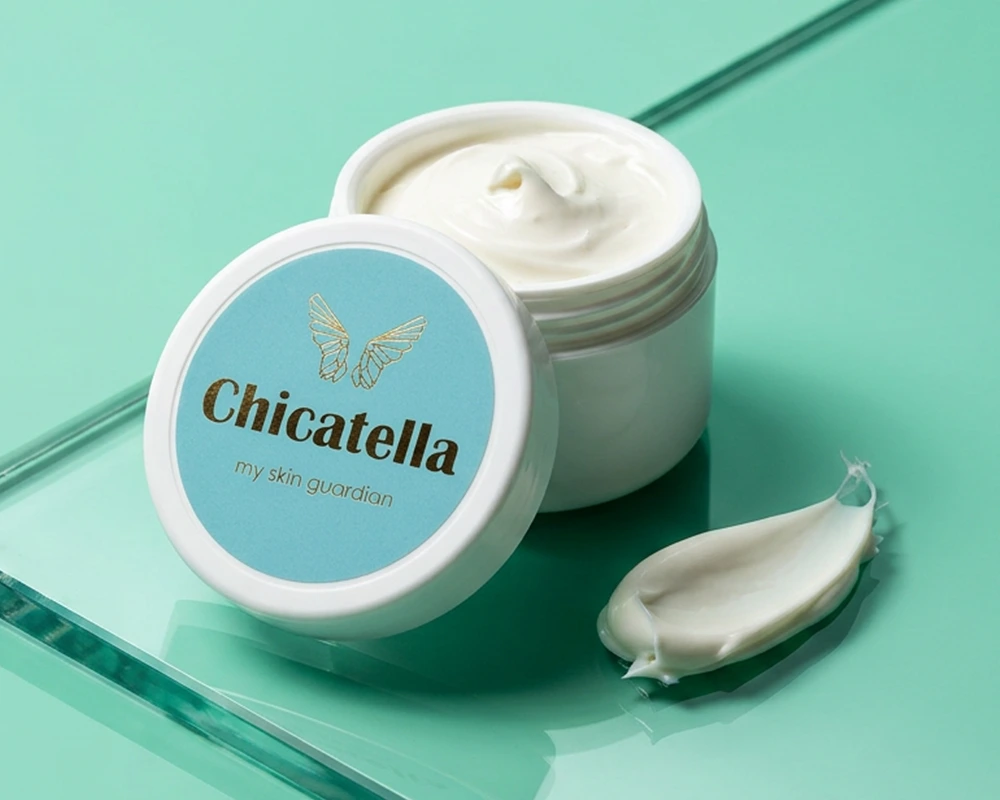
SOS Ointment – baby eczema cream for very dry, eczema-prone skin, open jar
FOR VERY DRY, IRRITATED SKIN
3 mo+
SOS Ointment
When you need something that stays put overnight.

A thick, occlusive ointment that stays on the skin: it covers cracks, locks in moisture and forms a barrier against drool, diapers and wipes.

✓Small, very dry and cracked areas; a thin layer also works as a barrier under the diaper.
✕Damp, oozing, infected or sweaty skin; damp skin folds.
See SOS Ointment →
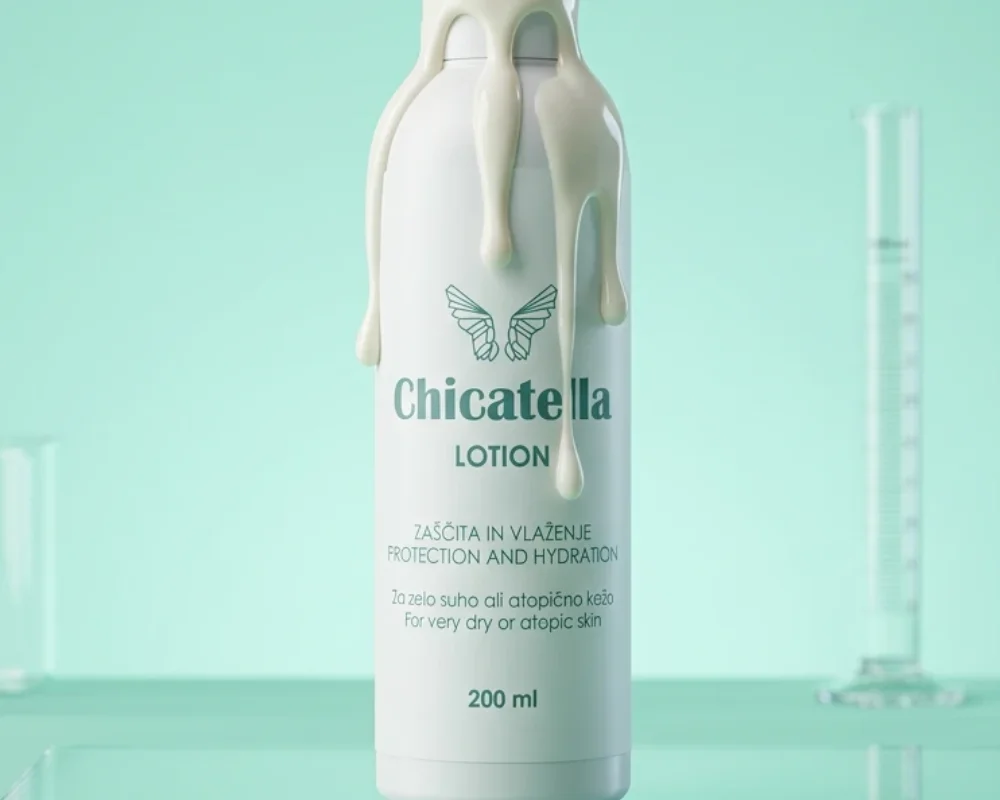
Body Lotion – eczema lotion for very dry skin, 200 ml bottle
Body, arms, legs · every day
3 mo+
Body Lotion
Everyday care to keep dry skin comfortable.

A light emollient texture that absorbs in seconds and locks the water from the bath into the skin.

✓Dry, unbroken skin on larger areas, best right after a bath.
✕Open, oozing or very painful skin.
See Body Lotion →
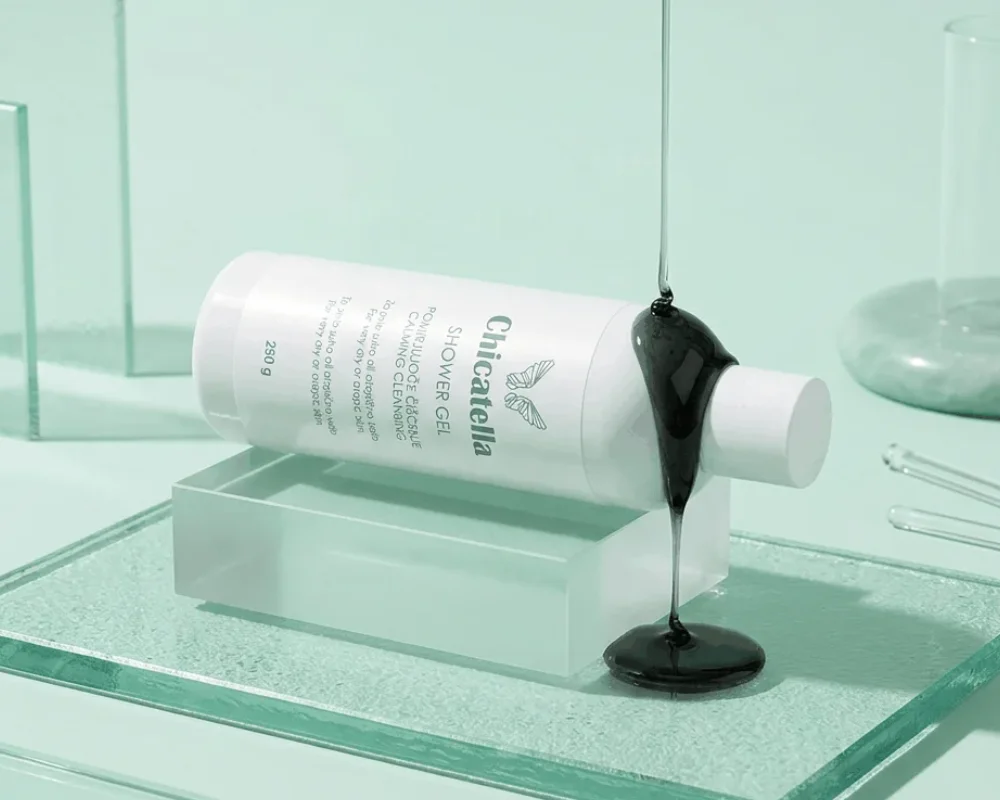
SOS Body Wash – gentle body wash for a baby’s dry, sensitive skin
GENTLE WASHING
3 mo+
SOS Body Wash
Cleanses without drying.

No harsh foaming agents or fragrance. After a bath, skin doesn’t feel tight. It’s soft and ready for moisturizer. 

✓Short, targeted washing only where it’s really needed.
✕Open or very painful areas.
See SOS Body Wash →
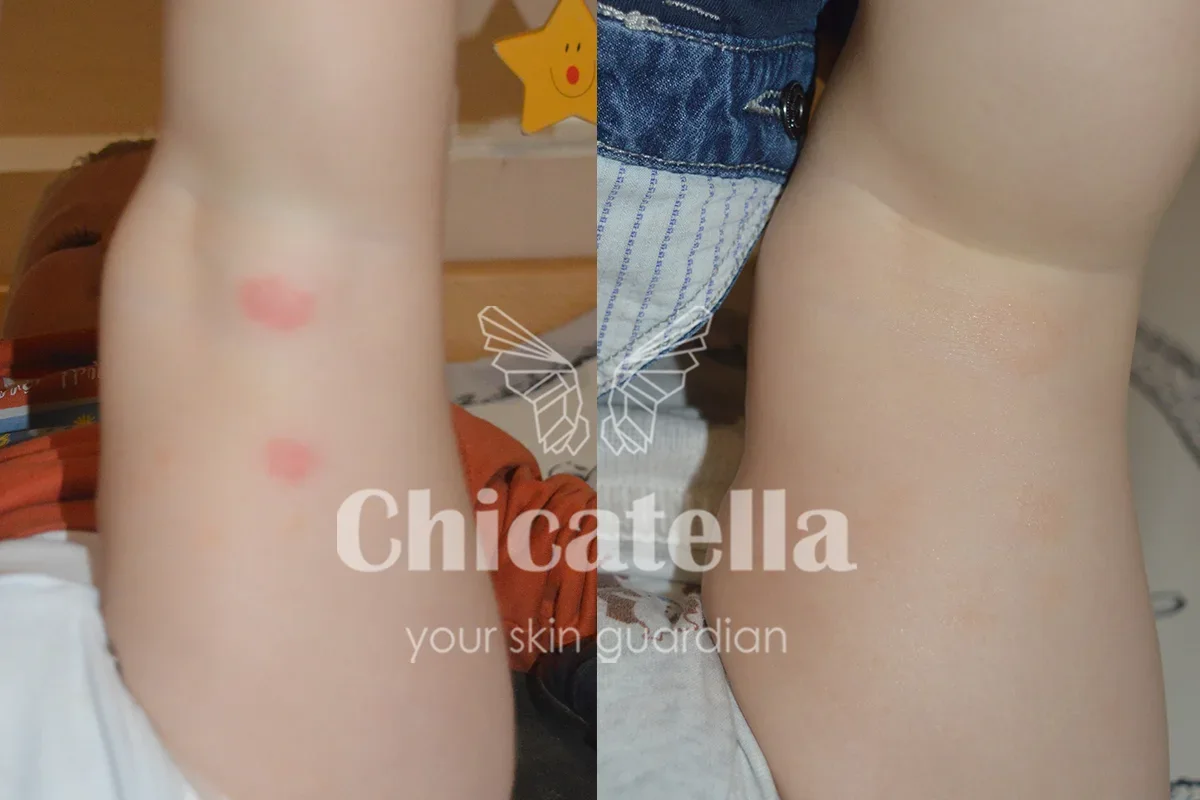
Before & after

When the right care supports a baby’s very dry or eczema-prone skin

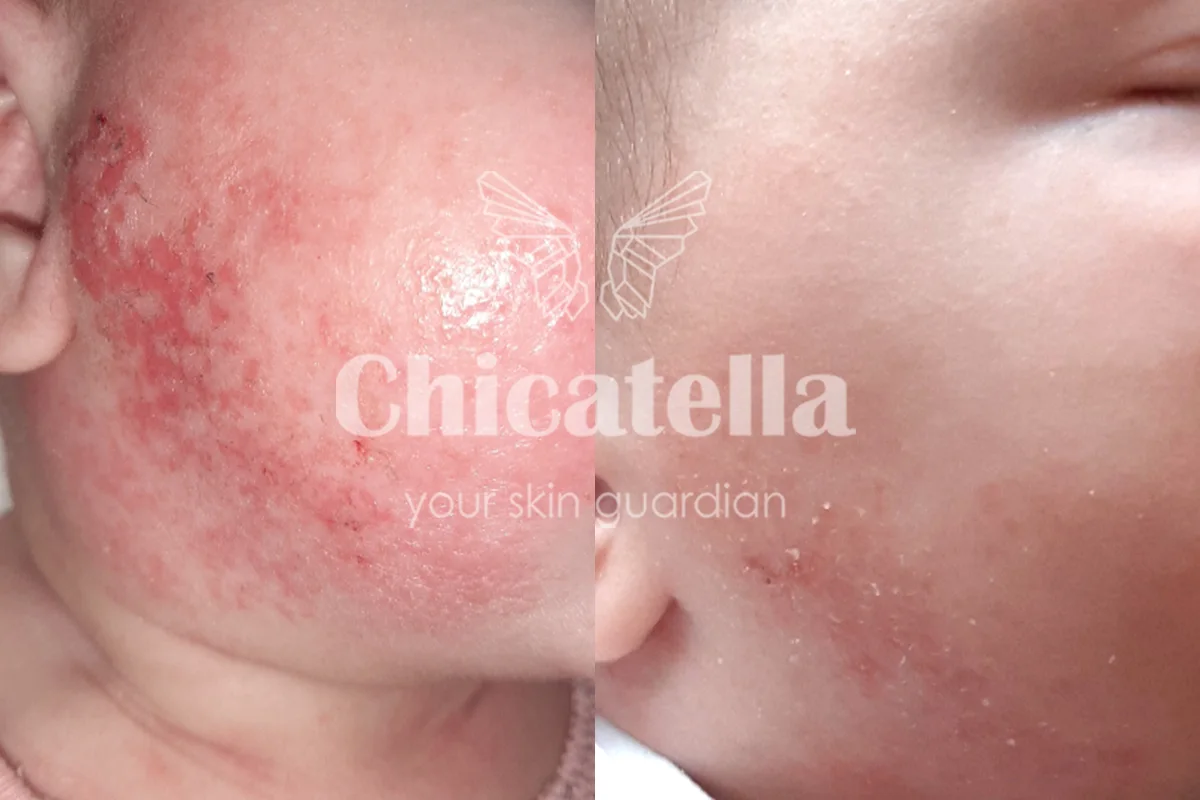
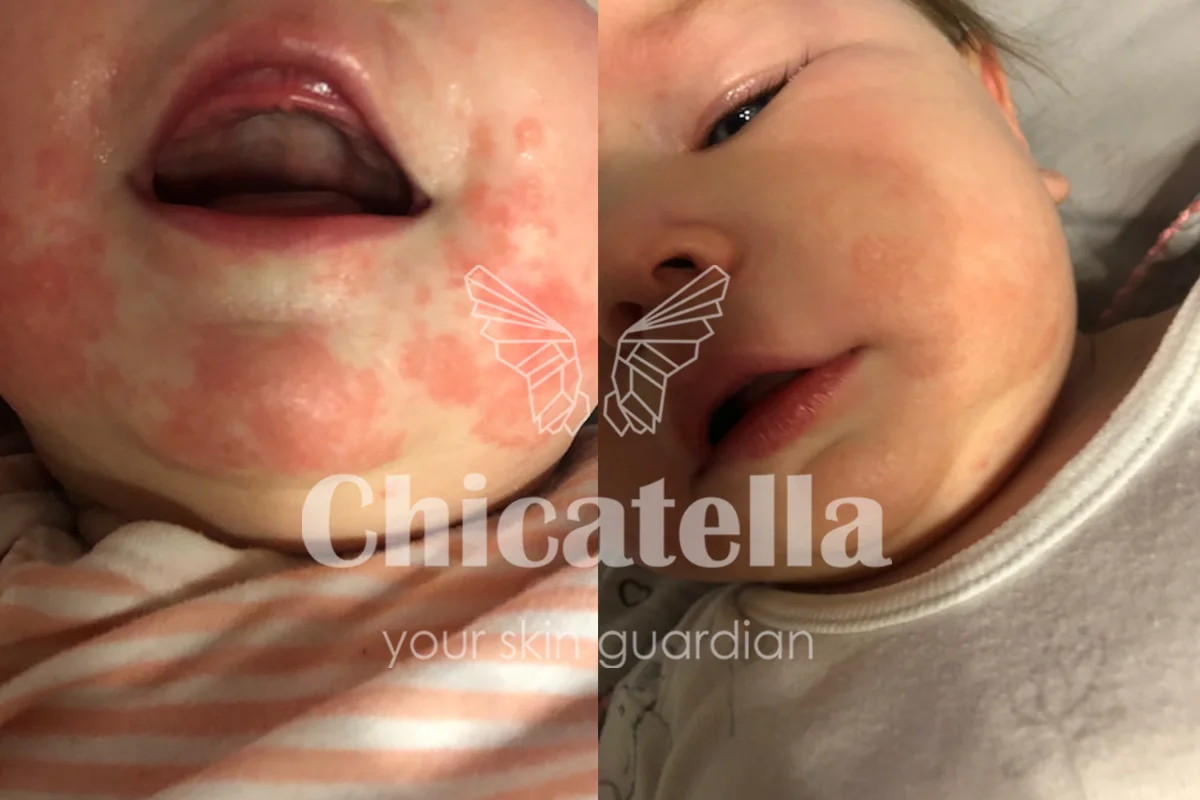
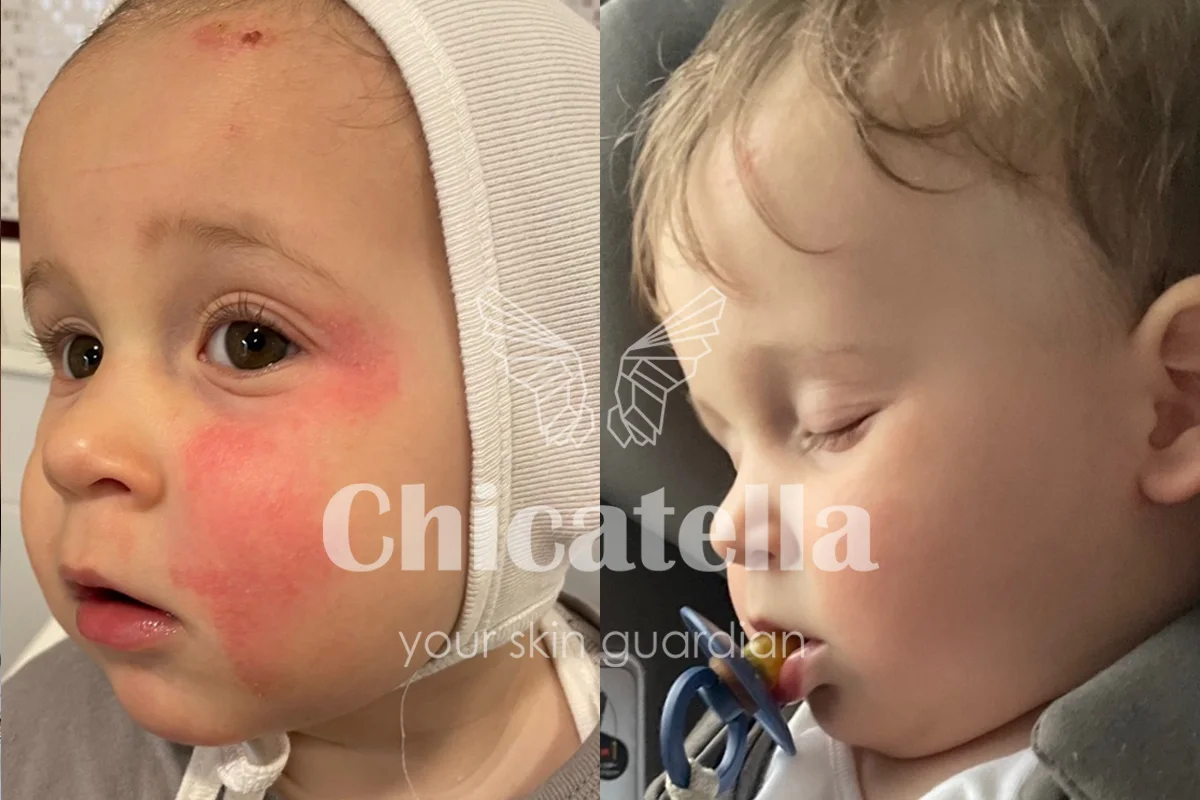
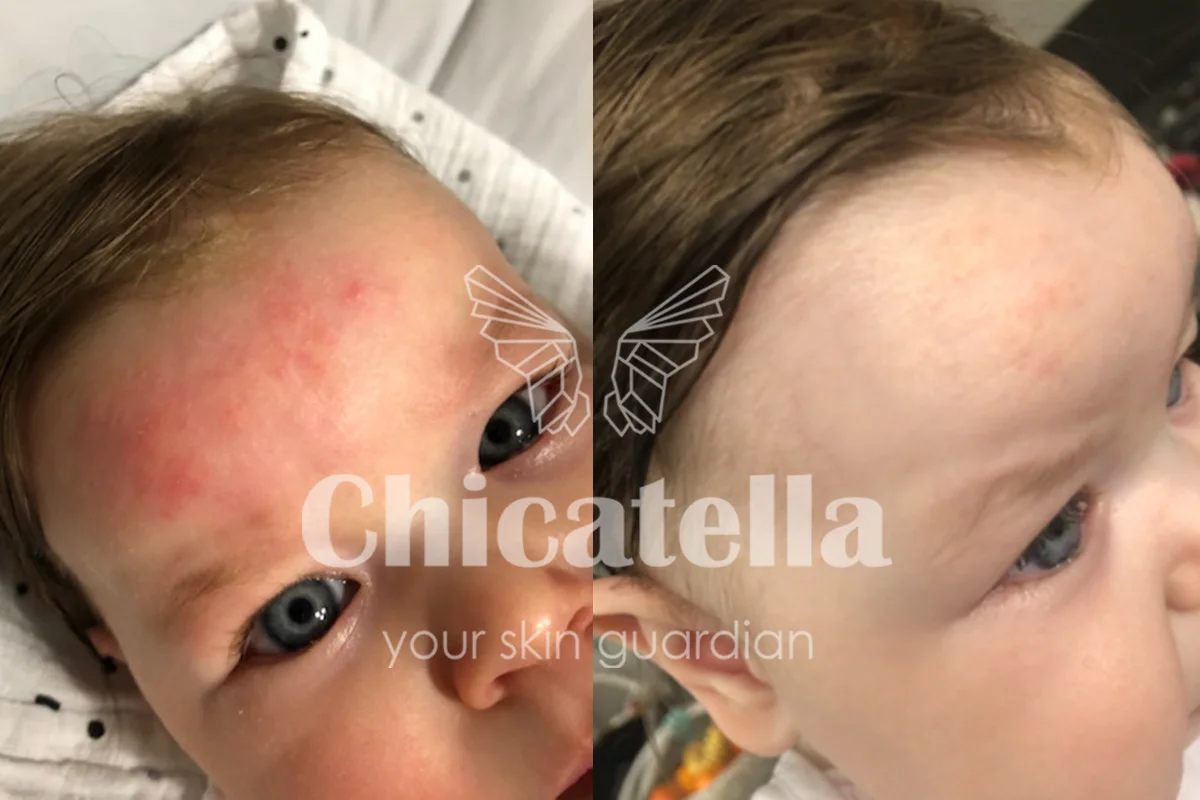
The same skin before and after care. Photos from parents, shared with permission.
Browse→
Baby eczema before and after: a few round red spots on a toddler’s skin
Baby eczema with atopic dermatitis: red patch on the chest and shoulder, before and after
Baby eczema on the face: weepy red rash on the cheek, before and after
Baby eczema around the mouth and chin: red drool rash, before and after
Baby eczema in winter: bright red cheeks on a toddler, before and after
Baby eczema or seborrheic dermatitis: red patch on a baby’s forehead, before and after

These photos show individual experiences with cosmetic care for very dry or eczema-prone skin. Chicatella isn’t a medicine for dermatitis, the photo doesn’t confirm a diagnosis, and results may vary.

Keep reading

Related guides

Eczema in children
When your baby grows up: what changes.
Read →
Atopic dermatitis in babies
The most common pattern in the first year.
Read →
Atopic dermatitis in children
An in-depth guide for parents.
Read →
Atopic dermatitis
The full overview of the condition.
Read →
Dermatitis
The umbrella term for skin inflammation.
Read →
Eczema
A type of rash and the skin’s current state.
Read →
Seborrheic dermatitis
Cradle cap and greasier flakes.
Read →
Contact dermatitis
Irritation and delayed allergy.
Read →
Perioral dermatitis
When it really is perioral dermatitis, and when it isn’t.
Read →
Dry skin
Supporting the skin’s protective layer.
Read →
To sum up

Reading what the skin really needs

Dry cheeks may need protection from water loss, a damp skin fold needs less moisture, strong inflammation needs the right medicine, and an infection needs a pediatrician. So the gentlest care starts with careful observation, not with the thickest layer of product.

Help me choose

Find the right care for your skin in three steps

No guesswork. Answer three quick questions and we’ll tell you what your skin needs.

This article helps you understand common patterns of dermatitis in babies, but it can’t diagnose anything or replace a doctor’s exam. A photo isn’t enough for a diagnosis; a pediatrician can check whether it’s inflammation, an infection or something else. Chicatella products are cosmetic skin care products, not medicines, and they don’t contain any medicine.

Sources & references
  1. 01Atopic Dermatitis: Update on Skin-Directed Management, 2025. American Academy of Pediatrics. ↗︎
  2. 02Treatment of Atopic Dermatitis. AAP. ↗︎
  3. 03Pediatric atopic dermatitis guidelines. American Academy of Dermatology. ↗︎
  4. 04How to treat eczema in babies. AAD. ↗︎
  5. 05Corticosteroids for childhood eczema. AAD. ↗︎
  6. 06Atopic eczema in children under 12 (CG57). NICE. ↗︎
  7. 07Immediate treatment of eczema herpeticum (QS44). NICE. ↗︎
  8. 08EuroGuiDerm guideline on atopic eczema, 2025 (PDF). ↗︎
  9. 09AAAAI/ACAAI Joint Task Force — Atopic dermatitis guideline (PDF). ↗︎
  10. 10Eczema in babies and children. HealthyChildren / AAP. ↗︎
  11. 11Treating and controlling eczema. HealthyChildren / AAP. ↗︎
  12. 12Common diaper rashes. HealthyChildren / AAP. ↗︎
  13. 13Cradle cap. HealthyChildren / AAP. ↗︎
  14. 14Cradle cap. NHS. ↗︎
  15. 15Nappy rash. NHS. ↗︎
  16. 16Rashes in babies and children. NHS. ↗︎
  17. 17Fever in children under five (NG143). NICE. ↗︎
  18. 18Skin Barrier Function in Neonates and Infants, 2025. PubMed. ↗︎
  19. 19Changes in Skin Barrier Function in Neonates, 2024. PubMed. ↗︎
  20. 20The Skin Microbiome in Pediatric Atopic Dermatitis and Food Allergy, 2024. ↗︎
  21. 21The skin barrier and microbiome in infantile atopic dermatitis, 2024. PubMed. ↗︎
  22. 22Skin microbiome dynamics in atopic dermatitis, 2025. ↗︎
  23. 23Skin care interventions in infants for preventing eczema and food allergy. Cochrane. ↗︎
  24. 24BEEP randomized trial — daily emollient during infancy for prevention of eczema. ↗︎
  25. 25Food allergy in children and young people (CG116). NICE. ↗︎
  26. 26Peanut allergy prevention guideline (PDF). NIAID. ↗︎