Eczema on your legs is one name for five different problems.
Shins that itch every winter. An ankle that swells by evening. A rash after new shoes. The back of the knee that flares every fall. A grade-schooler’s cracked feet. Each story has a different next step.
Your legs are the farthest from your heart and the closest to the ground. That’s why gravity, shoes, dry air and hot water all leave their mark there.

How we wrote this article
It’s not one disease. Dry skin, poor circulation, shoes, eczema-prone skin or sweaty kids’ shoes: five paths to a similar look.
Where on your leg it starts tells you more than how it looks.
Your shins have fewer oil glands than anywhere else on your body. That’s why they’re the first to give out in winter.
A brownish, swollen ankle is a vein problem, not a skin problem. Care helps, but you need a checkup.
What helps is a routine: less hot water, the right socks and shoes, dry skin between your toes and a layer that stays on your shins.
One leg that’s hot, swollen and painful, or a fever: get seen today.
Six patterns people describe most often
With eczema on the legs, the location tells you more than the color. If you spot your pattern here, it’s easier to understand why it keeps coming back and what really helps. The diagrams are simplified and don’t replace a checkup.
Quick answers first
What is eczema on the legs?
Why do my shins itch in winter?
Why is the skin around my ankle brownish and swollen?
Is eczema on the legs contagious?
Can shoes cause dermatitis?
Why does my child have cracked, shiny feet?
When should I see a doctor?
Where on your leg does it itch or burn?
Six areas, six most common reasons. The color on the sketch matches the color of the card.
Eczema-prone skin; heat and sweat in the crease.
Both legs, the same season every year, similar patches in the elbow creases or on the neck.
Very dry skin (winter, hot showers, wool); round patches; psoriasis.
Cracks in tiny polygons or sharply outlined patches; better when you cut back on hot water and soap.
Blood pooling in the veins; skin thickened from scratching.
Swells by evening, brownish skin, varicose veins; better in the morning than at night.
Contact allergy to something in your shoes; friction from the shoe tongue.
A shoe-shaped rash, worse when you sweat, better after a few days in different shoes.
Most often a fungal infection; trapped moisture.
Whitish, soggy skin between the 4th and 5th toes, odor, nail changes: a reason for a skin scraping, not for a greasy cream.
In kids, juvenile plantar dermatosis; in adults, blisters, cracked heels, fungus.
Shiny and smooth or scaly skin, blisters; are the spaces between the toes healthy?
The sketch isn’t a diagnosis. It’s a way to spot the pattern and tell your doctor where it started, whether it’s on both legs and when it’s at its worst.
Same look, five different ways to get there
1 · Dry skin that cracks: why the shins
The shin has very few oil glands and sits right over the bone. In winter, with dry heated air, hot showers and wool, it’s the first part of your body to give out. The skin cracks into polygons like crazed porcelain, and scratching turns the cracks into inflammation. Doctors call it asteatotic eczema, and it’s most common in older adults.5↗
Less hot water, no soap on your shins, cotton under wool, and care that stays on. More: dry skin.
2 · Blood that pools
The valves in your veins weaken, blood pools, and fluid leaks into the tissue above the ankle. The skin gets inflamed, itches and turns brownish. This is stasis (venous) dermatitis: after 50, 6–7 in 100 people have it; after 70, more than 20.1↗
- →Both legs, worse in the evening, varicose veins.
- →Skin here easily develops allergies to creams, so fewer ingredients is better.3↗
The foundation is compression, prescribed by your doctor. Skin care plays a supporting role. More: stasis dermatitis.
3 · Shoes and socks
Sweat pulls chemicals out of your shoes and onto your skin. Once your body becomes sensitized to one of them, just a few hours in those shoes can set off a rash in the shape of whatever touches your skin.
Glue inside the shoe, dark dyes in socks.
A patch test shows which substance is to blame, sometimes using small pieces of your own shoes. More: contact dermatitis.
4 · Eczema-prone skin
With eczema-prone skin, the barrier is weaker from birth. Once a child starts walking, eczema moves to the backs of the knees, the wrists and the ankles.9↗ Eczema-prone skin and the other paths can happen together. More: atopic dermatitis.
5 · Kids’ feet: wet in the shoe, dry outside
- →Kids ages 3–14, 8 on average.7↗ The front of the sole is shiny, reddish and cracked; the skin between the toes stays healthy.
- →The cause: sweating in synthetic shoes, then drying out fast, plus friction.
- →Cotton socks, breathable shoes, a change of shoes during the day, a rich moisturizer at night. It fades by puberty.
Numbers that show you’re not the only one
people over 50 have venous eczema on the lower legs1↗
over 702↗
of people worldwide have athlete’s foot8↗
of people tested for foot dermatitis are allergic to footwear or a foot product6↗
average age of a child with cracked soles7↗
Context: international data, not a Slovenian estimate. The 23% applies to people referred for testing, not to everyone with a rash.

A red, warm shin: is it an infection?
Venous eczema is red, warm and swollen, so even doctors often mistake it for a bacterial infection and prescribe antibiotics that don’t help.2↗ The call is your doctor’s.
- both legs;
- itches more than it hurts;
- lasts weeks, worse in the evening;
- brownish skin, varicose veins;
- no fever.
- one leg;
- hurts more than it itches;
- comes on in a day or two, spreads fast;
- fever, chills;
- a wound, blisters or pus.
What can look like eczema on the legs
| Possible condition | Helpful clue |
|---|---|
| Athlete’s foot (fungal infection) | White, soggy skin between the 4th and 5th toes; often one-sided, thickened nails. A skin scraping confirms it.8↗ |
| Psoriasis | Sharply outlined, thick patches with silvery scales on the knees and shins; often nail changes. |
| Cellulitis (bacterial skin infection) | One leg, pain, warmth and swelling that grow fast, fever. See above. |
| Skin thickened from rubbing | One or two hard, darker, very itchy patches on the ankle that someone has been scratching for years. |
| Scabies | Itching all over the body at night, changes between the toes, others in the household have it too. |
| Dry skin without inflammation | Rough skin without redness. More: dry skin. |
How a doctor looks for the cause
Questions: when it started, whether it swells by evening, which shoes, how many showers, whether it itches at night.
An exam of both legs, between the toes, the nails and the veins; pulses in the feet.
A vein ultrasound and an arterial check before prescribing compression.
A skin scraping for fungus when the toes, soles or nails are involved.
A patch test: a footwear series plus pieces of your own shoes.
Less often, a biopsy when the picture stays unclear.
What actually helps
1 · Cut out what dries your legs out every day
2 · Match your care to each part of your leg
3 · If blood is pooling, treat the cause
The foundation is compression (stockings or wraps) plus raising your legs and moving.1↗ Your doctor decides how much, because poor arterial circulation has to be ruled out first.
4 · Your doctor treats inflammation, skin care supports the barrier
Anti-inflammatory medication, an antifungal or a referral to a vein specialist, depending on the cause. Cosmetic care doesn’t replace treatment, but it helps with dryness, tightness and water loss. Don’t stop prescribed medication on your own.
When to get checked
One leg suddenly hot, swollen and painful, fever or chills, a red streak up the leg, pus or fast-growing blisters, sudden pain in the calf.
Your legs need a protective layer that lasts until morning
You sort out the cause with your doctor. But you can start calming dry, tight skin on your shins, heels and feet tonight: lotion on damp legs in the morning, ointment at night wherever the skin cracks. Two steps, two minutes.

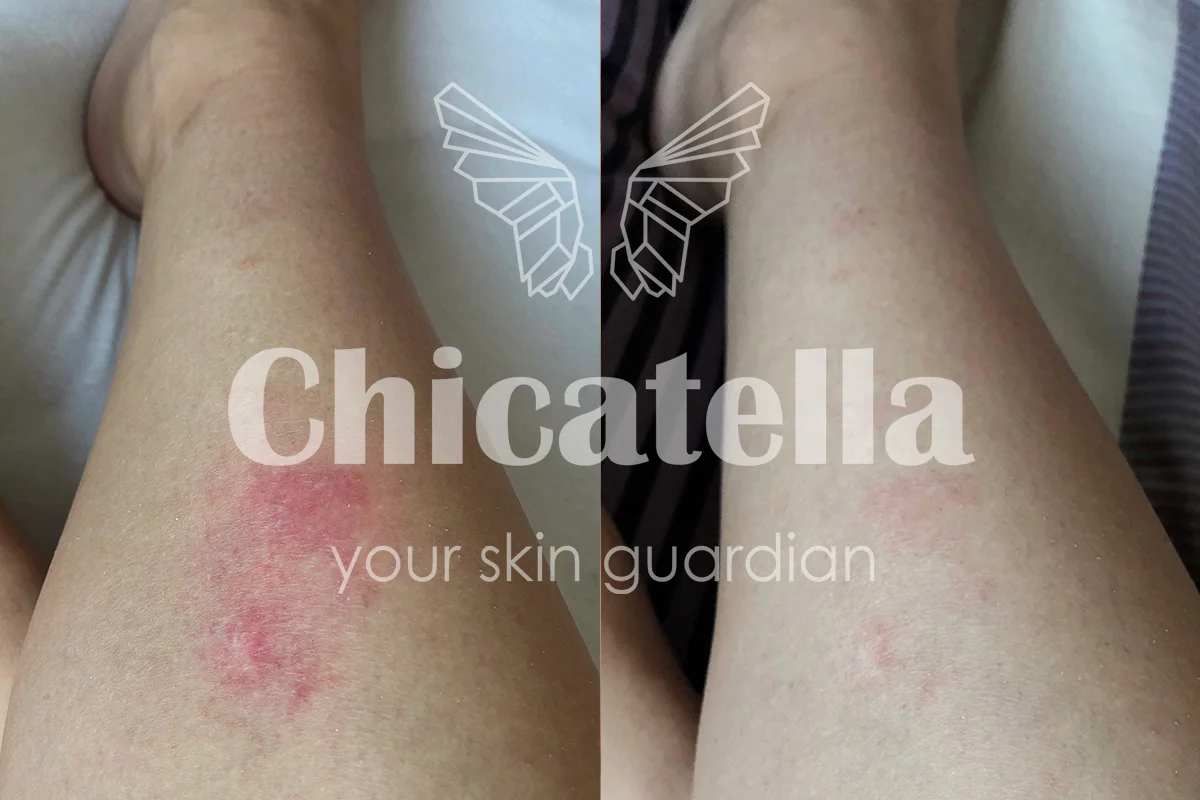
How eczema on the legs can change in appearance
Customer photos, shared with permission.
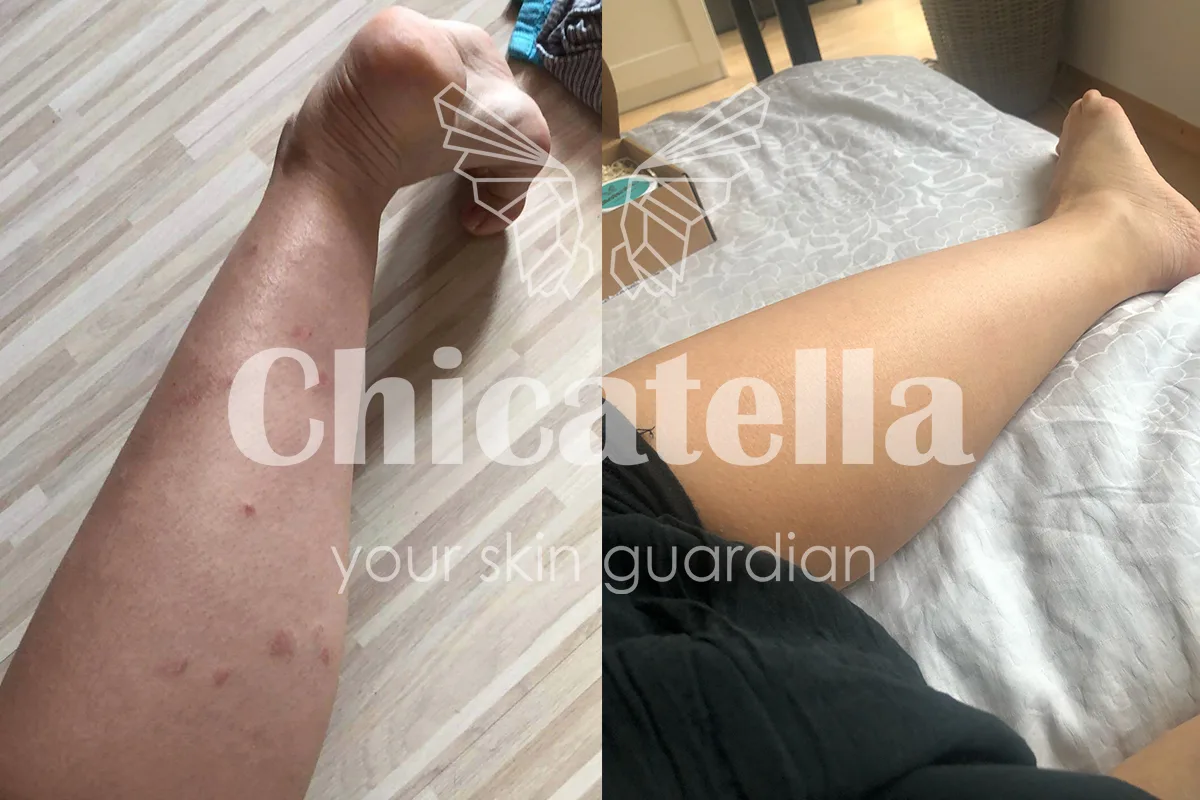
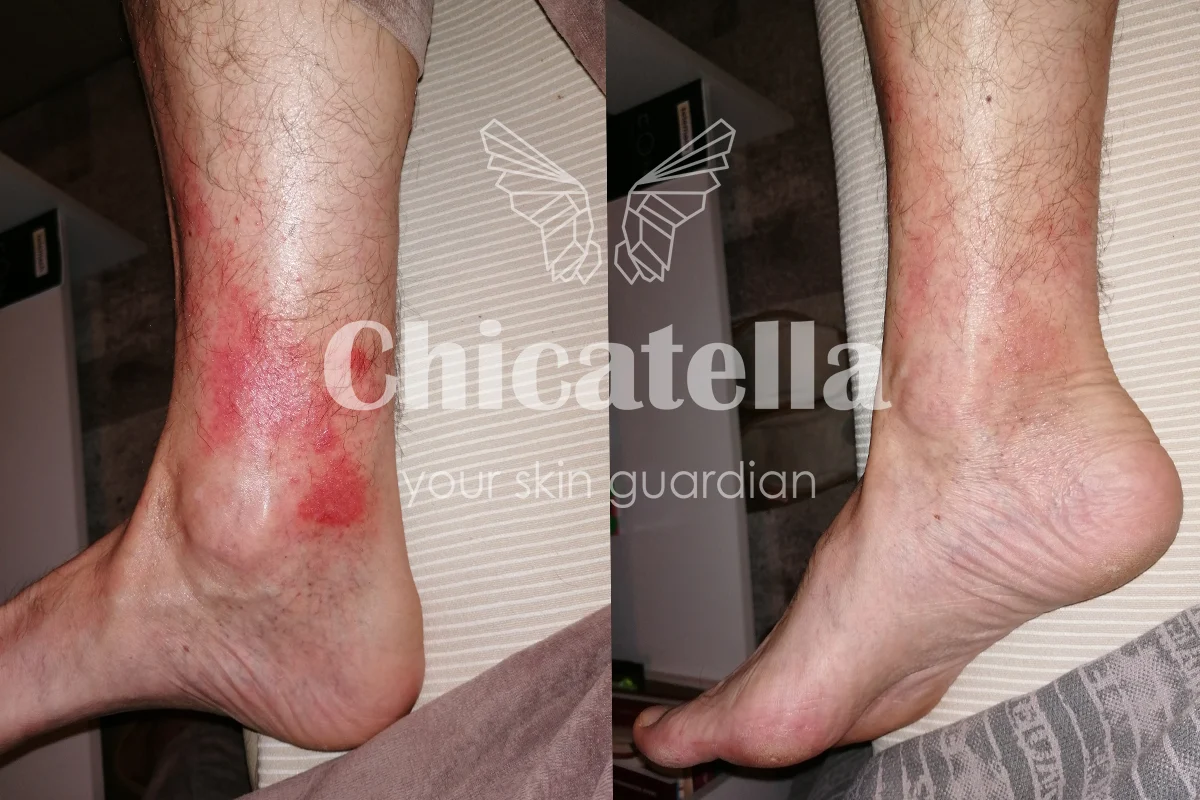
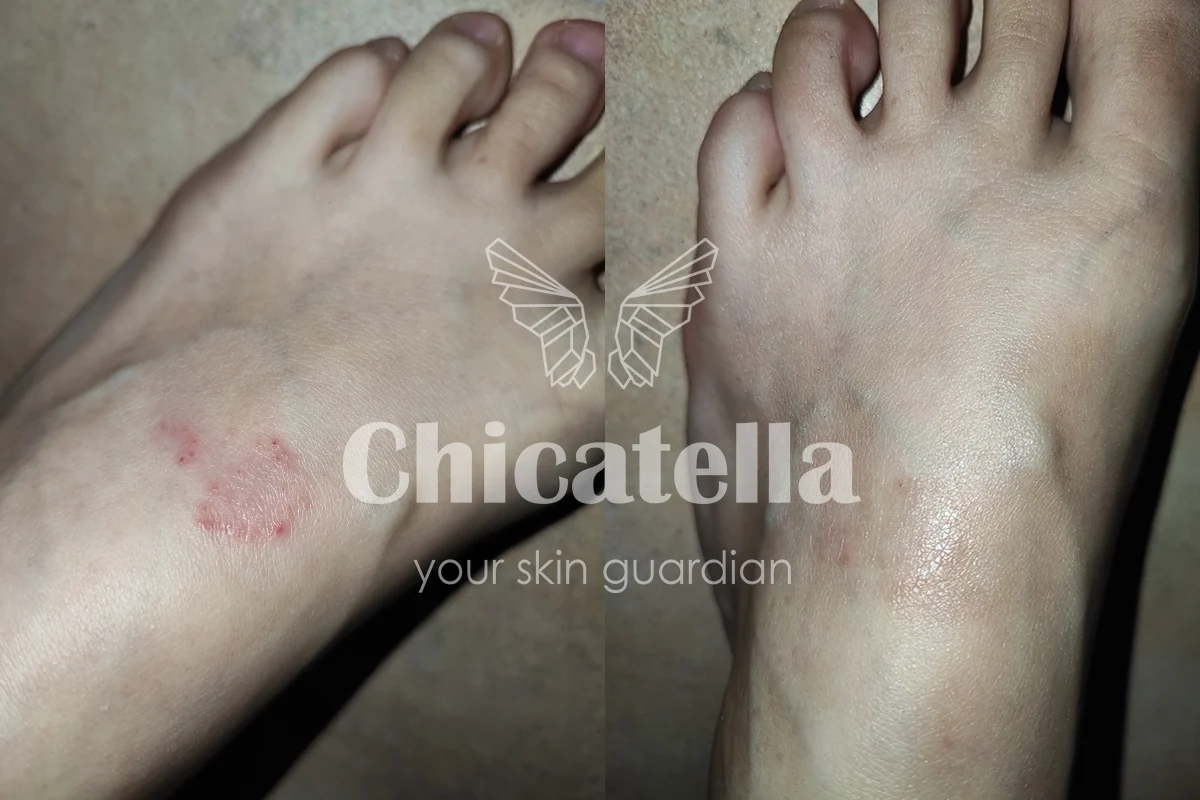
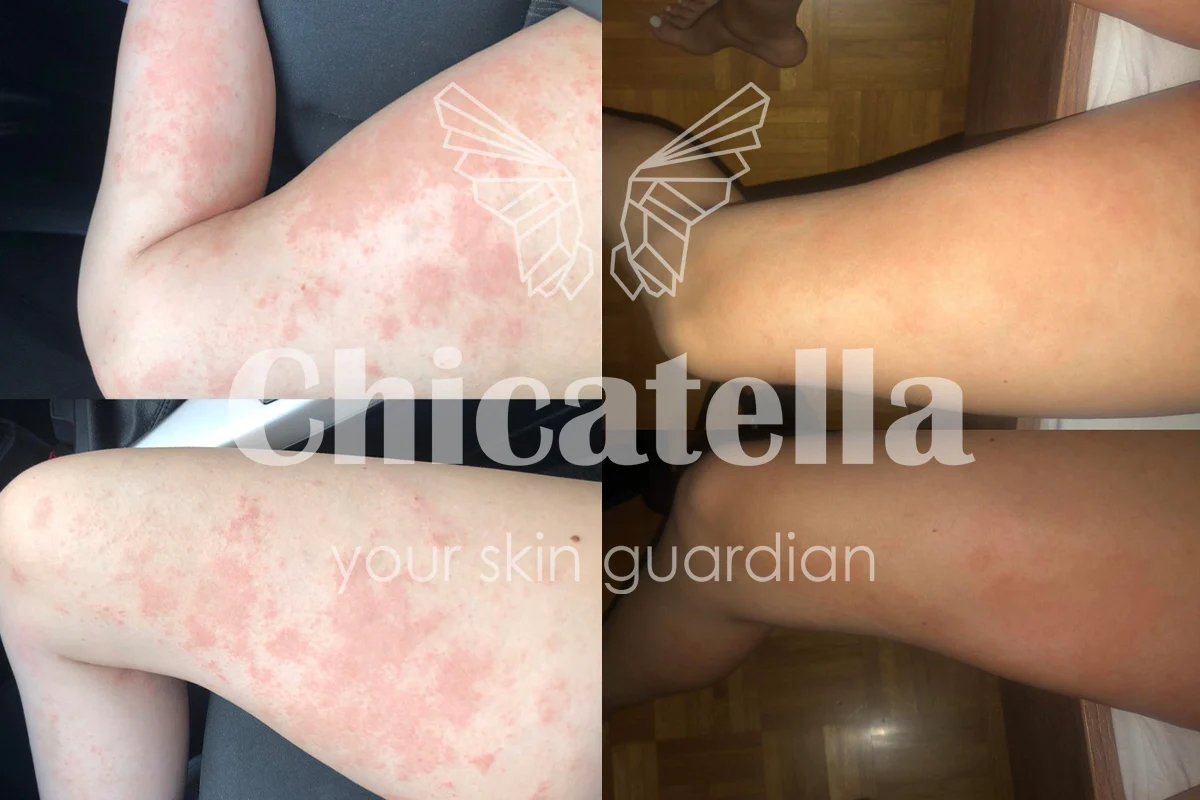
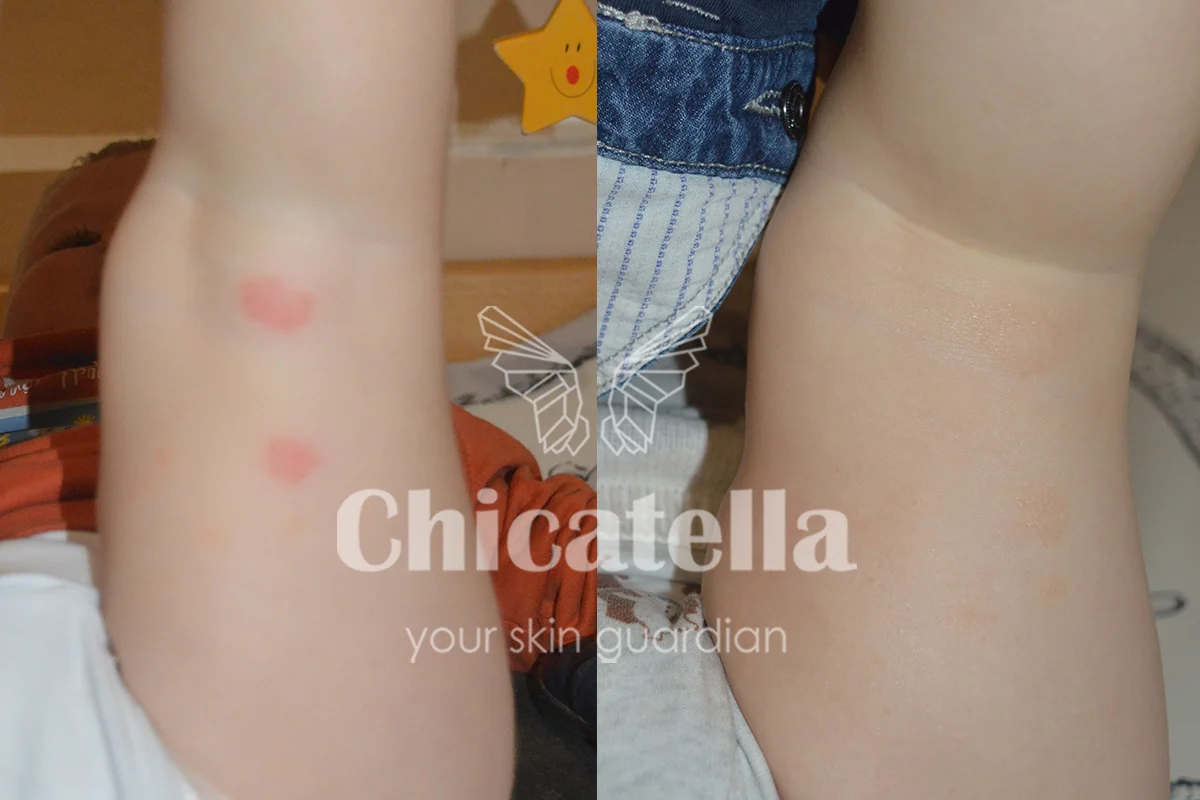
Individual experiences caring for very dry or irritated skin. Cosmetic care; results vary.
Looking for something else?
Your legs tell you where it hurts, if you listen
A shin that cracks every winter needs less hot water and a layer that stays on. An ankle that swells and changes color needs a vein checkup. A foot with a shoe-shaped rash needs different shoes and a test. Kids’ feet need cotton, air and time.
Find the right care for your skin in three steps
No guesswork. Answer three quick questions and we’ll tell you what your skin needs.
This article helps you understand eczema on the legs and choose your care. It doesn’t diagnose anything and doesn’t replace a checkup. Chicatella products are cosmetics, not medicines.
- 01Stasis Dermatitis: Burden of Disease, Diagnosis, and Treatment. Dermatitis, 2024. ↗
- 02Stasis dermatitis: a challenging patient journey. JEADV Clinical Practice, 2023. ↗
- 03Stasis dermatitis — an overview. ScienceDirect. ↗
- 04Allergy to rubber accelerators. DermNet NZ. ↗
- 05Asteatotic eczema. Primary Care Dermatology Society. ↗
- 06Patch testing with a shoe series in 230 patients. Contact Dermatitis, 2005. ↗
- 07Juvenile plantar dermatosis. DermNet NZ. ↗
- 08Tinea pedis: an updated review. Drugs in Context, 2023. ↗
- 09Atopic dermatitis. DermNet NZ. ↗
- 10Petrolatum: barrier repair and antimicrobial responses. Czarnowicki et al., JACI, 2016. ↗
- 11The role of moisturizers in addressing various kinds of dermatitis. Purnamawati et al., 2017. ↗
- 12Chromium release from leather shoes in contact dermatitis. Contact Dermatitis, 2020. ↗