Eczema and diet: is food really to blame for flare-ups?
When your skin gets worse again, it’s only human to start looking for the culprit on your plate. Milk? Eggs? Gluten? Sugar? Sometimes the link is real. But often, at the same time, your skin is reacting to cold, sweat, an infection, stress, poor sleep or skipped skin care. This guide helps you tell the difference without needlessly cutting foods from your diet or your child’s.
Searching for “eczema diet” often leads to long lists of foods you supposedly need to cut out. But research tells a much more interesting story: for a small group of people, food is an important trigger. For most, a strict diet doesn’t improve the skin enough to be worth the risks.

How we put this article together
Same diagnosis, different triggers
Four topics to help you judge whether food is a trigger for you at all: when food is more often the culprit, which foods are most common, how long after a meal a reaction shows up, and how to tell an allergy from irritation around the mouth.
Ten things worth knowing
Atopic dermatitis isn’t a food disease, but food allergies are more common in people with eczema.
Food is a more likely trigger in babies and children with moderate to severe eczema.
A positive blood or skin test doesn’t mean you have to cut that food out.
A fast allergic reaction usually shows up within a few minutes to two hours.
An eczema flare-up on its own can appear 6 to 48 hours later, but that’s much less common.
Cutting out milk, eggs or gluten across the board doesn’t bring most people any meaningful improvement.
An elimination diet only makes sense when there’s a well-founded suspicion and a planned reintroduction of the food.
In babies, avoiding an allergen unnecessarily may raise the chance of developing a real allergy later.
A varied, nourishing diet supports your overall health, but no diet repairs a damaged skin barrier.
Regular skin care still matters, even when a real food trigger is found.
If there’s trouble breathing, swelling of the tongue or throat, sudden severe weakness, or symptoms in several parts of the body at once, follow your allergy action plan and call 911. After a reaction like that, don’t try the food again at home without your doctor’s guidance.
Quick answers first
Which foods most often make eczema worse?
Do I have to cut out dairy?
Does a gluten-free diet help?
Does sugar cause eczema?
Does a positive allergy test mean I’m allergic?
Are probiotics helpful?
Does vitamin D help?
Should a breastfeeding mom cut out milk or eggs?
How long should an elimination diet last?
What should I eat if I have eczema?
Three things that aren’t the same
Mixing these up is exactly why so many people needlessly cut out foods they tolerate just fine. Tap a card.
A test measures the immune system’s response. A diagnosis also requires real, repeatable symptoms.
Two hours or two days: timing tells you a lot
A surprising result for elimination diets: 50 vs. 41
A systematic review of ten randomized trials with 599 participants compared how many people got a meaningful improvement in their skin with an elimination diet, and how many without one.Oykhman↗︎
Cutting out a confirmed allergen matters. But cutting out several food groups without a diagnosis usually isn’t justified.AAAAI/ACAAI↗︎
Why cutting out a specific food in a baby can do exactly the opposite
The leading scientific hypothesis: the immune system can meet a food through inflamed skin. That’s why you never rub food on the skin to test for an allergy.
This doesn’t mean a child should eat a food they’re already allergic to. It does mean you don’t cut out foods they already tolerate just because of a positive test or fear.
In the AAAAI/ACAAI guidelines, a blanket elimination diet was linked only to a small possible benefit for eczema, while indirect data in high-risk babies suggest that avoiding peanuts for longer may raise the chance of a later allergy.AAAAI/ACAAI↗︎
Eating peanuts early and regularly lowered the chance of peanut allergy in adolescence by 71% in high-risk children. That isn’t a treatment for atopic dermatitis, but it is proof that avoiding allergens early isn’t always the safer choice.NIH↗︎
This page doesn’t give a schedule or amounts. For a baby with severe eczema or a known allergy, let a pediatrician or allergist decide how to introduce foods.

When is the suspicion about food strong enough to check?
Food allergy is documented in about a third of children with moderate to severe atopic dermatitis. That doesn’t mean food causes eczema in a third of all children.EuroGuiDerm↗︎
A positive allergy test isn’t a list of forbidden foods
First, what matters is a detailed account of the reaction.
Then the doctor chooses only the relevant blood or skin tests.
A positive result means possible sensitization, not necessarily an allergy.
When the answer isn’t clear, the most reliable option is a supervised food challenge under medical supervision.
Foods a person eats regularly without problems aren’t cut out just because of a positive lab result.
If a child eats an egg every week without any trouble, a positive egg test alone isn’t a reason to drop eggs overnight.
Broad commercial panels and IgG tests for “sensitivity to 100 foods” aren’t the right tool for diagnosing food allergy. That doesn’t mean all allergy tests are bad. The problem is testing without a clear question.NICE↗︎EAACI↗︎
Milk isn’t one question, it’s three
Milk can make eczema worse for some people. The question isn’t whether milk is “bad”, but whether the link has actually been confirmed for you or your child.
What about gluten, eggs, sugar, histamine and “inflammatory foods”?
| Food or diet | What we know | When cutting it out makes sense |
|---|---|---|
| Cow’s milk | With a confirmed allergy it can be an important trigger, but cutting it out across the board has no convincing benefit | Confirmed allergy or a professionally supervised diagnostic trial |
| Eggs | A common allergen in young children, but not cut out just because of eczema | A repeatable reaction and a professional assessment |
| Gluten | No evidence that a gluten-free diet treats atopic dermatitis in general | Celiac disease, wheat allergy or another confirmed diagnosis |
| Sugar | Not a direct allergen, and no proof that it causes eczema on its own | Moderation for your overall health, not as a “skin cure” |
| Ultra-processed food | There are links with allergic diseases, but that doesn’t prove cutting it out cures eczema | Eating less processed food is a sensible general choice |
| Histamine | Recent reviews show only weak and uncertain evidence2025↗︎ | Only with a well-founded suspicion and professional guidance |
| Tomatoes, citrus and strawberries | Can irritate damaged skin around the mouth without a real allergy | Protecting the skin and watching for other symptoms |
| Nightshades | No good-quality evidence for cutting them out across the board | Only with a clear, repeatable individual pattern |
Instead of labeling foods “good” and “bad”, separate three different things: nutritional quality, skin irritation on contact and a real allergy. These are three separate questions.
Redness only around the mouth isn’t necessarily an allergy
- drool, citrus, tomatoes and other acidic or wet foods can irritate skin that’s already dry;
- the redness is limited to the area where the food touched the skin;
- without other symptoms, it’s not necessarily a real allergy;
- never rub food on the skin as a home allergy test;
- after eating, gently rinse or pat the skin, don’t rub.
- hives elsewhere on the body too;
- swollen lips or tongue;
- repeated vomiting;
- coughing, wheezing or trouble breathing;
- sudden, severe weakness.
With these signs, cosmetic skin care isn’t the answer. Medical care is needed, and for a severe reaction, call 911.
The articles on baby eczema and eczema on the face describe a similar distinction.ASCIA↗︎
A food diary that can actually show you something
If you don’t also note other triggers and your skin care, almost any food can wrongly become a suspect. That’s why this diary is more than a list of meals. The page doesn’t save anything, so print it or copy it into a notebook.
| What to write down | 1 | 2 | 3 | 4 | 5 | 6 | 7 | …14 |
|---|---|---|---|---|---|---|---|---|
| What you ate, and roughly when | · | · | · | · | · | · | · | · |
| Fast symptoms within the first 2 hours | · | · | · | · | · | · | · | · |
| How your skin looks morning and evening | · | · | · | · | · | · | · | · |
| Itching and sleep quality | · | · | · | · | · | · | · | · |
| Skin care and medication used | · | · | · | · | · | · | · | · |
| Sweating, sports or extra friction | · | · | · | · | · | · | · | · |
| Illness or infection | · | · | · | · | · | · | · | · |
| Stress | · | · | · | · | · | · | · | · |
| Weather or a change in temperature | · | · | · | · | · | · | · | · |
| A photo of the same area | · | · | · | · | · | · | · | · |
For about two weeks, keep your diet as normal as possible.
During that time, keep your skin care as consistent as possible.
Look for the same pattern repeating, not one bad day.
If you suspect something, show the diary to your doctor or a dietitian.
Cut out only the target food, and only according to the agreed plan.
Reintroduction is part of the diagnosis, not an optional extra.
After a fast allergic reaction, don’t reintroduce the food at home.
The diary doesn’t make a diagnosis. It’s a tool for a better conversation with your doctor.
A baby with eczema: don’t hold back foods just out of fear
This applies to a baby who doesn’t have a diagnosed allergy and is just starting solid foods. If an allergy has already been confirmed, follow the plan your doctor gave you.
- →Doctors no longer advise holding back milk, eggs or peanuts from a baby “just in case”.EAACI↗︎
- →Babies usually get their first foods besides milk at around 6 months, never before 4 months.
- →Well-cooked egg and peanut (in a form they can’t choke on, such as smooth peanut butter) should come soon after the first spoonfuls, not months later.ASCIA↗︎
- →Try each new food that commonly causes allergies on its own, not several at once. That way you know what caused it if something happens.
- →Once your child tolerates a food well, keep giving it regularly. A long break can undo the tolerance.
- →If your baby has severe eczema, a known allergy or has reacted to food before, talk to your pediatrician or an allergist before introducing foods.
We don’t cover exactly how much peanut to give or how; your pediatrician should tell you that. For skin care in the youngest, see atopic dermatitis in babies, and for older kids, atopic dermatitis in children.
A breastfeeding mom doesn’t have to live on rice and turkey
- →Cutting out allergens across the board during pregnancy or breastfeeding isn’t recommended for preventing allergies.
- →Most breastfeeding moms can eat a varied diet.
- →A mom’s diet should change only when there’s a well-founded suspicion of a specific allergic condition in the baby.
- →That kind of elimination needs a clear timeline, symptom tracking, professional support and a reintroduction plan.
- →If a larger food group is cut out for a longer time, help from a registered dietitian matters.
A mom’s diet can affect her baby. But a routine diet just because of eczema isn’t a good first move. It often costs the mom nutrients and energy without making a difference to the skin.
The gut microbiome: fascinating, but not a magic switch
- a 2024 EAACI report included 27 randomized trials of dietary interventions in children without a confirmed food allergy;EAACI↗︎
- with probiotics, or combinations with prebiotics, some studies showed a sign of improvement;
- other dietary interventions had much more limited data;
- a 2025 umbrella meta-analysis in children estimated an average drop in the SCORAD score, a research scale for rating severity, of about 3.75 points;2025↗︎
- the benefit wasn’t the same for every strain and was clearer in moderate to severe eczema.
Probiotics are an interesting add-on for further research, but right now they’re not a universal treatment for atopic dermatitis.
Vitamin D, omega-3 and other supplements
A 2024 meta-analysis covered 11 randomized trials with 686 children and adults and found a moderate average reduction in eczema severity. Larger and longer studies are still needed, and the ideal dose hasn’t been established.2024↗︎
It makes sense to correct a confirmed deficiency. A supplement doesn’t replace skin care or treatment. For a child, a health professional decides the dose, and more isn’t necessarily better.
Not all probiotics are the same. A study result for one strain doesn’t apply to every product on the shelf.
Studies suggest a possible benefit, but there’s still too little data to generally recommend supplements as treatment. Eating fish or other nourishing sources of fat is part of a varied diet, not a medicine.2024↗︎
There isn’t enough good-quality evidence for routine use in everyone with atopic dermatitis. Supplements make sense when a deficiency is found or there’s another clear need.
A plate that supports your body, without promising miracles
- →a varied diet;
- →enough energy and protein;
- →vegetables and fruit in different colors;
- →beans and lentils, whole grains and other sources of fiber, if you tolerate them;
- →fish or other good sources of omega-3;
- →good sources of calcium if milk has been cut out because of a confirmed allergy;
- →regular meals and enough fluids;
- →as little fear as possible of individual foods.
A Mediterranean or less processed way of eating supports overall health. But it isn’t a proven treatment for atopic dermatitis.
Diet can’t patch up the skin barrier
Even when a real food trigger is found, atopic dermatitis is still a condition of a weakened skin barrier. Cutting out a food can’t replace the moisture, lipids and protective film that dry skin needs every day.
Matters only for the person in whom the link is real and confirmed.
An everyday need for gentle cleansing, moisturizing, softening and reducing water loss.
Where Chicatella products make sense
Whatever’s on your plate, a dry skin barrier needs moisture, softness and a protective film. The products below are made for exactly that part of the problem.
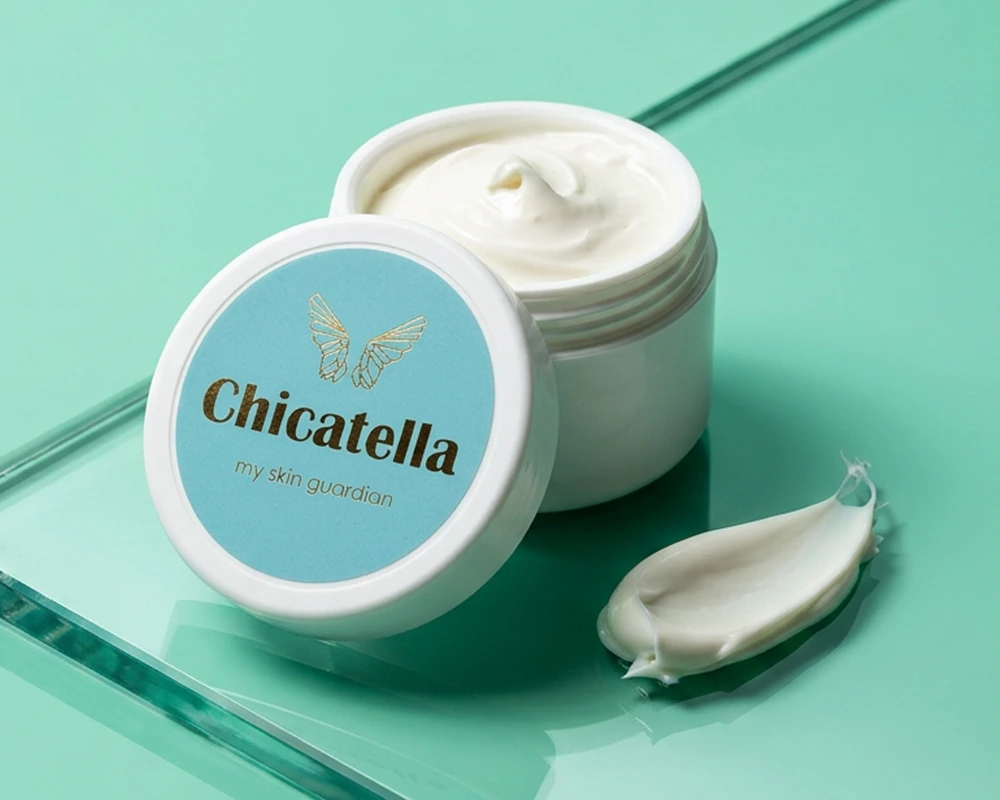
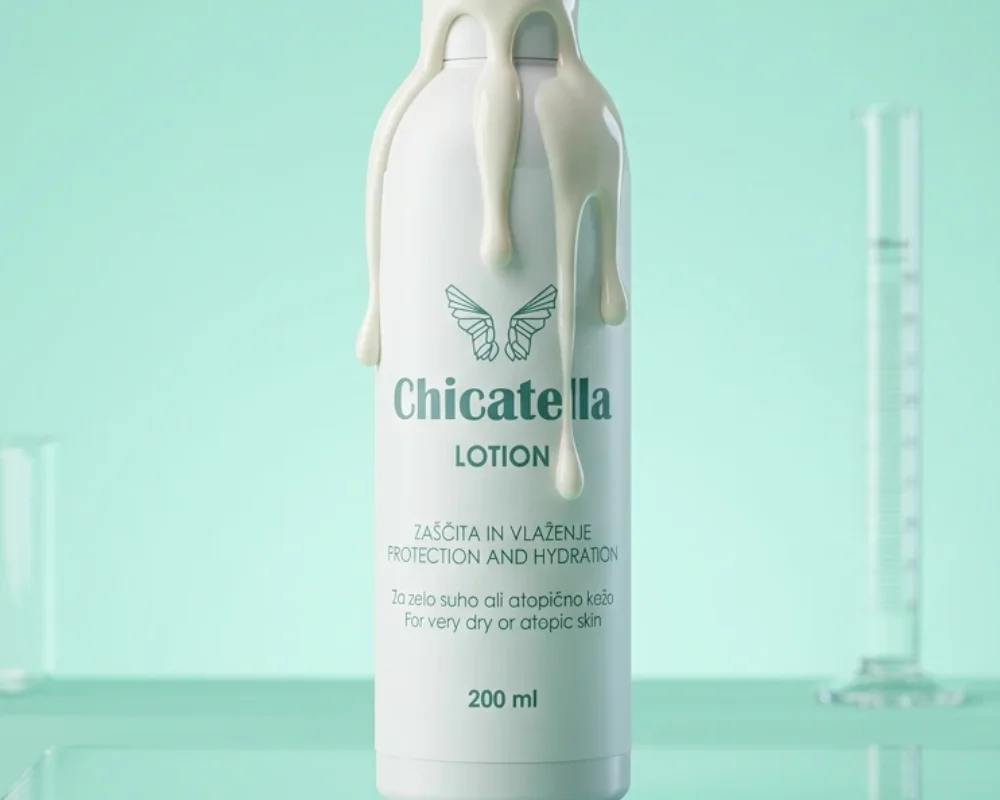
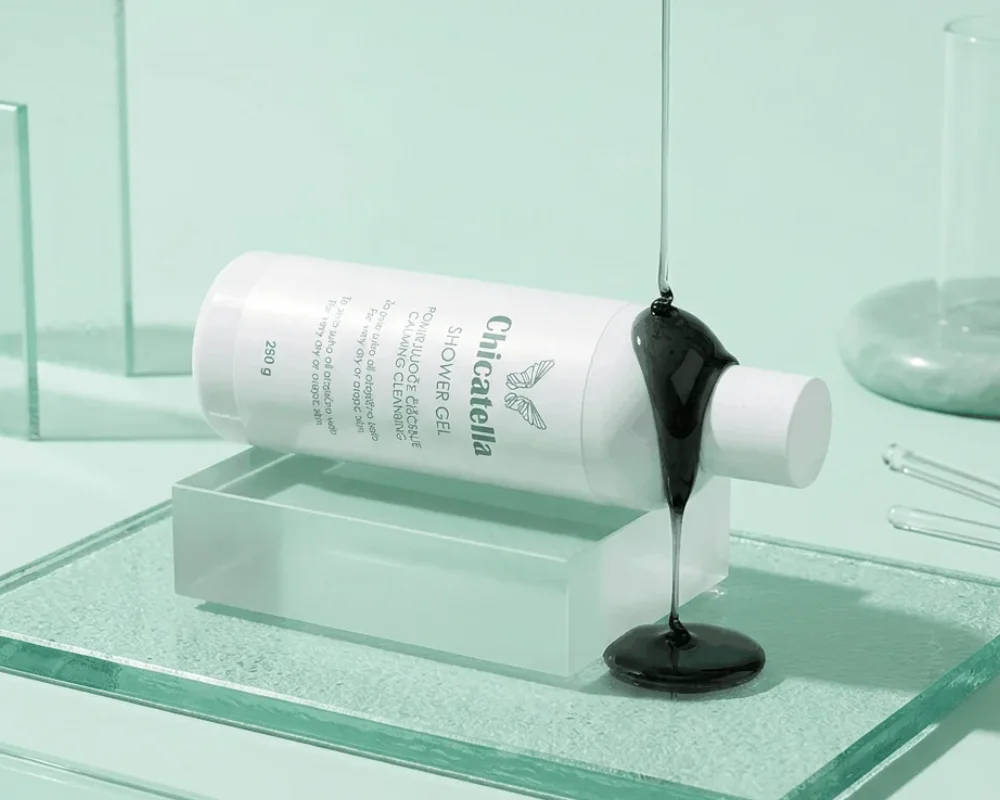
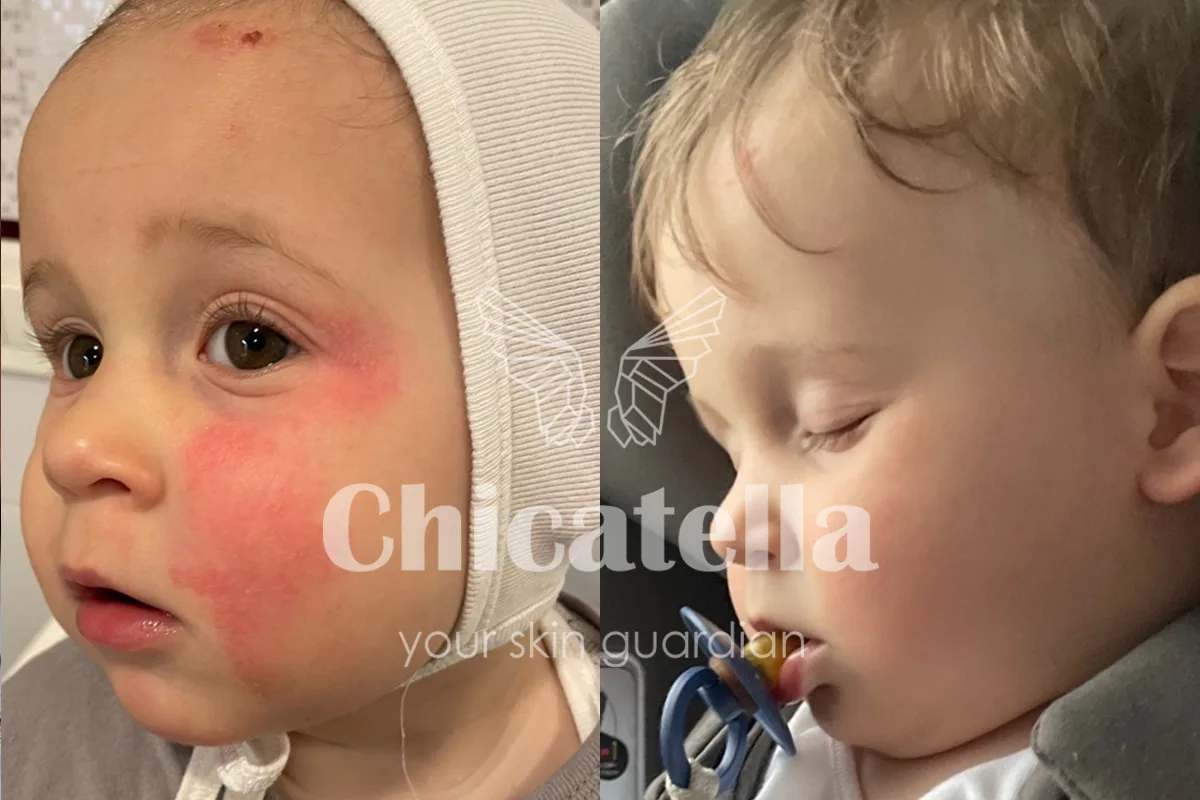
When consistent care supports dry skin again
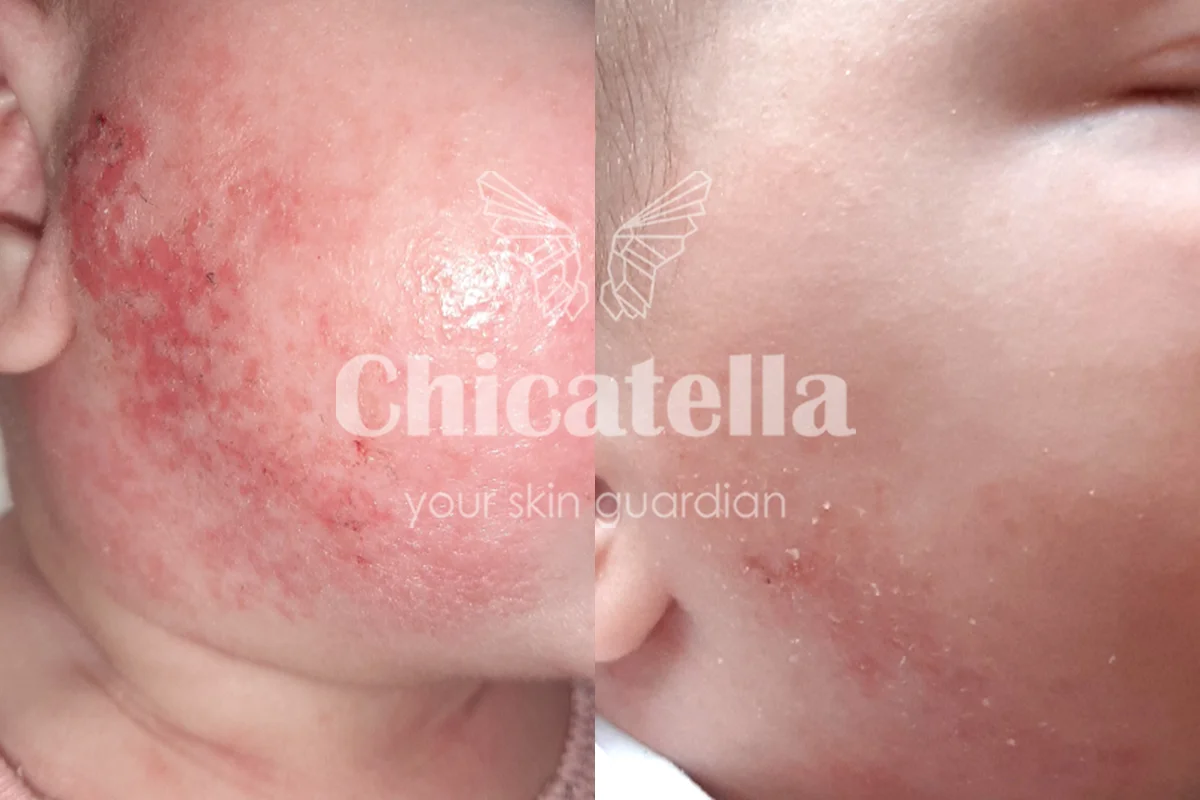
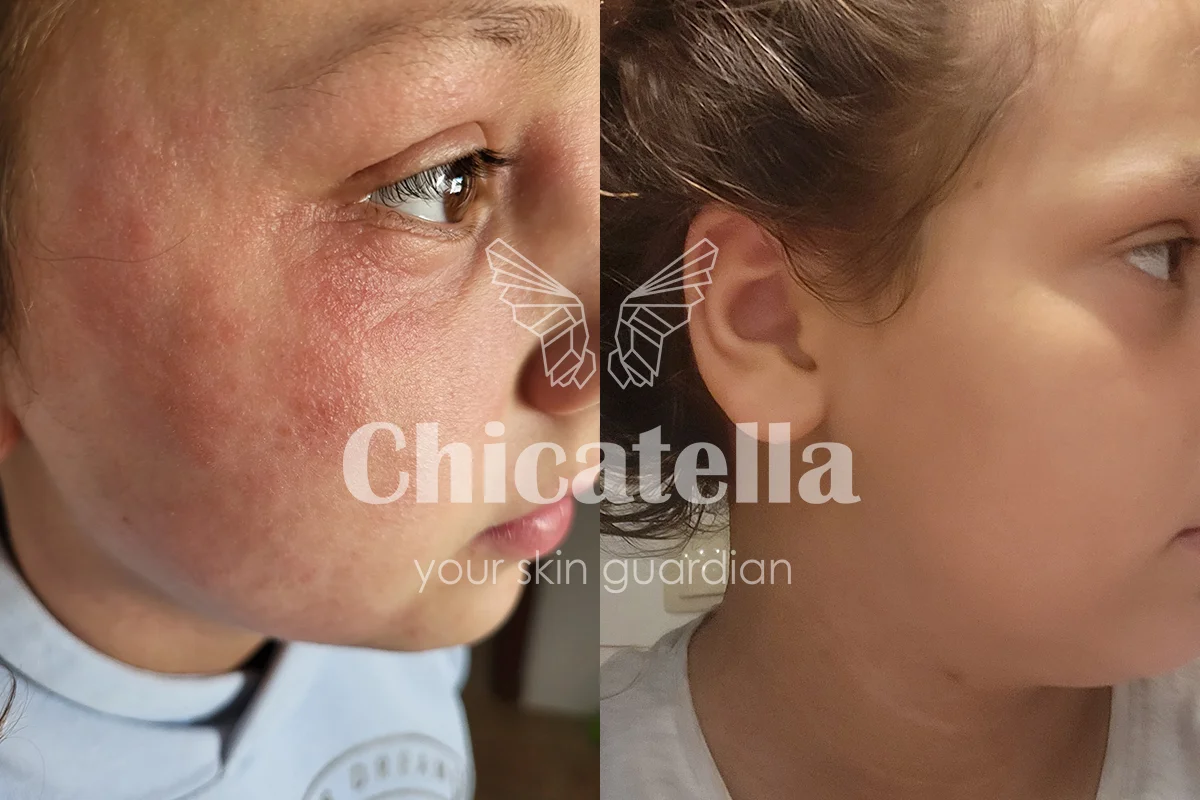
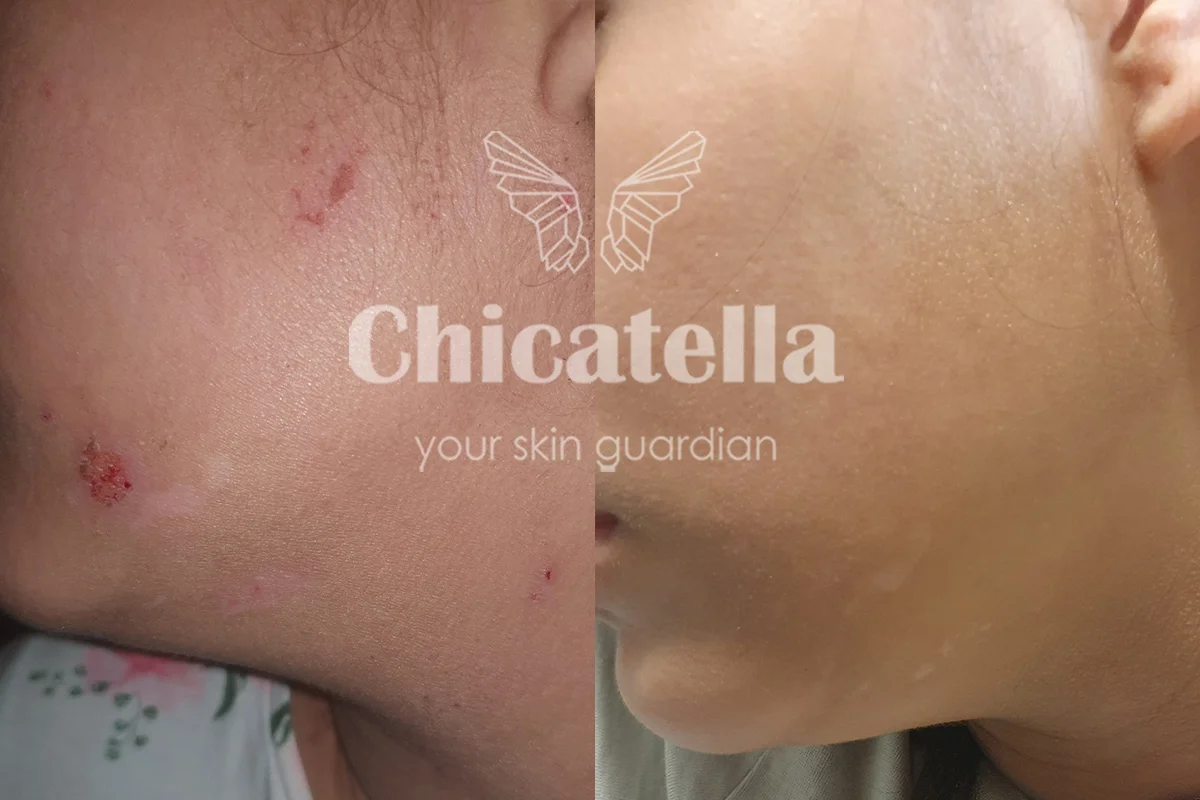
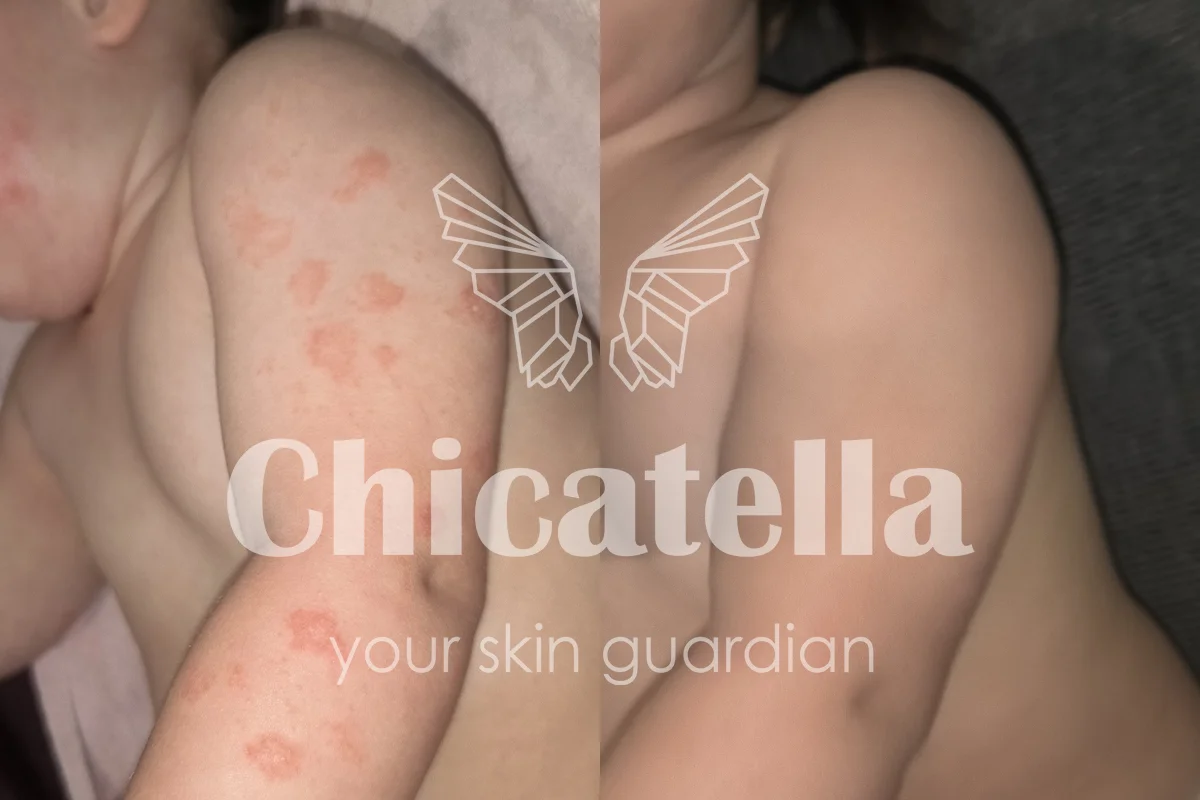
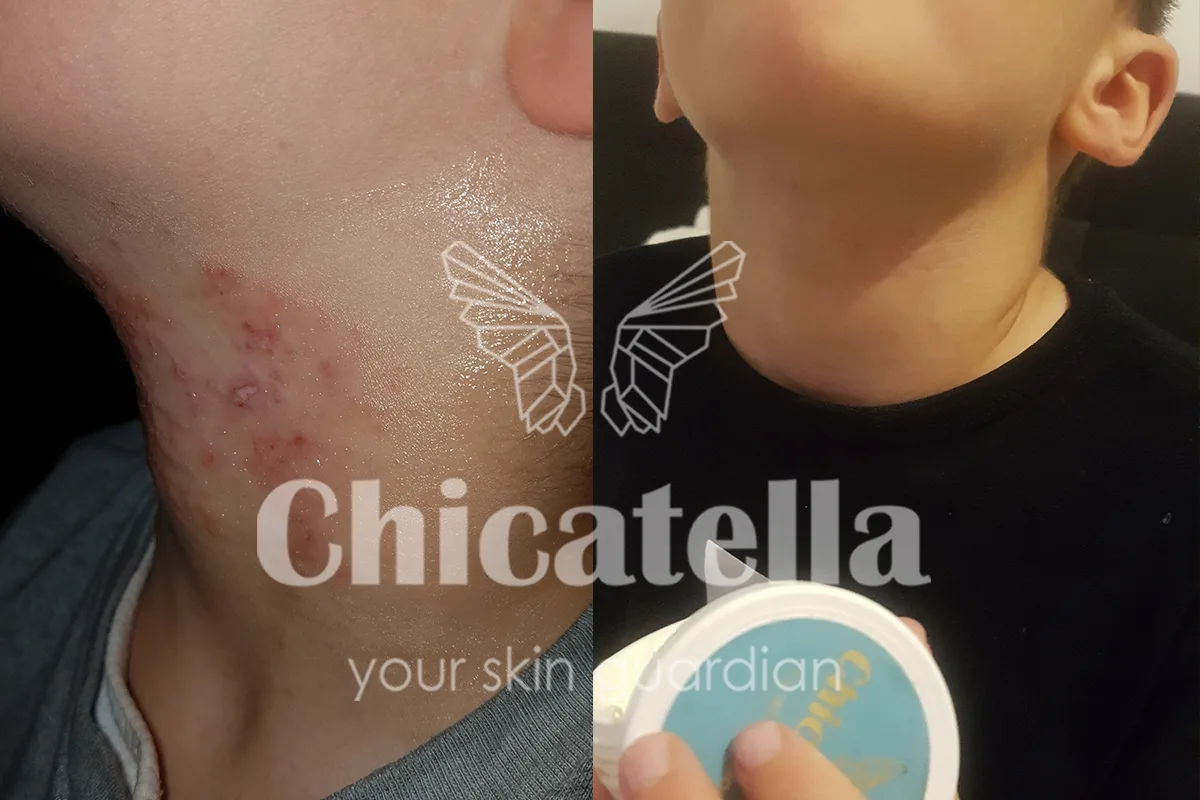
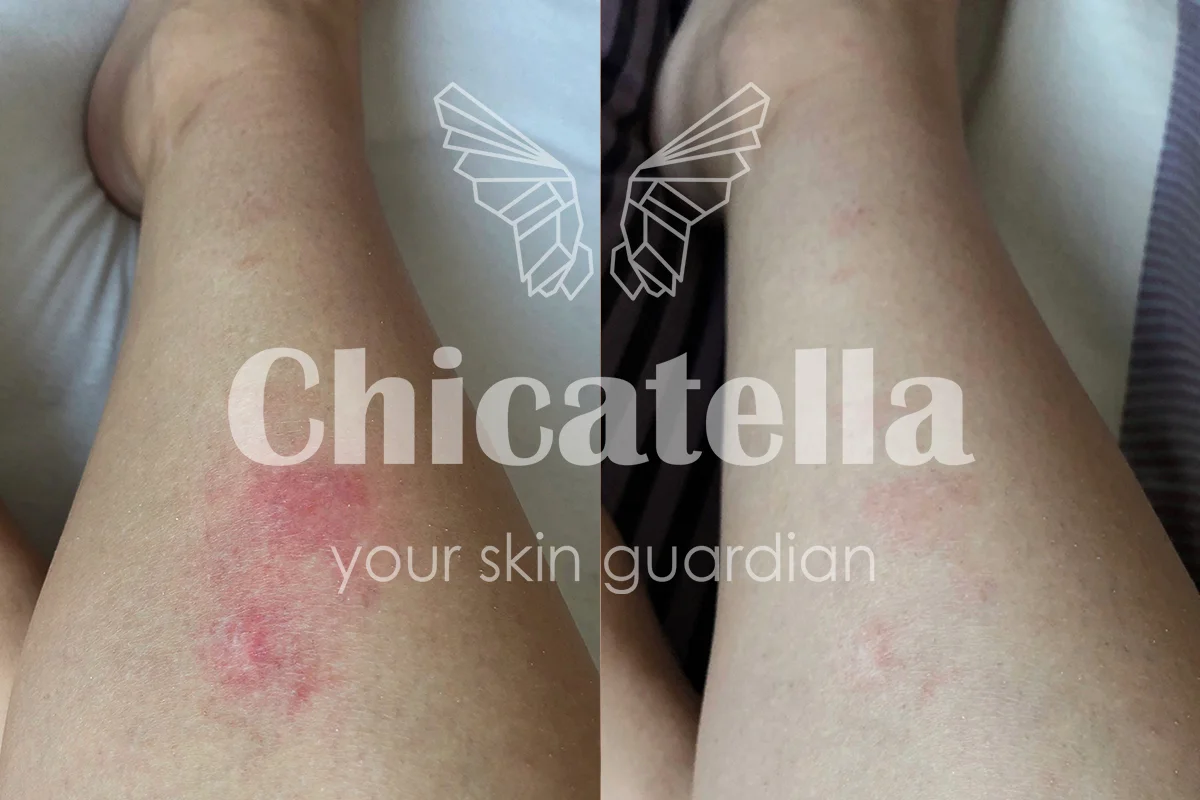
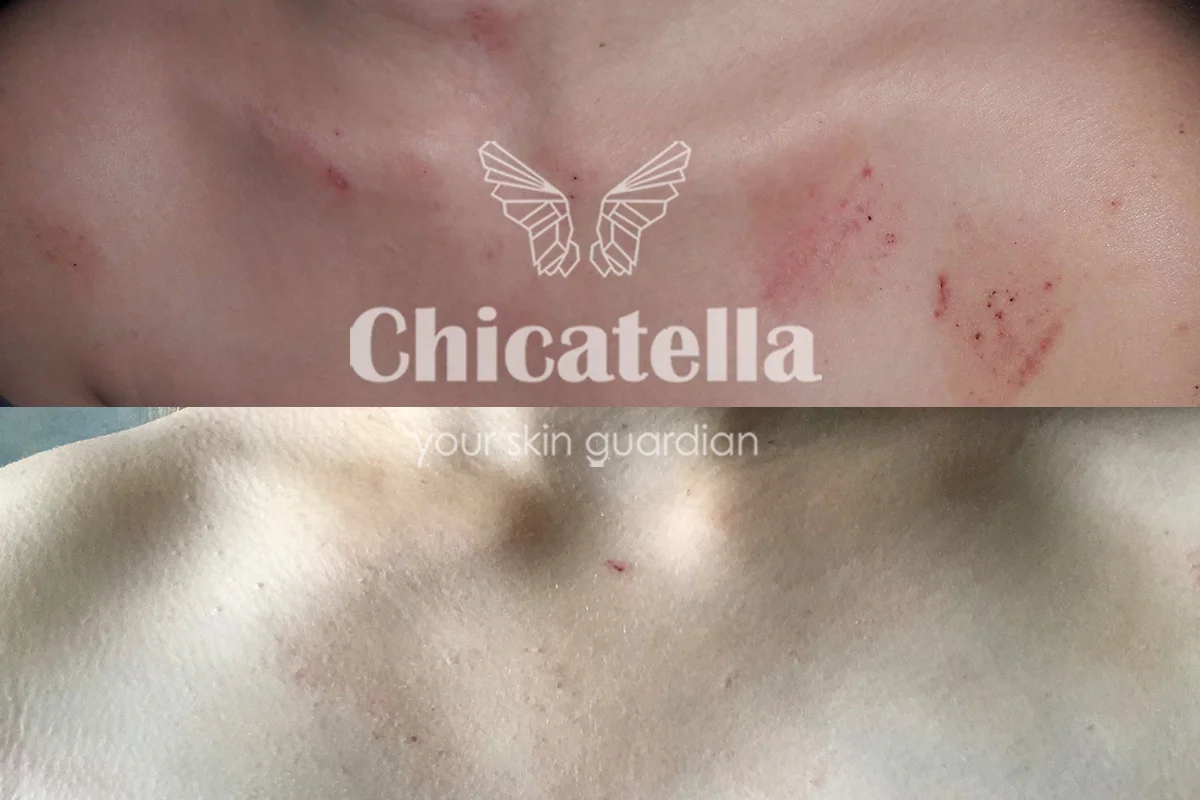
The photos show individual experiences caring for very dry or irritated skin. The products are for cosmetic care, and individual results may vary.
Related guides
Getting your skin’s needs right
When people search for “eczema diet”, most want a clear list of what to eat and what to avoid. But the most honest answer is more personal. If the same food causes repeatable symptoms, it’s worth having it checked by a professional. If there’s no clear pattern, a varied diet is usually safer than a long list of bans. And whatever’s on your plate, a dry skin barrier still needs consistent, gentle and rich enough care.
Start by figuring out what your skin needs today: less irritation, more moisture or a stronger protective film.
Find the right care for your skin in three steps
No guesswork. Answer three quick questions and we’ll tell you what your skin needs.
This article helps you understand the role of diet in atopic dermatitis, but it can’t diagnose you, replace an allergy assessment or serve as a plan for an elimination diet. Chicatella products are cosmetic skin care products, not medicines.
- 01Dietary interventions in atopic eczema (PDF). EuroGuiDerm. ↗︎
- 02Atopic eczema guideline, 2025 (PDF). EuroGuiDerm. ↗︎
- 03Atopic dermatitis guideline (PDF). AAAAI/ACAAI Joint Task Force. ↗︎
- 04Dietary Elimination for the Treatment of Atopic Dermatitis. Oykhman et al.; systematic review of 10 studies. ↗︎
- 05Nutritional and dietary interventions in children with atopic dermatitis. EAACI Task Force, 2024. ↗︎
- 06Guidelines on the management of IgE-mediated food allergy. EAACI. ↗︎
- 07Preventing food allergy in infants and young children. EAACI. ↗︎
- 08Updated infant feeding guideline, 2026. ASCIA. ↗︎
- 09Early peanut introduction and protection into adolescence. NIH. ↗︎
- 10Vitamin D supplementation for treating atopic dermatitis. Nielsen et al., 2024. ↗︎
- 11Prebiotics, probiotics and synbiotics in children. Wang and Xu, 2025; umbrella meta-analysis. ↗︎
- 12Food allergy in children and young people (CG116). NICE. ↗︎
- 13Intolerance to amines and salicylates in atopic dermatitis. Fischer et al., 2025. ↗︎
- 14Omega-3 supplementation in children with atopic dermatitis. Niseteo et al., 2024. ↗︎